


Listen to this article in audio!
There’s a strange thing that can happen not long after a baptism or chrismation.
Holy Week and Pascha were electric. The candles, the processions, “Christ is risen!”—maybe you even got a new name spoken over you as you received Communion as an Orthodox Christian for the first time. And then…Monday came. Or June came. Or October. The choir didn’t sound like angels every Sunday and your prayer rule got heavy. Gossip in the church touched your life.
Whatever it may be, the spiritual high faded, and you started to wonder, “Is this it? Am I already failing at being Orthodox?”
On the other end of the spectrum is the convert on fire. Three months after chrismation, he’s got strong feelings about icons, liturgical rubrics, and which Fathers everyone else is misreading (and sometimes he looks ready to punch someone when he talks about it). His social media feed is a running commentary on “the West” and perhaps he’s already got a chip on his shoulder about some priest or other out there with a podcast. It’s also entirely possible his family tiptoes around him, especially about religion, which he incessantly brings up. And his priest, if he’s wise, is quietly trying to help him safely land the plane without crashing.
And then there’s the quieter story: the slow drift. Someone is chrismated, shows up steadily for a while, and then life happens. Work gets busy. The prayer rule starts slipping. Liturgy gets swapped out for sleep now and then, or “Well, I watched it on YouTube, ya know.” Nothing dramatic happens; things just…thin out.
This is meant to be a field guide to that first year or so after chrismation or baptism—things to look for, things to do, and offer some help in making that season honest, sane, healthy, and grounded in the life of the Church. I don’t know if you saw yourself in any of those descriptions, but wherever you are on this spectrum, there’s hope for us all.
After the Feast: Why the First Year Is So Strange
One of the poorly advertised facts of the Christian life is that emotional “honeymoons” are frequently followed by much less glamorous terrain. The Church knows this; the Fathers talk about it. But it’s easy to assume that once you are finally Orthodox, things will only go up and to the right.
Instead, a lot of people experience:
A post‑Pascha crash: after all the intensity and joy, everything feels a bit flat.
A wave of old temptations returning with surprising force.
A new awareness of the Church’s very human side: parish quirks, imperfect leadership, un‑saintly behavior at coffee hour, perhaps you still don’t feel like “part of the crew.”
None of that means you “did it wrong.” In many ways, it means you’ve simply moved from engagement to marriage. The romance isn’t gone, but it’s no longer the whole story. The main task of this first year is learning what faithfulness looks like when you’re not being carried by what is exciting and new.
I don’t share this much, but when I was an Orthodox catechumen, I was on a very high high, followed by a brief crash and burn shortly before baptism. In an email with my friend Steve Robinson, he set me back on track when he wrote something to this effect: “I’ve had many spiritual highs, and I hope to never have one again, because the fall usually hurts.”
“None of that means you ‘did it wrong.’ In many ways, it means you’ve simply moved from engagement to marriage. The romance isn’t gone, but it’s no longer the whole story. The main task of this first year is learning what faithfulness looks like when you’re not being carried by what is exciting and new.”
- Jamey Bennett
What Has Actually Changed? (And What Hasn’t)
It’s worth pausing to name what really did change at your reception into Holy Orthodoxy—and what did not.
What changed:
You are now in full Eucharistic communion with the Orthodox Church. You’re not just visiting something holy; you belong to it.
And more importantly, this Eucharistic communion means that you are united to Christ, and being united to Christ indicates membership in the Body of Christ. It is going to change you if you let it.
You are under a bishop and a priest in a concrete place. The Church is no longer an inspiring idea or a podcast; you now are tied in with this parish, this altar, these people.
This bishop and priest answer to God for your soul—and you have become their spiritual child. This matters a good deal, you’re no freelancer anymore.
You have undergone a real sacramental change. However you feel on some random Tuesday, your baptism/chrismation weren’t mere symbolic ceremonies with fancy gestures—they are objective gifts and real turning points.
Nothing can undo your baptism, either. I always remind our catechumens that becoming Orthodox can never be undone—one can walk away and apostatize, but you can’t unring this bell. Once you’ve been “inside,” you’re accountable to God for it.
What has not automatically changed:
Your habits: Whatever patterns of prayer, distraction, anger, lust, Internet overuse, you had before—those don’t magically dissolve because oil touched your forehead.
You may have more weapons to fight with, but most likely you’re still going to be prone to the same temptations you had before—this is why the Church gives us additional, ongoing tools such as confession, so we can actually make some progress. But be aware—it takes years sometimes.
Your relationships: Family dynamics, losing old church connections, new workplace challenges: all of that takes time to adjust.
Your emotional life: You may not feel as “on fire” as you thought you would.
At some point you may find yourself more tired than triumphant, and that’s perfectly normal.
Baptism and chrismation are a new beginning. You’ve come out of the baptismal waters newly born, a spiritual rebirth; now, over years (and decades), you must learn to walk.
The Anchors: What a Normal Orthodox Rhythm Looks Like
Everybody wants to know, “Okay, now that I’m officially Orthodox, what’s expected of me?” You may be hoping for a clean checklist. Instead, I want to point to a few anchors—patterns that give shape to a normal Orthodox life—without pretending there’s a one‑size‑fits‑all rule.
Always, always: the concrete details of your life belong in conversation with your priest who you will know in person, and who will guide you for this stretch of the road. Think of these suggestions I’m making as the categories you’ll talk about together.
Sunday Liturgy and the Sacraments
For the ordinary Orthodox Christian life, Sunday Divine Liturgy is not an optional add-on, it’s the beating heart of the life in Christ. Barring illness, travel, or serious obstacles, the basic expectation is: this is where you are on Sunday morning. And if you miss one, come right back; miss three, still come right back; been gone a year, still, come back (and maybe consider scheduling a confession!).
Confession, too, becomes part of the normal rhythm. It’s not an emergency‑only sacrament reserved for spectacular moral failures; it’s one of the ordinary ways you keep your heart honest and your life tethered to Christ. New Orthodox Christians should speak to their priest about the frequency of confession, and find the pace that makes sense within that spiritual relationship. And unless you’re confessing before every communion (as is frequently done in Slavic churches), you can always ask for more.
Fasting and Feasts
It’s no secret that we fast in the Orthodox Church. Now that you’re in, you’re not just watching the fasts and feasts from the outside—you’re keeping them. But that does not necessarily mean instant maximalism.
Instead of assuming, “I must now keep every letter of the fasting calendar,” a better move is to go to your priest and say, “I want to take the fasts seriously. Given my health, work, family, and where I am spiritually, what makes sense for me?” Let the guidance be concrete and realistic.
Being overly scrupulous or completely dismissive of the fast are two opposite ditches we don’t want to fall into.
Feasts matter too. Letting yourself actually celebrate on feasts, and making it a point to observe the seasons and holy days in your life—liturgically and at home—is part of a healthy rhythm. Christianity is not meant to be an unbroken gray.
Prayer at Home
Those converts who attempt the Herculean leap from “occasional improvised prayers” to “full monastic cycle by Tuesday” usually last less than a week at prayer. Don’t set yourself up for failure.
A sane aim is a small, stable rule: morning and/or evening prayers, maybe you will incorporate a Psalm or two, perhaps you’re using the Jesus Prayer throughout the day, and maybe a few prostrations as your body allows. Simple, repeatable, and ideally with feedback from your confessor/priest.
For myself, I’ve always felt that it’s better to get in five minutes of prayer (or even 50 seconds) that I actually do than fifty-five minutes I feel guilty about not doing.
Becoming a Parish Person
Finally, life after reception into Orthodoxy means beginning to belong: not as a permanent visitor, but as a member of a particular community.
That might look like:
Staying for coffee hour and gradually learning names.
Finding one small way to serve: helping in the kitchen, reading, singing, cleaning, teaching (after we get to know ya!). One of my godsons basically became an essential part of coffee hour service overnight—and suddenly he knows everyone at the parish. For me, my big “break” in my current parish was becoming an usher. Serve others and you’ll see.
Becoming a faithful steward of your parish by giving financially according to your means, as a concrete way of saying, “This is my Church, too.” Everyone in the Church should have “skin in the game,” and committing to a financial gift to the Church is an important way of doing that.
You don’t have to become Parish Super‑Volunteer of the Year. But you are no longer just passing through. This is home, and everyone in the family should chip in.
Classic First‑Year Temptations
Let’s put a few of the usual suspects on the table.
Convert Triumphalism
The temptation is this: You’ve found the pearl of great price, and you can see exactly what’s wrong with everyone else’s pearls. Perhaps you’ve met some cradle Orthodox that you think seem lukewarm. And those other converts seem to have brought in so much baggage!
You discover the delightful pastime of mentally grading everyone’s Orthodoxy. Maybe you like to argue with the priest, because you’re more Orthodox than he is (or so you think). And you’d never mingle with that other filthy Orthodox jurisdiction.
Antidote: remember that you were received into something you did not build. The people who don’t match your idealized vision of “serious Orthodoxy” are often the ones who quietly kept the parish alive so that you could be received at all, and it’s always good to let the bishops doing the bishopin’. Humility here is an absolute must.
Over‑Asceticism and Burnout
You want to make God proud, so you pile on: strict fasting, long rules, every possible service. For a few weeks, it feels amazing. Then you’re exhausted, irritable, and tempted to chuck the whole thing. Stop trying to make God proud, because He doesn’t need your fasting, you do, and you don’t do yourself a favor by crashing out.
Antidote: think in decades, not weeks. Ask your priest for a rule you could imagine keeping in five years, not just five days. (You can always adjust later.) Think of the Church’s call to asceticism as an offer of medicine—it’s not a reality show Survivor or Challenge-style competition.
Online Radicalization
Now that you’re “inside,” the algorithm will happily show you every hot take, controversy, and micro‑schism inside Orthodoxy. You could spend your entire spiritual life angry at bishops you’ve never met in places you’ll never go. If you’re prone to following dunces, you might even find yourself organizing a boycott of some institution, ministry, or book that some dork on YouTube told you to hate. Knock it off, it’s a waste of time and spiritually draining.
Antidote: you soul will benefit from avoiding “jurisdictional politics” and instead making the peace and well-being of your parish and your diocese the center of gravity. And if something online disturbs you, take it to your priest, not to a comment thread.
Discouragement and Shame
You might have had a mental image of the kind of Orthodox Christian you’d be immediately following your baptism/chrismation. That imaginary person prays like an elder, fasts like a monk, and never yells at their kids. The real you…well…does not. Cue: shame, self‑loathing, and the suspicion that the sacraments “didn’t work.”
Antidote: trade the imaginary Orthodoxy in your head for the actual Orthodoxy in front of you. God is not surprised by your pace of growth. The measure is not “Have I arrived?” but “Am I repenting? Am I getting back up?” The Proverbs say “the righteous falls seven times and rises again” (24:16). That’s the only way.
When the Feelings Don’t Match the Faith
It’s very common for doubts or dryness to surface after reception, if not before. Before baptism/chrismation you were riding the wave of discovery; afterwards, some questions you shelved in the excitement may come back with new force.
You might find yourself second-guessing:
“What if I just talked myself into this?”
“Why does prayer feel harder now than before I was Orthodox?”
“Other people seem to ‘feel God’ more than I do.”
“I’m not even sure if God is real anymore.”
“So many jerks in Orthodoxy, I must have made a mistake.”
When that happens:
Keep the anchors. Show up to Liturgy; keep a reduced, honest prayer rule; don’t abandon confession.
Tell your priest the truth. It’s best not to fake zeal or use pious platitudes to avoid telling the truth. Say, “Here’s where I’m actually at.” You might be surprised; a good priest is patient with the struggles of the flock.
Be patient with yourself. It is better to limp toward the Kingdom than to pointlessly sprint around the yard in circles.
I experienced my own reception in a season of deep peace and healing—and the tumults came later down the road. I was baptized at Saint Juvenaly Orthodox Mission in Kailua-Kona, Hawaiʻi—a small, loving community where there were lots of Vespers, lots of Liturgies, and a steady environment for formation. Even in that beautiful setting, the habits took time, and the inner life did not instantly match the outer reality.
And then 5 or 6 years in, and at a decade in, I had various struggles that were much different than what I dealt with when I was newly illumined. That sort of thing is normal. If you don’t let your existential struggles dictate your Liturgy attendance, your faith might stand a chance.
Planning and Planting for Decades
The first year after baptism/chrismation is a time for planting, for growth, for making the life of the Church part of the rhythm of your life. You might think of it as planting a garden you hope to be still be harvesting from in twenty years.
You’re choosing, bit by bit:
Do I want Sunday Liturgy to be the axis of my week, or just one more thing to fit in?
Will I treat confession as occasional spiritual urgent care, or as normal medicine?
Am I going to let the fasting and feasting of the Church year shape my time, or will I mostly live by the civil calendar and squeeze Orthodoxy into the gaps?
Will I be the kind of parishioner who drifts on the edges or hangs in the back, or someone who lets themselves actually belong?
None of these questions are meant to induce panic, but rather to give you agency. You are no longer a passive object being pulled along by forces you don’t understand—you have been set free in Christ, you have real choices to make, and you have been offered real spiritual help from the Church.
If you stumble—and you will—remember: the measure of a Christian is not about the absence of falls, but is ultimately about the persistence of a life of repentance. You didn’t become Orthodox because you were strong enough. You became Orthodox because Christ is alive enough to carry you, in this very ordinary, often unspectacular life, all the way through.
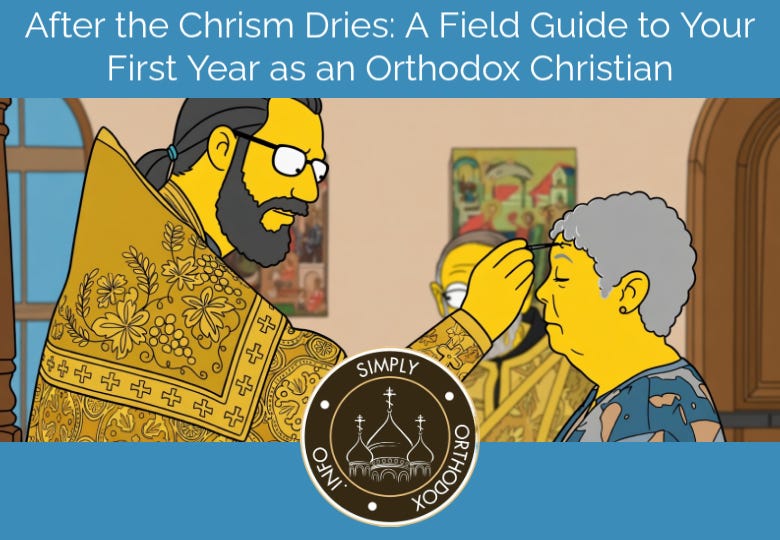
Father Thomas Hopko of blessed memory said that, when he went to seminary, his mother told him: “Remember God. Say your prayers. Go to Church.” This is the rhythm of the Christian life. This is what we should all be doing at all times, but especially when the chrism has been rubbed in.
If you’re in this first‑year zone right now, you might want to bookmark this page to return to. The oil has dried; the journey has only just begun.
Postscript
If you’ve already slipped away, and you feel like you’ve slipped away completely—the habits cracked, the zeal cooled, and you’re quietly carrying around the knowledge that you “used to be Orthodox”—I want you to hear this as clearly as possible: you are loved, and you are missed.
Whatever combination of burnout, hurt, boredom, sin, or simple drift led you out the side door, none of that has canceled Christ’s claim on you. He has already called you His own in baptism and chrismation; He is not pacing the narthex with crossed arms, waiting to scold you about missed services. He is the Shepherd who goes after lost sheep, the Father who runs to meet prodigals.
If you’re reading this with a knot in your stomach thinking, “Maybe I should go back,” consider that a mercy. Talk to your priest if you can, or another priest if you must, and just say the truth: “I’ve been gone. I want to come home.” There are conversations to have and steps to take, of course—but the basic movement is simple: turn around and come back. The doors are still open.
Additional Resources
“Preparing for Confession,” Our Life in Christ, Episode 1, Episode 2, Episode 3
“When Confession Feels Unsafe,” Healing the Unresolved Podcast
“Holy Conversation: Issues of Marriage and Sexuality,” Orthodox Marriage Podcast
This is super helpful and most encouraging. Thank you so much!
Dear Brother, this is amazing. Thank you so much for distilling so much wisdom so clearly. I'll be sharing far and wide!