


What follows is my reflection on a Theophany sermon by Fr. Anastasios Hallas, along with a video of the sermon—it’s only 7 minutes, less time than this will be to read. I’ll quote him directly in places so you can see how his words land before I start layering on my own commentary and a couple of favorite theologians (Florovsky and Schmemann) for good measure.
If you walked into an Orthodox church today, you might be forgiven for thinking we were making a very big deal out of a very ordinary thing. A big bowl or font of water sits in the middle of the temple; the priest plunges a cross into it three times, breathes on it, prays over it, and then people line up to drink it, carry it home, sprinkle it on their walls and children and kitchen sinks. We call this feast Theophany—the manifestation of God—and it comes with wilderness, a prophet, a river, a dove, and a voice from heaven.
But why water? Why this particular feast, squeezed between the joy of Nativity and the long road of Lent? And what does any of it have to do with your own baptism or the world outside the church doors?
We know the icons and the hymns, but the deeper pull—the way it reveals Christ’s renewal of all creation—can get lost in the spray. It’s no mere historical reenactment; it’s a liturgical participation in Christ’s baptism, an invitation to remember our own, and a window onto the world’s quiet transformation into the Kingdom.
Theophany unveils creation’s new beginning. So let’s walk through Fr. Anastasios Hallas’s sermon together: we’ll start with the feast’s liturgical rhythm, move into the Gospel wilderness with John the Forerunner, and then trace how it all opens onto the new creation.
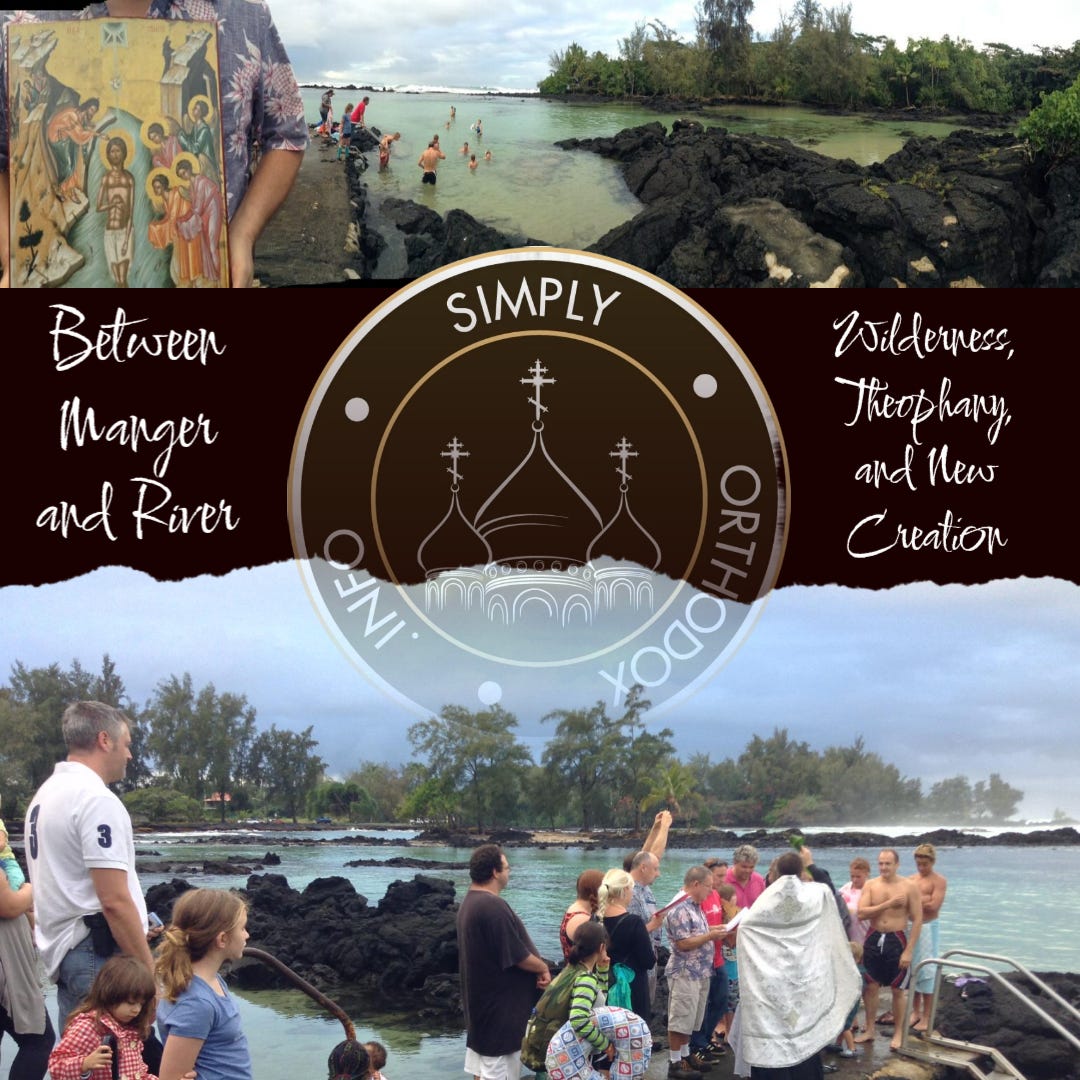
Between Christmas and Theophany: The “Good Feasts”
While many people think of the popular “Twelve Days of Christmas” (song and lore alike) as a countdown to December 25, it’s really more like an Advent calendar in reverse. The “first day of Christmas” is on Christmas Day, and traditionally initiates a brief stretch in the glow of the incarnation through to January 6, Theophany (or Epiphany).
Fr. Anastasios sets the scene right away:
“In the Orthodox Church, the 12 days of Christmas begin on Christmas Day, December 25, and end on January 6, the Feast of Epiphany, or Theophany.”
I’ve heard that in Greece, people wish one another Kala fota and “good feasts,” meaning the whole stretch from the cave in Bethlehem to the waters of the Jordan. Christmas is the Lord’s Nativity; January 1, His circumcision and naming; and then Theophany—Christ’s baptism and the manifestation of the Holy Trinity.
“On this day, we see Christ our God entering the waters of the Jordan River. We see the Holy Spirit descending upon Him in the form of a dove. And we hear the voice of the Father saying, ‘This is My beloved Son, in whom I am well pleased.’”
If you’re not Orthodox, this might be the part of the service you’ve never seen: the Great Blessing of the Waters. Fr. Anastasios walks the faithful through the very practical side of this: royal hours, vespers, the blessing of the waters on the eve of the feast, and then the blessing again after the Divine Liturgy on Theophany itself, with the faithful taking holy water home.
“We drink this holy water. We bless our homes, our cars, and everything around us with it… When Christ went down into the Jordan River, He sanctified the waters and, through them, all of creation. When we bless and drink holy water, we participate in that sanctification. We are reminded of our own baptism and our commitment to live in Christ.”
Interestingly, that phrase “good lights” echoes the feast’s theology: Christ as the Light illumining the world from manger to river. It’s one extended mystery, not isolated holidays.
Sidebar: What Are “Good Feasts” and Kala Fota?
In Orthodox practice, the period from December 25 to January 6 is not “post‑Christmas slump” time; it is an extended, festal season.
“Good feasts” is a way of blessing that whole arc of celebration, not just a single day.
“Kala fota” literally means “good lights” or “joyful lights,” and it is associated especially with Theophany, when the Church sings of Christ as the “Light” who has appeared and illumined the world.
Such greetings quietly encode the theology Fr. Anastasios is preaching: from manger to Jordan, we are walking through one mystery—the manifestation (epiphany or theophany) of the Light of the world.
The Wilderness Within: John’s Call to Repentance
From there, he turns to Mark’s Gospel and John the Baptist. The Theophany Gospel begins like this:
“The beginning of the gospel of Jesus Christ, the Son of God” (Mark 1:1).
Fr. Anastasios pauses over that first line:
“This is not just the beginning of a book. It is the beginning of hope, the beginning of healing, the beginning of God entering into our broken world in a way we cannot ignore.”
But before Christ steps into the Jordan in Mark’s Gospel, we hear a voice crying in the wilderness. That word “wilderness” hits hard because, as Fr. Anastasios notes, it’s not just a dusty Judean landscape—it’s a heart condition. Dry, empty, restless spots far from God.
He puts it plainly:
“The wilderness is not only a place on a map. It is also a condition of the heart. It is that place in us that feels dry, empty, restless, far from God. It is loneliness, confusion, fear, and struggle. And right there, in that wilderness, God sends a voice.”
You don’t have to live near the Judean desert to know what that feels like. The wilderness today might look like the bottom of your inbox, the late‑night anxiety rut, or the sense that you’re somehow both over‑stimulated and under‑nourished all at once. Scripture names that internal landscape and then, right into it, puts a prophet.
John’s word is simple and demanding:
“Repent.”
And here Fr. Anastasios does something important. He rescues repentance from our worst imaginations.
“Repentance is not about shame. It is not about beating ourselves up. It is not about thinking that we are worthless. Repentance is a gift. It means to turn around, to change direction, to come home. It is to stop walking away from God and to begin walking toward Him.”
If you’ve only ever heard repentance preached as “feel bad enough about yourself and maybe God will tolerate you,” this is a different tone entirely. It’s not a performance of misery, or beat yourself up until you feel bad enough. It’s really more of a change of course.
John Prepares, Christ Sanctifies
Crowds go out to John. They leave the city, head into the barren places, and do something most of us would rather not do: they tell the truth.
“They came to the Jordan River to confess their sins. They did not come pretending to be perfect. They came with honesty and humility, admitting that their lives were not in order, that they needed God. They entered the water not as people who had it all together, but as people hungry for God.”
John knows his role. He’s not the main event.
“After me comes One who is mightier than I, the strap of whose sandals I am not worthy to stoop down and untie… I have baptized you with water, but He will baptize you with the Holy Spirit” (Mark 1:7–8).
Untying sandals, as Fr. Anastasios points out, is the job of the lowest servant. John says he’s not even worthy of that. That’s not some pious humility on the part of Saint John—no, it’s clear vision. Despite his obvious holiness, John doesn’t clutch the spotlight, he points away from himself.
And that’s where we move from John’s ministry to Christ’s.
“John’s baptism with water was real, but it was preparation. It washed the outside. It woke people up. Christ’s baptism with the Holy Spirit goes deeper. It heals the soul. It transforms the heart. It gives strength to the weak, light to those in darkness, and forgiveness to those trapped in sin.”
As St. Gregory the Theologian sums it up:
“But John baptizes, Jesus comes to Him perhaps to sanctify the Baptist himself, but certainly to bury the whole of the old Adam in the water; and before this and for the sake of this, to sanctify Jordan; for as He is Spirit and Flesh, so He consecrates us by Spirit and water.”
That’s the shift—from preparation to transformation. That little line—John baptizes, Jesus sanctifies—captures Theophany in miniature.
When Christ descends into the Jordan, He’s not there because He personally needs repentance. He’s there to step into the same water as sinners, to stand in line with us, to make the river itself an instrument of new creation.
Here Fr. Anastasios summarizes: “John opens the way; Christ comes to renew all things.”
Florovsky: The Beginning of the New Creation
This is where I want to slow down and bring in Georges Florovsky for a moment, because he helps us see how big this “beginning” really is—and how Theophany plugs into the whole story of the Bible.
There is this sense that the arc of Scripture can be understood in terms of a tension between two “moments”: creation and new creation. In an essay on revelation and the Bible, Florovsky writes:
Scripture begins with the creation of the world and closes with the promise of a new creation. And one senses the dynamic tension between both these moments, between the first divine “fiat” and the coming one: “Behold, I make all things new” [idou, kaina poiô panta—Revelation 22:5].
That “dynamic tension” is not a mere literary flourish of the Biblical authors; it is the drama of salvation. The first page of Genesis gives us a world that is good, ordered, and given as a gift. The last pages of Revelation show us that same world transfigured as the “new heaven and new earth,” the New Jerusalem descending, and God dwelling with His people.
For Florovsky, you cannot fully understand any single event in the Gospel—Bethlehem, Jordan, Tabor, Golgotha, the empty tomb—unless you hold it inside that tension. These are not isolated miracles scattered through an otherwise ordinary “religious history.” Each is a “moment” in what we might call the divine economy: the one, coherent work of God to bring His creation from its first beginning to its final, glorified state.
In that light, the Incarnation is not simply God visiting us in our world. It is the beginning of the world’s own resurrection. The Son assumes the created, material, historical life of humanity so that, in Him, creation itself can pass through death into newness. Theophany, then, is a kind of public unveiling of that plan. The eternal Word through whom all things were made steps down into the river of His own creation, and the Spirit descends upon Him as once the Spirit hovered over the primordial waters.
If you put your thinking cap on here, you can hear Mark’s line, “The beginning of the gospel of Jesus Christ, the Son of God,” in at least three registers at once:
It is the “beginning” of his written account.
It is the historical beginning of Christ’s public ministry.
It is, Florovsky might say, the eschatological beginning—the first appearance, within time, of the future that God has promised: the new creation breaking in.
Fr. Anastasios continues:
“When Christ entered the Jordan, He did not do it because He needed to repent. He did it to stand with us, to stand in the place of sinners, and to make the waters of baptism the place where we die and rise with Him. In Theophany, all of creation begins to be renewed in Christ.”
This is no escape hatch from the world, but it’s resurrection starting now, where the Spirit hovers again over waters like in Genesis. It is about the world itself being re‑created from within by the crucified and risen Christ.
The Jordan is not a side stream to that story! It is one of the places where the first and the last pages of Scripture suddenly meet.
“…the Incarnation… is the beginning of the world’s own resurrection. The Son assumes the created, material, historical life of humanity so that, in Him, creation itself can pass through death into newness. Theophany, then, is a kind of public unveiling of that plan. The eternal Word through whom all things were made steps down into the river of His own creation, and the Spirit descends upon Him as once the Spirit hovered over the primordial waters.”
Water as Mystery: Schmemann’s Close-Up
Sacraments (or holy mysteries) aren’t “religious” interruptions in a secular world; they reveal creation’s true purpose as communion with God. Fr. Alexander Schmemann spent much of his ministry pushing back against the idea that the sacraments are strange “religious” interludes in an otherwise secular universe. In his view, the sacraments do not temporarily suspend the world’s normal functioning; they reveal the world’s deepest truth. Creation, he argues, has a “sacramental” structure—its whole existence is ordered toward being a means of communion between God and humanity.
In that sense, the world is called to be the “sacrament of God’s presence.” Matter is not an obstacle to God but the means through which God chooses to give Himself. Bread and wine, oil and water, time and space: these are not raw materials we use to reach upward. Properly received, they are gifts in which God reaches us. Schmemann can therefore speak of creation as matter becoming communion—not in a magical sense, but as matter offered back to God in thanksgiving—and thus revealed for what it was created to be.
When he considers Theophany and the Great Blessing of the Waters, Schmemann notices something crucial in the prayers. The water is not treated as a neutral substance we “charge” with supernatural power. Instead, the Church remembers the whole history of water in God’s saving work: the Spirit over the deep in Genesis, the waters of the Flood, the Red Sea, the Jordan. The blessing is, in a sense, an act of anamnesis—a remembering that makes present.
For Schmemann, this means the blessing unveils the water’s true vocation rather than adding something foreign to it. He argues that in the rites for Theophany, the Church does not impose a kind of “supernatural quality” onto water that it did not possess before, nor did it change the molecular structure of water either. Rather, it was a revelation of Christ, of the water of trule if in Christ, the water that was a gift from God, the means of life, and therefore a kind of “symbol” of the world itself.
In other words, the Jordan on Theophany is not a departure from what water is—it is water finally being itself in Christ.
If we keep that in mind, the very “stuff” of the feast hits different (as the kids say). The bowl or font of water in the middle of the church is not an exception to a godless universe; it is a small, concentrated icon of what God desires for all creation. The blessing of the waters is the Church learning to look at the world eucharistically—to see creation as gift and as invitation to communion with God, not just as a stockpile of resources to be consumed or exploited.
That is exactly what Fr. Anastasios is getting at when he urges the faithful at Saint Mark not to treat Theophany water as a superstition or a souvenir:
“When we take holy water home, when we drink it and bless our homes with it, we are not playing with magic. We are confessing that, in Christ, no part of our life is outside of His care. Our homes, our work, our fears, our joys—everything can be touched by His grace.”
Schmemann would say that in this feast, the Church gets a brief glimpse of the world seen rightly. For a moment, we act as though it were true (because it is) that every created thing is, in principle, capable of bearing grace—capable of being taken, blessed, broken, and shared in Christ. (Otherwise we wouldn’t bless public waters!) Theophany is not about escaping matter; it is about matter being restored to its liturgical calling.
If Florovsky gives us the wide‑angle view—creation straining toward new creation—Schmemann hands us a close‑up shot: a drop of water falling on your forehead, a sip of blessed water on your tongue, your apartment walls sprinkled and prayed over. In that drop, in that sip, in that room, the new creation is already, quietly, at work.
Schmemann calls the world “eucharistic”—offered back to God. In that sip or sprinkle, new creation stirs.
(I’ve found Schmemann’s sacramental theology in his For the Life of the World and for Of Water and the Spirit: A Liturgical Study of Baptism to be indispensable resources in understanding these Holy Mysteries, and much of this is a distillation of my understanding of Schmemann.)
Preparing the Way: Concrete Steps in Theophany’s Light
Fr. Anastasios doesn’t leave Theophany in the realm of ideas. He keeps coming back to John’s voice as something still addressed to us:
“The call of John the Baptist did not end two thousand years ago. His voice still cries out in the wilderness of every age: ‘Prepare the way of the Lord; make His paths straight.’”
So what does “preparing the way” look like for people who don’t live within walking distance of the Jordan?
He gives some examples:
“We prepare the way when we forgive someone we have been holding in our heart with anger.
We prepare the way when we turn off the noise of this world and make time for prayer.
We prepare the way when we come to confession with honesty and humility.
We prepare the way when we admit our weakness and ask God for help.”
Bringing this home, consider the following:
Name your wilderness. This can get a little hokey if we get carried away, but the exercise is worth pondering for a moment. As he puts it, the “wilderness” is that dry, restless place within you, and this is exactly where God wants to send His voice.
Approach repentance as homecoming. Not as self‑hatred, but as the courage to say, “I’ve been walking in the wrong direction. I want to turn toward Christ.” Always know this: God loves you and he is a good Father.
Make room for silence and Scripture. Even ten minutes with Mark’s opening verses (without an iPhone distracting) can be a way of “going out to the wilderness” to hear John.
Use holy water like you mean it. Bless yourself in the morning and remember your baptism. Sprinkle your home and pray that Christ would be Lord over its conversations, its screens, its worries. Bless your kids, drink a little bit and cross yourself, put some in your food if you wish. Sprinkle some in your neighborhood. It’s sanctified, and it sanctifies, so use it reverently but freely! Blessed is the Kingdom! Theophany can be shot through with joy if we let it.
Fr. Anastasios drives the point home:
“Christ does not force Himself into our hearts. He waits. He waits for us to clear away the clutter, the anger, the pride, the fear, the distractions, the sin. When we do, even a little, He comes. He enters with mercy. He enters with healing. He enters with the Holy Spirit.”
That is as good a one‑sentence summary of Theophany’s invitation as I know: clear a little space, and He comes.
Watch Fr. Anastasios’s sermon on the Saint Mark YouTube Channel:
Listening to the Voice, Standing in the Water
After Christmas, we were living liturgically between manger and river—between the quiet glory of Bethlehem and the open heavens over the Jordan. We have now come to the bank of the river Jordan to witness Christ’s baptism and the revelation of the Holy Trinity.
This is the beginning of the new creation; water (and the whole material world) is not an afterthought but a bearer of grace. Fr. Anastasios reminds us that all of this lands in the very ordinary wilderness of your own heart.
My prayer—for our faithful Orthodox, for catechumens, and for the simply “Orthocurious”—is that this Theophany would be, in Saint Mark’s words, a new “beginning of the gospel of Jesus Christ, the Son of God” in each of us.