


Did you know you can also download or stream and listen to this article?
Someone in our catechism class recently asked about the Immaculate Conception. What happened next was exactly what happens every time: half of the room believed we were discussing how Jesus was conceived. (We were not.) And the fact that we’re confused enough to not know what this 19th-century Roman Catholic dogma actually claims is telling us something.
So let’s resolve this. Afterward, we’ll discuss why the Orthodox Church rejects the concept—because it disrupts the mechanism of how God saves us.
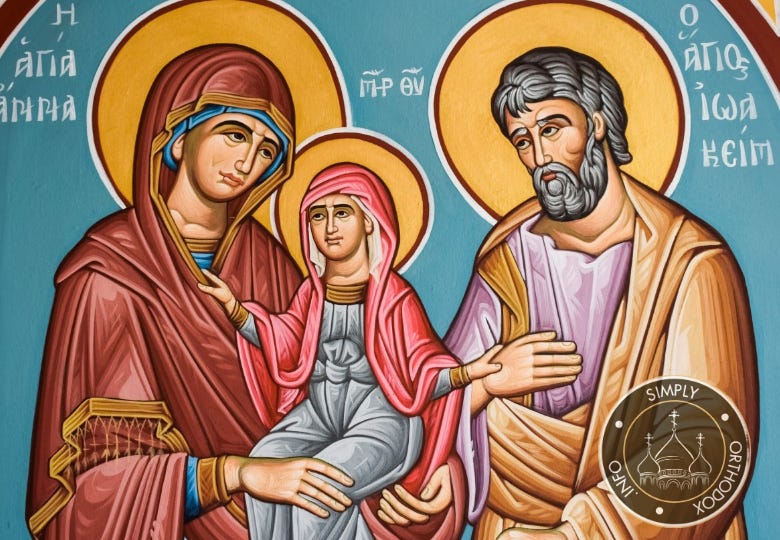
What the Immaculate Conception Actually Is
The Immaculate Conception is unrelated to Christ’s birth in Bethlehem. It pertains to Mary’s conception in the womb of her mother, Saint Anna. Pope Pius IX defined it as dogma in 1854: Mary, from the very first instant of her conception, was preserved from all stain of original sin by a singular grace of God, applied in advance on account of the future merits of Jesus Christ.
In simpler terms, God reached back through time and protected Mary from the guilt of Adam’s fall before she ever drew breath. God made Mary an untouched, sealed vessel—one untainted by the universal infection that affects every human being.
That is what is claimed. Let us now discuss why it exists.
At Issue Behind the Dogma
We cannot understand the Immaculate Conception without comprehending how the Latin West understands the Fall of Adam. This is where things begin to diverge significantly, because the Orthodox East and the Catholic West are addressing two fundamentally different questions.
Saint Augustine of Hippo was both an outstanding and necessary holy Father—but not an infallible one. Through the Latin translation he used of Romans 5:12, the West produced a unique interpretation of Paul: that all humanity sinned in Adam. From this interpretation, Western theology developed the idea that original sin is primarily guilt passed on through inheritance. Every child brought into the world comes with a judicial determination: guilty. Not due to any actions they performed themselves, but because Adam’s wrongdoing was transmitted down through each successive generation like an unpaid debt.
Based on this premise, we face a conundrum regarding the Mother of God. If Mary carried Adam’s guilt, then Christ received flesh from a guilty woman. The Immaculate Conception resolves this issue: a preemptive pardon granted to Mary — essentially a type of exemption placed on her soul before the guilt could affect her.
However, the Orthodox read the Fall differently. This is key.
How the East Understands Original Sin
The Eastern Fathers—Irenaeus, Athanasius, the Cappadocians, Maximus the Confessor—never viewed original sin as inherited guilt. Examine Romans 5:12 in Greek and the phrase that formed Augustine’s structure disappears. Saint Paul states that death spread to all people, because (Greek: ἐφ’ ᾧ, eph’ hō) all sinned. Death spread first. Then we all sinned within that mortal condition. Note the order.
What we inherit from Adam is a condition. Mortality. Decay. A nature that deteriorates over time and draws us toward sin like a weakened foundation draws a house toward collapse. We enter a world that is already sick, and we contract the illness. Some may interpret our existence as carrying a terminal prognosis—yet none of us have been charged with another individual’s crime.
This presents an enormous distinction, because if original sin is a disease, we need a physician. And that physician is Christ. As Saint Paul writes to the Romans, chapter 5, verse 12 and 15:
Therefore, just as sin came into the world through one man, and death through sin, and so death spread to all men because all sinned... much more have the grace of God and the free gift by the grace of that one man Jesus Christ abounded for many.
The remedy is the Incarnation itself—for all humanity.
Why the Immaculate Conception Disrupts Salvation?
This is where the Orthodox objection cannot be overlooked.
Saint Gregory the Theologian laid down a principle in the fourth century that became the spine of all Orthodox Christology: “What is not assumed is not healed.”
Consider this. If Christ intends to repair fallen human nature—our mortality, decay, and tendency toward sin—He must accept that nature entirely and without restriction. And He accepted it from Mary. Her body became His body. Her human nature became the basic substance from which our salvation arose. She gave God His DNA.
Now. If Mary was exempted from fallen human nature—if she possessed some other type of humanity, a pre-Fall variety—then Christ did not assume our humanity. He assumed something else. Something that required no healing.
And if He did not assume our nature, He did not heal it. You may even state that salvation collapses entirely. Ouch!
Saint Ignatius Brianchaninov, the 19th-century Russian bishop, stated this clearly: the Mother of God was conceived and born under the general law of humanity’s fallen condition. She required a Redeemer. She required resurrection. She required everything we require.
To clarify: Orthodoxy maintains that Mary never personally sinned—she is the Panagia, the All-Holy. Her personal sinlessness resulted from her fierce cooperation with God’s grace while possessing a mortal, fallen body. She navigated the same fallen world we do. She resisted. She chose. She prevailed. Brianchaninov employed a strongly worded 19th-century Russian corrective to Rome, and while some of his wording exceeds the ferocity on this point of the broader Patristic tradition, his fundamental assertion remains valid: Mary is one of us. That is precisely the point.
What Orthodoxy Truly Believes About Mary
We refer to her as Panagia—the All-Holy. We refer to her as Theotokos—the God-Bearer. Our hymns celebrate her as “more honorable than the Cherubim and more glorious beyond compare than the Seraphim.” No one in Orthodoxy attempts to denigrate Mary.
Her holiness results from a response.
Upon hearing Gabriel speak to her, she replied: “Behold, I am the servant of the Lord; let it be to me according to your word” (Luke 1:38). That “yes” was Mary’s free, fully human response as a woman living within the same fallen world we inhabit—and she chose God regardless.
Vladimir Lossky argued that by excluding Mary from the common condition of humanity—thereby making her fiat a foregone conclusion rather than the culmination of countless generations of faithfulness ripening in one young woman from Nazareth—the Catholic dogma devalues the most important free choice in human history.
And that word—generations—deserves greater emphasis than we typically give it. Orthodoxy views all of the Old Testament as an ongoing refinement process across numerous generations of human flesh and blood. For millennia God worked through the line of Abraham and David, refining that genealogy until it could finally bring forth an individual capable of giving voice to that “yes.” Mary represented the greatest degree of human synergy with God’s grace—the fruit of thousands of years of human striving toward God, culminating in a teenage girl from Nazareth who willingly offered herself as a living Ark.
She represents the summit of humanity. She embodied our nature totally—and still said yes.
The Moment of Purification
A discerning Catholic reader may ask: if Mary was not purified at her conception, how could a fallen human vessel contain the uncontainable God in her womb without being consumed?
St. John of Damascus and the broader patristic tradition teach that Mary was purified by the Holy Spirit at the moment of the Annunciation—immediately after she gave her free consent. “The Holy Spirit will come upon you, and the power of the Most High will overshadow you” (Luke 1:35). That overshadowing was not merely the act of conception. It was her purification, her preparation to become a living temple of God.
Notice the timing:
In the Catholic framework, Mary is purified at her conception—before she existed as a sentient individual, before she had chosen anything.
Orthodoxy teaches that Mary was purified at the Annunciation—after she voluntarily agreed.
There is a great deal of significance in that distinction. One makes Mary’s sanctity a passive state caused by an external factor. The other is a collaborative action between divine grace and human will. God does not supersede Mary’s will. He honors it.
The Icon That Tells Us Everything
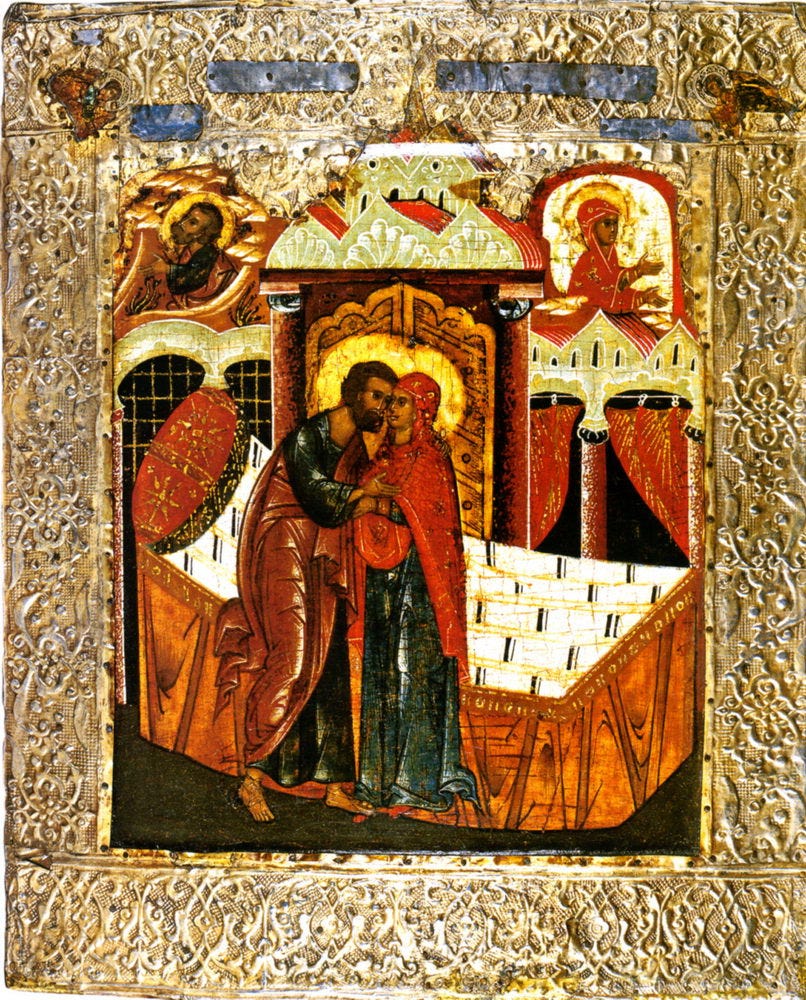
Let’s talk about the bed. The icon of the Conception of the Theotokos—celebrated on December 9th—is one of the most earthy, beautifully human images in our tradition. You have Saints Joachim and Anna, an elderly couple who endured decades of barrenness and the social shame that came with it, locked in a tender embrace.
And right there in the background, unapologetically, is their marriage bed.
While including a bed in an image depicting saints may appear incongruous or even sacrilegious today, icons rarely feature random items in their backgrounds. Each stroke of paint has intentionality in iconography. Their marriage bed serves to emphasize an essential truth: Mary was conceived naturally.
The Church celebrates the miracle of Anna’s barren womb becoming fertile — but Mary was conceived through a normal, physical, marital act. Our services are explicit on this subject: only Christ’s conception by the Holy Spirit was seedless. Mary herself came into existence the way every human being does.
Moreover, it is worth noting: the Orthodox Church observes this feast, commemorating Mary’s natural conception as holy and worthy of gold leaf and liturgical hymns. The marital union of Joachim and Anna was a grace-filled act. By placing this event on our liturgical calendar and depicting it in icons, the Church declares that ordinary physical human reproduction is good, capable of existing in a holy union, and capable of producing the Mother of God.
The bed is really a declaration. The icon emphasizes that Mary shares our humanity completely. She was not genetically engineered in any way. She did not possess a “pre-fallen” nature. Like every other human being, she was born into the same grimy, mortal reality we experience daily. The icon is visual theology—an iconographic corrective to any notion that would remove Mary from unity with the rest of Adam’s descendants.
And that unity is crucial to our salvation—it is our salvation. Because if Mary doesn’t share our nature, she cannot pass that nature to Christ. And if Christ does not receive our nature, Gregory’s maxim applies with the greatest of force: what is not assumed is not healed. The bed in that icon safeguards Mary’s dignity as an authentic woman with an actual husband and an actual body—and it safeguards the Incarnation itself.
What About Christ’s Conception?
Now—since this began with confusion on this very point—let’s land this plane.
Scripture testifies to the Virgin Birth itself: Jesus was conceived by the Holy Spirit within Mary’s womb, without a human father (Matthew 1:18–23; Luke 1:35). The Orthodox Church acknowledges this without reserve. It appears in our Creed: “incarnate of the Holy Spirit and the Virgin Mary.”
Christ took real human nature from a real human mother. He entered our condition—mortality and all—and healed it from the inside out by uniting it to His divinity. He needed a willing vessel. He found one in Mary.
That’s the difference between a legal religion and a hospital.
The Landing
The Immaculate Conception addresses an issue we do not have. It responds to a question the Greek (and other Eastern) Fathers never asked. And in answering it, it quietly severs the very connection between Christ and fallen humanity that makes salvation possible.
The icon of Joachim and Anna knows this. It places their marriage bed right in the gold-leafed background where everybody can see it—unembarrassed, ordinary, physical. The woman who gave God His human flesh had to be ordinary in her nature so that His taking of that nature could be extraordinary in its effect.
Mary didn’t need a “forcefield” to protect Her from God. Turns out she just needed a Son. And that’s particularly what is so special about Mary—she knows that He is what we need, too.
Comparative Summary of Points of Departure
Nature of Original Sin
Latin West (Post-1854): Inherited legal guilt (Debt).
Orthodox East: Inherited mortality/decay (Disease).
Mary’s Nature
Latin West (Post-1854): Exempted from fallen nature.
Orthodox East: Shared our fallen human nature.
Timing of Purification
Latin West (Post-1854): At her own conception.
Orthodox East: At the Annunciation (Luke 1:35).
Purpose of the Fiat
Latin West (Post-1854): Result of preemptive grace.
Orthodox East: Culmination of human synergy.
The “Problem” Solved
Latin West (Post-1854): Preventing Christ from inheriting guilt.
Orthodox East: Healing the nature He assumed.
Do Orthodox believe in Mary’s perpetual virginity or do they believe she went on to have a normal, physical union with her husband?