


Listen to the audio version of this post:
Often it takes twenty years. That is the timeline often cited by the monks of Mount Athos for a novice to acquire the mind of the Church.
Two decades of chopping vegetables, standing in the dark, submitting to a spiritual father, and having your ego systematically ground into dust before you can even begin to trust your own theological instincts. Twenty years of silence before you can reliably distinguish the voice of the Holy Spirit from the voice of your own pride.
We do not like that timeline. We live in America. We have Amazon Prime.
We read a copy of Metropolitan Kallistos (Timothy) Ware’s The Orthodox Church, watch three hours of aggressive YouTube apologetics, buy a prayer rope, and suddenly we feel entirely equipped to correct our priest on his liturgical rubrics. We want the phronema—the deep, intuitive Orthodox mindset—by next Tuesday, and think somehow we can download the ancient faith like a software update.
Metropolitan Saba, the primate of the Antiochian Archdiocese of North America, recently sat down for a wide-ranging interview with Ancient Faith Radio. If you haven’t tuned in, you should (see below). He is one of the greatest gifts to the Church in the Americas right now. He brings the gravity of the Middle East to the non-stop, anxious energy of our American religion.
Listening to His Eminence speak—or listening to him pray—is like witnessing a master physician diagnose a patient who didn’t even realize he is sick. The thing is, we are trying to build the ancient Church using American corporate tools and internet paranoia. Metropolitan Saba is gently pointing us toward a different way.
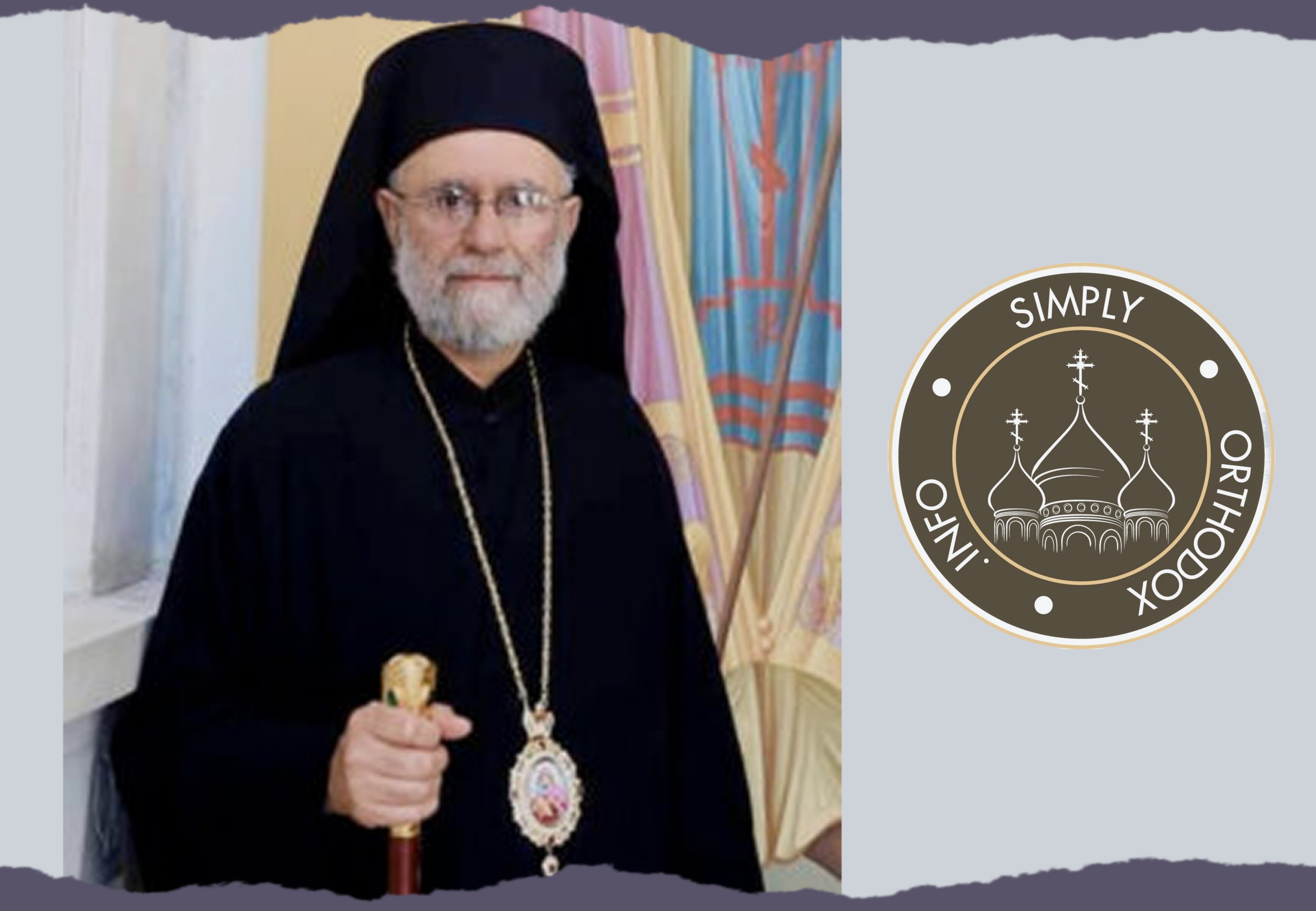
The Bunker and the Sons of God
There is a specific fear that grips many of us when we enter the Orthodox Church. It makes sense. We look out at the culture, and we see a secular acid bath. Everything is dissolving.
We look back at the Evangelical or mainline Protestant churches we left, and we watch them frantically adapting to the culture, compromising their theology into oblivion just to keep the seats full. We are afraid of doing it wrong. We are scared that if we loosen our grip for even a second, the Orthodox Church will slide into the exact same liberalism we just fled.
So we build a bunker. We take the ancient canons of the Church and we pour them over our heads like concrete. We scour the internet for the strictest, most severe monastic advice we can find.
Metropolitan Saba noted this exact phenomenon in the interview: priests are dealing with a rising tide of fundamentalism, largely driven by online lectures and social media algorithms that reward the more extreme voices online. He mentioned a common tale: a young man, deeply influenced by YouTube videos about Elder Ephraim, becomes visibly upset when his rigid, downloaded understanding of the faith is challenged by actual pastoral reality.
We bring our Protestant literalism with us, we just swap out a literalist reading of the King James Bible for a literalist reading of the Rudder.
This is the leaven of the Pharisees. In the Gospel of Matthew, Christ unleashes his most devastating critique not on the pagans, but on the religious fundamentalists of his day. “They tie up heavy, cumbersome loads and put them on other people’s shoulders, but they themselves are not willing to lift a finger to move them” (Matthew 23:4). When we turn Orthodoxy into a hyper-rigid legal code, we are tying up heavy loads. We take a faith designed to heal the soul and turn it into a checklist designed to crush it.
We forget the entire argument of the Apostle Paul to the Galatians. Paul writes that the law was put in charge to lead us to Christ. It was a guardian. It was a babysitter meant to keep us from running into traffic while we were still children. “But now that faith has come, we are no longer under a guardian” (Galatians 3:25).
God did not send his Son to make us perfect law-keepers. He sent his Son so that we might receive adoption. “Because you are his sons, God sent the Spirit of his Son into our hearts, the Spirit who calls out, ‘Abba, Father.’ So you are no longer a slave, but God’s child” (Galatians 4:6-7).
Metropolitan Saba understands this. His Eminence told his interviewer that we have to learn to respect the canons of the Church while simultaneously living in the liberty of the sons of God. The canons are not a penal code. They are medical guidelines.
A spiritual father does not read a manual and dispense uniform punishments; he looks at the specific spiritual sickness of the person sitting in front of him and prescribes custom medicine. You cannot get custom medicine from a YouTube channel—you need a relationship with an in-the-flesh priest.
The Religious Vendor
The fundamentalism we battle is heavily fueled by the culture we live in.
Metropolitan Saba was born in Latakia, on the Mediterranean coast of Syria. He grew up in a world where the Orthodox faith was not a hobby, a fun thing to debate with friends, but a matter of survival. When he talks about the Middle East, he talks about a people who have endured economic collapse, war, and centuries of persecution. That kind of pressure produces a deeply collective culture. You survive because of solidarity. You survive because the Church is your family.
Then he came to America. The shock he describes is telling. In America, we do not have persecution. We have money. And because we have money, our default instinct is to turn the parish into a religious business.
We view the priesthood as a religious profession rather than a spiritual martyrdom. We run our parishes like vendors. We pay our dues, we expect a certain quality of liturgical service, and if the youth group isn’t performing up to our standards, we take our business elsewhere. The financial dimension dominates our ecclesiastical life. We have line-item budgets and strategic planning committees, but we lack the fierce, bleeding solidarity of the Christians who kept the faith alive under the Ottoman Empire.
We have organized the people of the Church, but we have individualized the faith. This is the great danger for those of us living in the wealthy West. We think our money protects us. But the witness of the Middle Eastern Christians is a glaring reminder that the truest spiritual resilience is not found in an endowment fund. It is found in a community that knows how to suffer together.
We have so much to learn from their courage, if we would only stop trying to run our parishes like corporate franchises.
The Corporate Merger
Nowhere is this corporate mindset more obvious than in how we handle the scandal of Orthodox disunity in America.
It is a glaring canonical failure. The ancient rule of the Church was simple: one city, one bishop. With time, the practice expanded to one diocese, one bishop, but the principle was the same: The bishop is the icon of Christ, the center of unity for the local eucharistic community. But look at any major American city today. We may have a Greek bishop, an Antiochian bishop, a Russian bishop, and an OCA bishop, all claiming neighboring zip codes, all operating parallel administrative structures.
It is an ecclesiological mess that violates the very canons we claim to hold so dear.
But our proposed solution to this problem reveals our underlying disease. Because we view the Church through the lens of American corporate structures, we treat pan-Orthodox unity like an impending corporate merger. We think the problem will be solved when the CEOs—the bishops—get into a boardroom in New York or Istanbul, sign a treaty, consolidate their assets, and announce a new organizational flowchart.
We wait for a top-down administrative fix. Metropolitan Saba takes this apart brick by brick. The Church is not a company. It is the Body of Christ. You do not unite a living body by signing a piece of paper. You unite it by living together.
If we want unity, we have to build it from the base. We have to activate our pastoral activities across jurisdictional lines. The Antiochian parish should probably invite the Greek parish down the street over for Vespers. The OCA youth group might need to run a food pantry with the Russian youth group. We have to exchange visits. We have to pray together. We have to actually stand at the same chalice and discover, through the messy, inconvenient reality of shared human life, that we are already one.
Unity is not an administrative achievement. It is a spiritual reality that has to be lived before it can be codified. As long as we sit in our respective ethnic or convert silos, complaining about the bishops on the internet, we are the ones perpetuating the division.
We want the quick fix. We want the corporate merger. We do not want to do the slow, unglamorous work of loving the parish across town.
The Medicine
We are in a massive moment of transition. Converts are flooding into the Church. The internet is funneling thousands of spiritually starved Americans toward the ancient faith. By some estimates, as many as 16,000 new converts were received in the United States at Pascha in 2026.
This is a profound gift. As Metropolitan Saba notes, these converts bring a serious, intense dedication that often wakes up the cradle Orthodox who may have been taking the sacraments for granted. There is new life pouring into our parishes.
But with that new life comes the chaotic, aggressive energy of American religion. We bring our literalism. We bring our impatience. We bring our desperate need to be right, our fear of the secular world, and our tendency to treat the Kingdom of God like a corporate franchise.
We want to skip the cross and go straight to the resurrection.
Orthodoxy does not work that way. The Church is a hospital, and the medicine takes time. It requires an American-born spiritual leadership rooted deeply in the tradition, and as Metropolitan Saba gently reminds us, that kind of leadership takes generations to cultivate. It cannot be rushed.
It takes twenty years to acquire the mind of the Church.
It takes decades of standing in the nave, submitting to the fasts, and keeping your mouth shut before the frantic, argumentative energy of the American convert finally burns off, leaving behind the quiet, unshakeable peace of the sons of God.
Stop checking your watch. Just take the medicine faithfully.
I used to say ten years, then heard some people saying 20 and I called B.S. But now at 27 years, I think 20 was about the point I STARTED not filtering stuff through my former delusions and Bible college frameworks and theological assumptions.
I haven't had time to watch the video, but thank you for linking. I just wanted to comment that you are right that unity needs to start with the parish and thankfully the parishes in my city are well-linked. When the Bulgarian priest went on a pilgrimage, the parishioners attended the Greek church. When the Greek church was waiting for a new priest, the recently-retired OCA priest was the interim priest and continued to concelebrate and mentor the new priest for awhile. The Greek parish is the biggest, so often people from the other parishes will attend their classes and studies. It's great to see!