

Prefer to listen? You can enjoy the audio version of this post here:
See part 1 here and part 2 here.
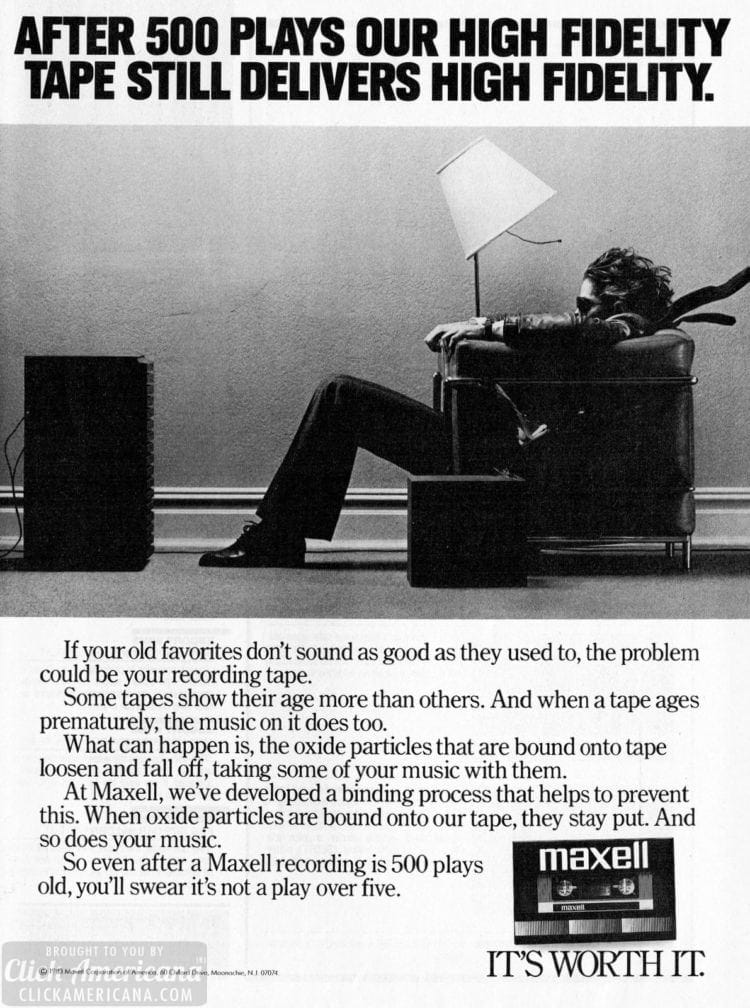
Have you ever seen the Maxell cassette ad from the ‘80s? A guy in sunglasses sits in a leather armchair facing a speaker, and the sound blasts him backward—hair streaming, tie flapping, lampshade rattling. That image lives in my head rent-free, and lately it keeps showing up next to Vladimir Lossky.
Because Lossky says something about the Trinity that sounds a lot like that armchair: “It is rather the Trinity that seizes man and provokes praise in him.”
In the last two posts, we saw that God is beyond everything we can think, and that the Fathers refused the philosophers’ god. That leaves a question hanging. If God is that far beyond us, how can we say anything at all? How can we sing, right after Communion, “We have seen the true light”?
The answer comes in three pieces: Trinity, Incarnation, purification. Let’s take them one at a time.
The God Who Hides
Start with the God of Israel. Lossky notes that he “hides the profundities of His nature; He manifests Himself only through His authority; His name itself is unpronounceable.” Nobody sees Him and lives. Taken on those terms alone, Lossky writes, “neither true reciprocity nor face to face encounter are possible between this terrifying divine monad and the humility of the created.”
Then God reveals Himself as Father, Son, and Holy Spirit. And everything opens.
Don’t Ask How
St. John of Damascus describes the Father as the fountainhead of the Godhead: “All then that the Son and the Spirit have is from the Father, even their very being.” The Son is begotten of the Father. The Spirit proceeds from the Father—”the Spirit of truth, who proceeds from the Father,” as Jesus says (John 15:26).
And how exactly does that work? St. John answers with what might be the most Orthodox sentences ever written: “You hear that there is generation [of the Son]? Do not waste your time in seeking after the how. You hear that the Spirit proceeds from the Father? Do not busy yourself with the how.”
I love that. It’s the theological version of a dad saying “Because I said so,” only this time it comes from reverence. (Parents of preschoolers know the other version well.)
Lossky calls the Trinity “primordial fact, ultimate reality, first datum which cannot be deduced, explained or discovered by way of any other truth; for there is nothing which is prior to it.”
We don’t reason our way to the Trinity. We receive it. And once we rest there, something happens: “Here thought gains a stability which cannot be shaken; theology finds its foundation; ignorance passes into knowledge.”
He also warns that it costs something. “The dogma of the Trinity is a cross for human ways of thought. The apophatic ascent is a mounting of calvary.” The Trinity won’t fit our boxes, and our minds get crucified a little in receiving it.
The Word Became Flesh
So how do we actually know any of this? Through Jesus Christ.
Lossky is clear: “The source of true Christian theology is thus the confession of the Incarnation of the Son of God.” In Christ, one person unites the unknowable divine nature with our human nature, and carries that union “as far as the tomb, as far, indeed, as Hell.” Elsewhere he says it in one line: “In Christ, transcendence becomes immanence and gives us the possibility of speaking about God, that is, of being theologians.”
“For in him the whole fullness of deity dwells bodily” (Colossians 2:9). The God nobody can see took a face. Because he took our nature, the unknowable God can be known personally, the way we know a friend.
Lossky captures the paradox. We strip away everything—stars, angels, goodness, even being itself—until we conclude that God “is not.” “But here is the Christian paradox: He is the God to Whom I say ‘Thou,’ Who calls me, Who reveals Himself as personal, as living.”
Clean the Lens
Here’s the catch. Knowing God takes more than information—it takes a clean heart.
St. Gregory the Theologian: “It is a great thing to speak of God, but still better to purify oneself for God.” Jesus said it first: “Blessed are the pure in heart, for they shall see God” (Matthew 5:8). And: “The eye is the lamp of the body. So, if your eye is healthy, your whole body will be full of light” (Matthew 6:22).
Metropolitan Hierotheos Vlachos observes that “most people live in the prison of the senses.” He’s talking about us. Our phones buzz, our feeds scroll, our minds hop from screen to screen. The Fathers’ word for the eye of the soul is the nous, and ours is usually a mess. “The benighted and blind nous must be illumined and enlivened,” he writes.
The Church’s path to that healing is old and practical. “Vision of God (theoria) begins with repentance,” writes Metropolitan Hierotheos, “continues with noetic prayer, reaches illumination, is led to the vision of God and then to continual theoria.”
Repentance. The Jesus Prayer. The services, fasting, confession, the Eucharist. None of it glamorous. All of it is cleaning the lens.
And the goal is nothing short of staggering: “What God is, by nature and by essence,” Metropolitan Hierotheos writes, “the deified man becomes, by grace and by participation.”
St. Peter calls it becoming “partakers of the divine nature” (2 Peter 1:4).
From Sinai to Tabor
In Part 1, we left Moses walking into the thick darkness of Sinai. Here’s where his story ends up. Lossky: “The darkness of Mount Sinai will be changed into the light of Mount Tabor, in which Moses at last was able to see the glorious face of God incarnate.”
That’s the trajectory for all of us. “And we all, with unveiled face, beholding the glory of the Lord, are being transformed into the same image from one degree of glory to another” (2 Cor. 3:18). “For now we see in a mirror dimly, but then face to face” (1 Cor. 13:12).
St. Dionysius pictures the end as endless light: “we shall be forever with the Lord, as Scripture says, enjoying His visible theophany in most pure contemplations, illumined by His bright rays just as the disciples were at the time of His divine Transfiguration.”
St. Symeon the New Theologian adds, “Blessed are they who have drawn near the divine light and entered within it and become wholly light.”
Blown Back
Lossky leaves us with a warning that doubles as an invitation: “Outside of praise and adoration, outside of the personal relationship of faith, our language, when speaking of the Trinity, is always false.”
So back to the Maxell guy in his armchair. That’s us at the end of Liturgy, if we’re paying attention. We’ve just received the Body and Blood of Christ. The choir takes up the hymn: “We have seen the true light; we have received the heavenly Spirit; we have found the true faith, worshiping the undivided Trinity, who has saved us.”
We still can’t explain him. He’s seized us anyway—hair back, tie flapping, singing.
Sources
Lossky, Vladimir. Dogmatic Theology: Creation, God’s Image in Man, and the Redeeming Work of the Trinity. Translated by Anthony P. Gythiel. Edited by Olivier Clément and Michel Stavrou. Yonkers, NY: St Vladimir’s Seminary Press, 2017.
Lossky, Vladimir. In the Image and Likeness of God. Edited by John H. Erickson and Thomas E. Bird. Crestwood, NY: St Vladimir’s Seminary Press, 1974. Source for the quotation from St. Dionysius.
Lossky, Vladimir. The Mystical Theology of the Eastern Church. Crestwood, NY: St Vladimir’s Seminary Press, 1976. Source for St. John of Damascus and St. Gregory the Theologian.
Lossky, Vladimir. Orthodox Theology: An Introduction. Translated by Ian and Ihita Kesarcodi-Watson. Crestwood, NY: St Vladimir’s Seminary Press, 1989.
Symeon the New Theologian. On the Mystical Life: The Ethical Discourses. Vol. 1, The Church and the Last Things. Translated by Alexander Golitzin. Crestwood, NY: St Vladimir’s Seminary Press, 1995.
Vlachos, Hierotheos. The Illness and Cure of the Soul in the Orthodox Tradition. Levadia, Greece: Birth of the Theotokos Monastery, 1993.
Scripture quotations are from the English Standard Version.
“We have seen the true light” is from the Divine Liturgy of St. John Chrysostom.