


It takes a special kind of saint to be excommunicated and imprisoned by a church council—before being canonized by the Church later. But that is more or less what happened to St. Gregory Palamas.
In 1344, Gregory Palamas, a monk from Mount Athos, was condemned by a council in Constantinople and thrown into prison. His crime? He was defending the absurdly bold claim that ordinary human beings could actually, (physically? tangibly?) experience the living God. Three years later, a different council completely vindicated him. Nine years after his death, the Church officially declared him a saint. It’s a historical whiplash that easily reminds one of Saint Athanasius being repeatedly exiled from Alexandria.
But this Sunday might seem a bit puzzling, this Second Sunday of Great Lent. So, let’s get this straight, just after the Sunday of Orthodoxy, the Church hands us not a martyr, not a desert oddity, but…[*checks notes*]…. a theologian? (Also a monk and a bishop.) And a man whose name many of us know just well enough to mispronounce with confidence!
SO, it’s natural to ask: Why, right when we are deep in the trenches of fasting, prostrations, and repentance, does the Church hit the pause button to commemorate the hero of a 14th-century Byzantine theological dispute?
Let’s start with this: The Church does not pause mid-Lent for Gregory Palamas because she wants you to admire some Byzantine-era controversy or to beef up on your Church history trivia, or every necessarily to become one of his full-on navel-gazers. No, the Church pauses for him because Lent is not merely about restraint, it is about transformation.
It is about what a human being is for, what prayer is doing to us, and whether communion with God is real—or merely religious talk with candles around it.
Seminary Ed Day
Recently I listened to an insightful conversation from Saint Vladimir’s Seminary featuring Rev. Dr. Bogdan Bucur and Dr. Alexander Titus, whose translation work on Palamas’s Triads is helping make this great text more accessible. In their discussion, Palamas does not come across as a specialist’s saint, but he came across as a saint for those of us trying to repent in the real world.
I thought it would be a helpful exercise to pull insights from this conversation and in so doing shine a light on why we spend an entire Sunday honoring this great saint and theologian.
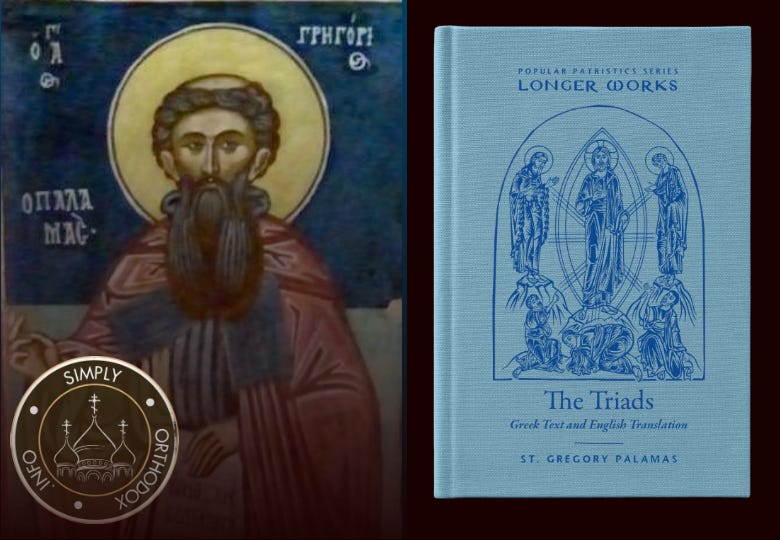
(Full disclosure: Fr. Bogdan was one of my absolute favorite professors in the Master of Orthodox Theology program at the Antiochian House of Studies. He has a unique gift for making high level theology feel as exciting a five-alarm fire in your own living room, and he does not disappoint here. His specialty, in my opinion, is his explanation of the significance of Christ’s Transfiguration.)
He Was Defending a Life, Not Starting a School
One of the most useful points in the conversation is also one of the simplest. Palamas was not writing theology in order to build a career, fill a CV, or win an abstract argument. He was drawn into controversy because something precious needed defending.
During the webinar, they laid out the central conflict. Palamas was facing off against a philosopher named Barlaam of Calabria. Barlaam looked at the Hesychast monks on Mount Athos—men who prayed with their heads bowed, regulating their breathing, seeking to bring their minds into their hearts—and he scoffed.
For Barlaam, God is utterly transcendent and unknowable. Therefore, Barlaam argued, any “experience” of God a monk claims to have must just be a created symbol. A nice feeling, maybe a psychological state, but not actually God. Barlaam wanted to keep the mind safely detached and elevated. For him, the body was basically not invited to the party.
As Dr. Titus puts it, the Triads ask a basic question: “What is the role of the mind… in the spiritual life?” That may sound narrow at first, but it opens into almost everything. In Dr. Titus’s words, “the nous needs to be integrated into the spiritual life… involved in prayer… centered in the heart.”
Not the mind floating above us. Not the body dragging behind us. Not a religious self and a real self. The whole person.
Most of us in the modern world know what fragmentation feels like. Our attention is scattered. Our desires are uneven. Our prayers are interrupted by shopping lists, anxieties, resentments, and whatever else is living rent-free in ours brains and our souls.
Palamas matters because he refuses to accept such things as normal. The mind is not meant to roam around endlessly like a nonstop tourist. It is meant to return home.
“No, the Church pauses for [Saint Gregory Palamas] because Lent is not merely about restraint, it is about transformation. It is about what a human being is for, what prayer is doing to us, and whether communion with God is real—or merely religious talk with candles around it.” - Jamey Bennett
Fire and Sun: What “Divine Energies” Actually Means
Palamas saw this as a disaster. If Barlaam was right, then true communion with God is impossible. We are just down here thinking hard thoughts about a God who stays strictly upstairs.
To defend the monks, Palamas leaned into a distinction that is at the bedrock of Orthodox spiritual life: the difference between God’s essence and His energies.
In the webinar, Dr. Titus explains that when Palamas speaks of God’s energies, he means “the self manifestation of God… the experience of God himself.” Not something created by God as a buffer between Himself and us. Not a religious effect. Not a symbolic glow. God Himself—as He gives Himself to be known.
That matters because Palamas is trying to preserve two truths at once.
First, God in His essence remains beyond comprehension. We do not master Him, define Him, or capture Him.
Second, God really is experienced. We do not merely think about Him from a distance. We truly participate in His life.
Dr. Titus uses the image of fire and sunlight. We cannot seize the sun in our hands, but we really do experience its light and heat. Light and heat are not imaginary, not a lesser “fake” sun. No, light and heat are the sun as it reaches us.
Palamas is not asking us to fall in love with terminology for its own sake. He is defending the Church’s conviction that the living God truly gives Himself to His people. Fr. Bogdan Bucur adds: “The words are negotiable; what is defended by the words is non-negotiable.” What is non-negotiable is that God truly gives Himself to us. Not a postcard of Himself. Himself.
And if that sounds like more than theology, it’s because it is: It is theology in defense of prayer.
Lent Is About the Whole Person
One reason Palamas can speak to the present moment is that he refuses to treat the body as an inconvenience.
We live in an age that is deeply confused about bodies. We either treat them as meat-machines to be “biohacked” and optimized, or even as awkward fleshly cages for our “true,” inner selves that are dying to get out and be “affirmed.” Barlaam fell into a version of this trap, acting as if the intellect was the only part of a human that mattered to God.
Palamas vehemently disagreed. As Dr. Titus says plainly, for Palamas, “the nous needs to be integrated into the spiritual life... involved in prayer... centered in the heart.” In short, Palamas reminds us that repentance is not the improvement project of an inner ghost.
Instead, Dr. Titus reminds us, “the body is not excluded from the life of prayer.” We fast with our stomachs, we make prostrations with our knees, we cross ourselves with our hands. This is why Fr. Bogdan says, “the whole human person is the locus of divine encounter.”
That was part of the scandal in Palamas’s own day. The hesychast monks spoke about prayer in a way that included the body: stillness, posture, breath, attention, watchfulness. Their critics found that embarrassing, primitive, or even dangerous. Palamas did not.
Further, Palamas regarded the chase for a purely disembodied spiritual experience as a delusion. That certainly resonates with me in our own age, when we tend to live either as brains on sticks or as bundles of insatiable appetites, and insist on being “spiritual but not religious”—which usually means neither religious nor particularly spiritual, just deluded.
That is why the Transfiguration stands so near the center of Palamas’s thought. Christ’s light on Tabor is not stage lighting. It is the truest revelation of who He is. As they point out in the discussion, this vision is not an experience of “something” around Christ, but of Christ Himself. Fr. Bucur puts it into sharp focus: “there is no way to have an experience of the Divine energies” apart from an experience of Christ.
So when the Church gives us Palamas during Lent, she is reminding us that this season is not so much for behavior management, but participation in the life of Christ.
“St. Gregory Palamas matters as much now as ever, because he tells us that repentance is not just feeling bad, and we don’t fast and pray to be come good little citizens. That’s not what we are doing. We are doing theosis. We are looking for re-integration in Christ.” - Jamey Bennett
Why Palamas Matters Today
And that takes us, at last, back to Lent. Last week it was the Sunday of Orthodoxy and we celebrated the restoration of the icons. We affirmed what we believe: that the invisible God became visible flesh. This week, the Church takes the next logical step: If God took on human flesh, then human flesh is capable of holding God.
We are tempted to make Christianity merely moral:
Or merely intellectual.
Or merely emotional.
Or merely symbolic.
We are tempted to treat prayer as self-soothing, theology as personal branding, and sacramental life as “nice traditions.”
Or even worse, we reduce the faith into a kind of “Moral Therapeutic Deism,” where true Christianity is simply about “being nice,” feeling good, and utilizing this distant God as a cosmic therapist.
Palamas will not let us do any of that. You might say Palamas matters today because we are still tempted by the same old errors, even if we use very different vocabulary.
In the seminar, Dr. Titus is careful to say that Palamas is not anti-sacramental, not anti-ecclesial, not some freelance mystic doing spirituality off to the side. In fact, he insists that the same uncreated grace at work in hesychast prayer is what we encounter “in the life of the church including in the sacraments.” Even more simply: “all of them lead towards divinization.” There is the real modern relevance.
St. Gregory Palamas matters as much now as ever, because he tells us that repentance is not just feeling bad, and we don’t fast and pray to be come good little citizens. That’s not what we are doing. We are doing theosis. We are looking for re-integration in Christ.
Palamas reminds us that ascetic life is not judicial decree, but it is the healing of perception.
Palamas reminds us that asceticism isn’t about punishing the body; it’s about untangling the soul so that the whole person can be flooded with light.
Palamas reminds us that theology is not a spectator sport; it is the Church finding words sturdy enough to do justice to what the saints have actually lived and our God has revealed.
And that is why the Church pauses to commemorate him in Lent. We are stepping into the sacramental life of the Church—which Dr. Titus reminds us is “the ordinary channel through which the same uncreated grace flows”—so that we might be completely transformed. Fr. Bucur closes the conversation with a line from the hymns of Transfiguration: “all of mortal nature now divinely shines.”
That is as good a summary of Palamas as any. More importantly, it is as good a summary of Lent as any. We fast, pray, repent, confess, and return not because matter is bad, or because bodies are embarrassing, or because holiness is for specialists. We do these things because in Christ, the human person can actually be illumined.
At the risk of belaboring the point, in sum: the goal of the Christian life is not merely to think differently about God; it is to be changed by Him. That is why Gregory Palamas matters. That is why the Church holds him up to us now.
Watch the Full Conversation: If you want to understand how the Orthodox Church actually views the spiritual life, you need to watch this SVS Press webinar with Fr. Bogdan Bucur and Dr. Alexander Titus. It is both accessible and insightful, exploring the Triads and the explaining the theology of the Transfiguration:
Grace🔥 and peace⛲ to you Amigo, Thank you!
☀️🌴⛪🌙☦️✍🏼📚🕊️🎶⚓🔔 Tone 6/ EOTHINON 6 today, onward to Jerusalem!
https://claude.ai/public/artifacts/2581098b-b139-4f12-8682-0945162c2781
MOST HOLY THEOTOKOS SAVE US! 📿🕯️🏔️♥️🌐