


Take a moment to close your eyes and imagine you are standing in a dark, incense-filled Orthodox Church at midnight, at the end of a long winding road to Pascha (Easter).
Did you do well? Perhaps your stomach is a hollow cavern after forty days of lenten rations, your legs are vibrating from exhaustion, and you’re wondering if you can honestly make it through another three hours of standing.
Or perhaps you ate a ribeye a few times, popped by Mickey D’s for some nuggets, and boozed it up with your buddies after work. Did you screw up? Did you drop the ball? Did you fail? Come anyway.
Regardless of how you prepared for Pascha, the royal doors will be thrown open. The Church will be flooded with the brightness of the light of Christ, and the priest isn’t going to just read, but might actually boldly proclaim or shout a 1,600-year-old sermon at the congregation!
This is the Paschal Homily of Saint John Chrysostom. We read it every single year on Pascha night, usually right when our physical and mental endurance is running on fumes. But this homily isn’t just a piece of soaring ancient poetry designed to give us a second wind. It is a scripturally saturated breakdown of the metaphysical earthquake that just occurred in the basement of the universe.
Many of us carry a massive amount of legalistic baggage into our faith, sometimes even if we were raised Orthodox. We too often treat God like a cosmic magistrate and salvation like a courtroom acquittal.
Chrysostom takes a sledgehammer to that entire framework with his ancient sermon. Through a masterful rhetorical delivery, Chrysostom dismantles our spiritual meritocracy, redefines repentance, and reveals the terrifying, glorious “physics” of how Jesus Christ actually murdered Death.
The Economics of Grace (Matthew 20)
To some extent, all humans are accustomed to meritocracy. You clock in, you get paid. You do the crime, you do the time. Because of this, it is incredibly easy to slip into a transactional view of God and religion—treating sin like a legal infraction, fasting like a currency, and salvation as a wage we earn by being relatively good people.
Chrysostom puts an end to this transactional nonsense in his very first breath by channeling Jesus’s Parable of the Workers in the Vineyard (from Matthew 20):
If they have toiled from the first hour, let them receive their due reward; If any have come after the third hour, let him with gratitude join in the Feast! ...And he who arrived only at the eleventh hour, let him not be afraid by reason of his delay.
In Matthew 20, the master of the vineyard pays the guys who worked one hour the exact same denarius as the guys who sweated through the heat of the day. To our modern, merit-obsessed minds, this is a gross miscarriage of justice. It’s no surprise that those among us who keep the Lenten fast the strictest are frequently tempted to act like the resentful first-hour workers.
But Chrysostom reminds us that God is not an IRS agent auditing a spiritual tax account. “He gives rest to him who comes at the eleventh hour, as well as to him who toiled from the first... The deed He honors and the intention He commends.”
If salvation were a strict legal contract, this could certainly be a breach. But as Saint Paul writes, “The wages of sin is death, but the free gift of God is eternal life” (Romans 6:23). The Kingdom of Heaven isn’t a wage you earn, it is pure gift and an inheritance you step into. Whether you kept the fast perfectly or stumbled into the nave at the last minute smelling like a cheeseburger and a beer, the Table is richly laden. The grace of God is violently disproportionate to human effort.
The Fatted Calf and the Death of Guilt (Luke 15)
Once we realize we can’t truly earn our way to the table, the immediate temptation for many of us is to despair. We look at our own wretchedness, our own failures to pray, to love our neighbors, or to conquer our passions, and we assume we are disqualified.
Chrysostom anticipates this exact psychological trap. He pivots directly to the imagery of the Prodigal Son from Luke 15:
Feast royally on it, the calf is a fatted one. Let no one go away hungry; partake, all, of the cup of faith... Let no one mourn that he has fallen again and again; for forgiveness has risen from the grave.
When the Prodigal Son returns home, he has a prepared speech (probably with note cards and all). He essentially wants to negotiate a plea deal: Make me as one of your hired servants. He is still trapped in a transactional mindset. But the Father doesn’t even let him finish the sentence. He sprints down the road, throws a robe over his filthy shoulders, and has the fatted calf slaughtered.
This is the eradication of guilt. “Let no one mourn that he has fallen again and again.” Why? Because forgiveness didn’t just issue a decree; forgiveness rose from the grave.
Under a legal framework, if you break a law, you pay a fine. But in the Orthodox framework, sin isn’t a parking ticket; it is more like a terminal illness. You don’t take a cancer patient to traffic court, you take them to a hospital.
On Pascha, the Great Physician has successfully synthesized the cure for human mortality, and He is distributing it to absolutely everyone willing to drink the cup of faith. As St. Paul assures us, “There is therefore now no condemnation for those who are in Christ Jesus” (Romans 8:1).
The Metaphysics of the Bait-and-Switch (1 Corinthians 15)
But the question remains in light of this mercy: How did Jesus actually pull this off? How did a man dying on a Roman instrument of torture result in the liberation of the human race?
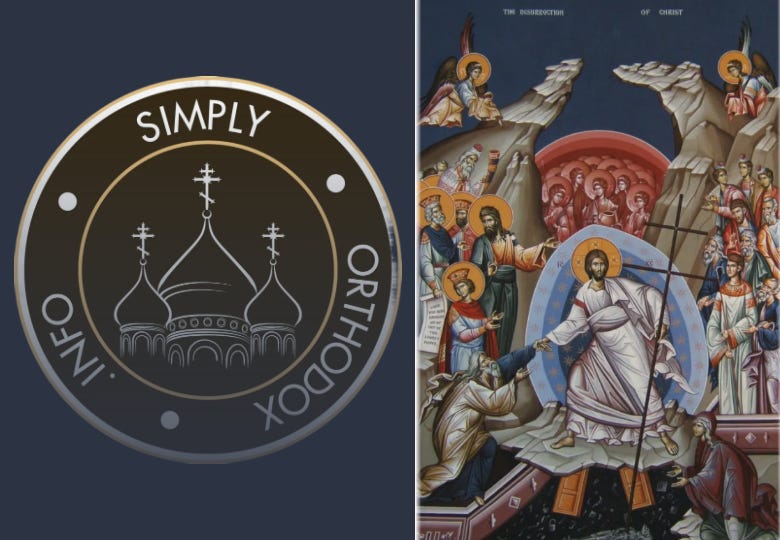
This brings us to the theological climax of the homily, where Chrysostom gives us the mechanics of the Harrowing of Hades (the realm of the dead). His sermon builds with a cadence like a drumbeat:
He destroyed Hades when he descended into it. He put it into an uproar even as it tasted of His flesh... Hell took a body, and it discovered God. It took earth, and encountered Heaven. It took what it saw, and was overcome by what it did not see.
For thousands upon thousands of years, Death had a flawless winning streak. It swallowed every human being that walked the earth. When Christ was crucified, Death looked up and saw a bruised, bleeding, mortal man. It opened its jaws to swallow Him, just like it swallowed Adam, Abraham, and David. It took the “bait” of His humanity, and His death.
But to understand what happened next, we have to consider what theological scholars call the “Hypostatic Union.” This is the bedrock doctrine that Jesus Christ is fully God and fully man, united in one single, undivided person. The uncreated, infinite divine nature and the created, finite human nature are perfectly united.
When Death swallowed the human soul of Jesus, it unknowingly swallowed the infinite fire of His divinity. Death, which only has an appetite for the finite, the corrupt, and the fallen, tried to digest the Author of Life. It choked.
St. Peter preaches this exact reality in his first sermon at Pentecost: “God raised him up, loosing the pangs of death, because it was not possible for him to be held by it” (Acts 2:24).
Saint Gregory of Nyssa (4th century) puts it like this:
…it was not in the nature of the opposing power to come in contact with the undiluted presence of God, and to undergo His unclouded manifestation, therefore, in order to secure that the ransom in our behalf might be easily accepted by him who required it, the Deity was hidden under the veil of our nature, that so, as with ravenous fish, the hook of the Deity might be gulped down along with the bait of flesh, and thus, life being introduced into the house of death, and light shining in darkness, that which is diametrically opposed to light and life might vanish; for it is not in the nature of darkness to remain when light is present, or of death to exist when life is active.
Christ didn’t just survive death; He weaponized it. He used death to destroy Death from the inside out. He kicked the gates of brass off their hinges, grabbed Adam and Eve by the wrists, and dragged human nature out of the tomb.
As St. Paul taunts in 1 Corinthians 15, “O death, where is your sting? O Hades, where is your victory?” Chrysostom echoes the Apostle perfectly: “Christ is risen, and you, O death, are annihilated!”
“This is the eradication of guilt. ‘Let no one mourn that he has fallen again and again.’ Why? Because forgiveness didn’t just issue a decree; forgiveness rose from the grave.” - Jamey Bennett
The Bottom Line
Pascha is not just a historical memorial of something that happened in a dusty tomb in AD 33. It is an eschatological event. It is the end of the world breaking into the here and now.
When the priest booms this homily at midnight, he is declaring an ontological shift in the very fabric of reality. Because Christ is the “first-fruits of those who have fallen asleep,” Death has been permanently demoted. It is no longer a dark, inescapable dead-end; it has now become a doorway to Resurrection. The sting is gone.
We do not worship a God who is waiting in the heavens to catch us on a technicality. We worship the God who willingly descended into the deepest, darkest basement of human misery, planted a bomb, and blew the Hell out of Hell to drag us out of it.
The fast is over. The doors are open. The Kingdom has been revealed. Enter into the joy of your Lord.
The Paschal Homily of Saint John Chrysostom
Is there anyone here who is a devout lover of God?
Let them enjoy this beautiful bright festival.
Is there anyone who is a grateful servant?
Let them rejoice and enter into the joy of their Lord!
Are there any now weary with fasting?
Let them now receive their wages!
If they have toiled from the first hour,
let them receive their due reward;
If any have come after the third hour,
let him with gratitude join in the Feast!
And he that arrived after the sixth hour,
let him not doubt; for he shall have sustained no loss.
And if any have delayed until the ninth hour,
let him not hesitate; but let him come too.
And he who arrived only at the eleventh hour,
let him not be afraid by reason of his delay.
For the Lord is gracious and receives the last even as the first.
He gives rest to him who comes at the eleventh hour,
as well as to him who toiled from the first.
To this one He gives, and upon another He bestows.
He accepts the work as he greets the endeavor.
The deed He honors and the intention He commends.
Let us all enter into the joy of the Lord!
First and last alike receive your reward;
rich and poor, rejoice together!
Sober and slothful, celebrate the day!
You that have kept the fast, and you that have not,
rejoice today for the Table is richly laden!
Feast royally on it, the calf is a fatted one.
Let no one go away hungry; partake, all, of the cup of faith.
Enjoy all the riches of His goodness!
Let no one grieve at his poverty,
for the universal kingdom has been revealed.
Let no one mourn that he has fallen again and again;
for forgiveness has risen from the grave.
Let no one fear death, for the death of our Savior has set us free.
He has destroyed it by enduring it.
He destroyed Hades when he descended into it.
He put it into an uproar even as it tasted of His flesh.
Isaiah foretold this when he said,
You, O Hell, have been troubled by encountering Him below.
Hell was in an uproar because it was done away with.
It was in an uproar, because it was mocked.
It was in an uproar, for it was destroyed.
It is in an uproar, for it is annihilated.
It is in an uproar because it is now made captive.
Hell took a body, and it discovered God.
It took earth, and encountered Heaven.
It took what it saw, and was overcome by what it did not see.O death, where is your sting?
O Hades, where is your victory?Christ is risen, and you, O death, are annihilated!
Christ is risen, and the evil ones are cast down!
Christ is risen, and the angels rejoice!
Christ is risen, and life is liberated!
Christ is risen, and the tomb is emptied of its dead;
for Christ, having risen from the dead,
is become the first-fruits of those who have fallen asleep.To Him be glory and power forever and ever. Amen!
He is truly risen. ☦️
A quote from Palamas, shared by Fr Andrew Stephen Damick:
"[Christ] took upon Himself our human flesh, which was subject to suffering and death, even though it was completely pure, and He used it in His divine wisdom as a bait to hook the serpent, the originator of evil, through the Cross, and set free the whole human race which he had enslaved. When a tyrant falls, all those he tyrannized are liberated."
- St. Gregory Palamas, "On Redemption"