


The aroma of incense, the hushed cadence of the evening service, and then… that profound, collective bowing. It’s Lent in the Orthodox Church, and for us, the Prayer of Saint Ephraim the Syrian becomes a familiar refrain, recited in services at Church or back at home in the privacy of one’s own prayer corner.
This Lent I would like to pause to consider just what profound spiritual surgery this short, powerful prayer is performing on our souls.
We know it’s important. It’s everywhere during Lent, both in Church and in our private prayer corners. Yet, for all its seeming to be everywhere, its direct, almost blunt petitions can fly by, becoming part of the Lenten atmosphere rather than an earnest, personal plea.
So, let’s explore this little Lenten prayer that has withstood the test of time. We’ll peel back its layers, understand the ancient wisdom it condenses, and see how this prayer, century after century, offers a direct path to spiritual healing and true communion with the God who is there.
O Lord and Master of my life, take from me the spirit of sloth, despair, lust of power, and idle talk.
But give rather the spirit of chastity, humility, patience, and love to Thy servant.
Yea, O Lord and King, grant me to see my own transgressions, and not to judge my brother; for blessed art Thou unto ages of ages. Amen.
Source: OCA
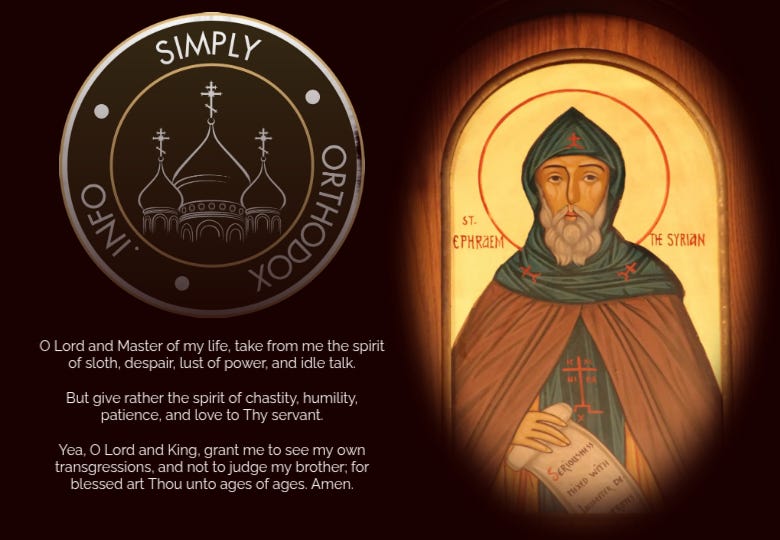
Dissecting the Petitions: The Four Foes and the Four Friends
Saint Ephraim’s prayer is a two-part spiritual diagnostic.
First, it identifies the primary diseases of the soul we need God to remove.
Then, it prescribes the essential virtues we need God to implant. It’s a masterful piece of spiritual engineering: concise, precise, and effective.
O Lord and Master of my life, take from me the spirit of sloth, despair, lust of power, and idle talk.
This isn’t a generic “make me a better person” petition. Ephraim names four specific, insidious “spirits” that corrupt us from within.
Sloth (ἀργία - argia): This isn’t just about being lazy and binging Netflix. This is spiritual sloth, a listlessness of the soul that resists effort towards God. It’s the spiritual inertia that keeps us from prayer, from charity, from any real striving for holiness. Sometimes it comes across as a comfortable apathy that says, “eh, tomorrow.” (There are some differences between the Greek and Slavonic here that are interesting.)
Despair (ἀθυμία - athymai): Sometimes this is translated as “faint-heartedness,” this is the spirit that tells us it’s too hard, we’re too weak, God can’t possibly forgive this. It’s a parlyzing doubt, the inner voice that whispers to us that spiritual growth is for others, not for our pathetic selves. Interestingly, the desert fathers saw despair as one of the ultimate temptations, because it cuts off the very hope needed for repentance.
Lust of Power (φιλαρχία - philarchia): This isn’t just about wanting to be CEO. This is the desire to dominate, to control, to impose our will on others, even subtly. It’s pride’s ugly cousin, whispering that we know best, that our opinions are superior, that our way is the only way. You need a permit in fourteen U.S. states to attempt that level of self-importance, but here we are, asking God to yank it out of us.
Idle Talk (ἀργολογία - argologia): Oh, the chatter! And in our digital age, this one hits close to home. It’s not just gossip, but all speech that is empty, pointless, or destructive. It’s the incessant internal monologue, the endless scrolling, the words that build nothing up but tear down reputation, peace, or truth. It’s spiritually junk food for the soul.
This prayer is a direct plea for God’s grace to pull out these deep-rooted and tenacious weeds from our souls.
But give rather the spirit of chastity, humility, patience, and love to Thy servant.
Having cleared the ground, Ephraim then asks for the cultivation of four essential virtues. These aren’t just external behaviors; they are qualities that transform the very fabric of our being, making us more truly human, more truly like Christ.
Chastity (σωφροσύνη - sophrosyne): It’s more than sexual purity (but not less than sexual purity), so this ancient virtue speaks to inner integrity, sobriety, and self-control across all aspects of life. It’s the spiritual clarity that allows us to see things as they truly are, unclouded by passion or illusion. It’s aiming for a unified, healthy soul.
Humility (ταπεινοφροσύνη - tapeinophrosyne): The queen of virtues, often misunderstood. It’s not self-abasement; it’s self-knowledge. It’s seeing ourselves accurately before God and others, without pretense or exaggeration. It’s the freedom from needing to prove anything, the quiet confidence that comes from resting in God’s grace.
Patience (ὑπομονή - hypomonē): This is not passive resignation but active endurance. It’s the steadfastness that allows us to bear trials, temptations, and delays without losing heart. It’s the long-suffering love that trusts in God’s providential love, even when we don’t understand this mortal existence.
Love (ἀγάπη - agapē): The highest virtue, the very essence of God Himself. It’s selfless, sacrificial love, the kind that seeks the good of the other before its own. It’s the glue that binds all other virtues together, making them truly Christ-like.
The Mirror, Not the Hammer: Seeing My Own Transgressions
Yea, O Lord and King, grant me to see my own transgressions, and not to judge my brother; for blessed art Thou unto ages of ages. Amen.
This final petition is the prayer’s pinnacle, the place where it has been leading all along. It’s the antidote to pride and the foundation of true repentance. How often do we, as humans, find it so much easier to spot the speck in our brother’s eye than the plank in our own? Saint Ephraim cuts to the chase, and with him we ask for the grace of self-knowledge, the radical honesty to confront our own fallenness.
This prayer and this petition isn’t really about wallowing in guilt; it’s about clarity. It’s about turning the spiritual microscope on ourselves, recognizing our inner “spirits” of sloth or lust of power, and simultaneously disarming the judgmental spirit that so quickly rises when we look at others.
True humility, the prayer teaches us, leads not to condemnation of our neighbor, but to compassion, because we know all too well our own battles.
Sidebar: The Syrian Sheepdog
It’s a great irony of Church history that Saint Ephraim the Syrian—one of the most prolific and complex poets and theologians of the ancient Christian world—is globally famous today for a prayer that takes about thirty seconds to say, complete with gestures and prostrations.
In the fourth century, Ephraim was a towering intellectual. He was ordained a deacon by a bishop who had actually sat at the Council of Nicea. But he didn’t fight the theological battles of his day with dry academic treatises. He fought them with lyrics.
As the Orthodox YouTube channel Patristix notes in a great video essay on the topic, Ephraim used his hymns to build a fortress of truth against the swirling heresies of his era. In fact, a century after he died, another saintly poet, Jacob of Serugh, gave him the perfect title: “a sheepdog guarding the sheep of God’s household.” Ephraim literally built a protective sheepfold out of poetry to shield the faithful from spiritual storms.
He didn’t just argue. He sang.
We can remember this when we drop to the floor to pray his Lenten prayer, that we aren’t just reciting an isolated monk’s private journal entry. We’re borrowing the field-tested notes of a fourth-century theological sheepdog.
(To dig a little deeper into the history of the man behind the prayer, I highly recommend the short breakdown from Patristix below.)
From Words to Life: Living the Prayer
This prayer is not merely recited; it’s lived through gesture and intention. Whether bowing alongside our brothers and sisters during a Pre-Sanctified Liturgy, or quietly in the solitude of our homes, its rhythm is meant to imprint itself on our bodies and souls.
The bodily action that accompanies this prayer—which can vary in specifics, but pretty much always involves some form of bowing or prostration—is crucial. It reminds us that repentance is not a purely mental exercise. It involves the whole person—mind, heart, and body—bending in submission and humility before God. As the Fathers understood, the body is a full participant in our spiritual lives, not just vessels for our souls and the thoughts that rattle around our heads.
Fr. Alexander Schmemann (of blessed memory) put it like this:
In the long and difficult effort of spiritual recovery, the Church does not separate the soul from the body. The whole man has fallen away from God; the whole man is to be restored, the whole man is to return. The catastrophe of sin lies precisely in the victory of the flesh—the animal, the irrational, the lust in us—over the spiritual and the divine. But the body is glorious; the body is holy, so holy that God Himself “became flesh.” Salvation and repentance then are not contempt for the body or neglect of it, but restoration of the body to its real function as the expression and the life of spirit, as the temple of the priceless human soul. Christian asceticism is a fight, not against but for the body. For this reason, the whole man—soul and body—repents. The body participates in the prayer of the soul just as the soul prays through and in the body. Prostrations, the “psycho-somatic” sign of repentance and humility, of adoration and obedience, are thus the lenten rite par excellence.
Incorporating Saint Ephraim’s prayer into our daily lives during the Lenten weeks transforms our days into a school of spiritual combat and a deepening self-awareness.
Rightly understood, it teaches us that true fasting isn’t just about abstaining from food, but from the passions that distort the image of God within us. Each time we utter it, each time we bow, we are engaging in a micro-act of metanoia, allowing God to work His healing, transformative power within us.
So this Lent, as the familiar words rise from your lips, take a moment. Let them sink in. Feel the weight of each petition, the cutting edge of each diagnosis, and the soaring hope of each virtue on offer in the prayer.
Because in this short but bold prayer, we hold the scalpel that cuts to the heart—in order to truly heal it.
⛪🎶🕊️ Grace and peace to you Amigo,
https://claude.ai/public/artifacts/d4bf54e9-9f82-479c-a6e4-f04f9d81147e
Most Holy Theotokos save us! 🌐📖🔥🪽
Nine Months until Nativity 🌳 Luke One 🔔
......Salvation becomes 🩸 InCarne!