


Listen to the audio version of this piece:
There’s a poem making the rounds—you may have seen it—where a woman named Eira Quinn lists everything Sunday school supposedly hid from her. Noah’s drowned children. Job’s ruined life used to win a celestial bet. Isaac’s trauma. The concubines and the war crimes. Laws about disobedient sons, gay lovers, and virginity tests. She ends with the line doing all the work: “faith without truth is just fear in nicer clothing.” The implication is clear—once you actually read the text, the God who inspired it can’t survive contact with the reading.
I want to take this seriously. Most of her citations are accurate - the flood does drown people, Job’s suffering is permitted, not accidental, and Judges 19 is as horrifying as advertised. What I want to push back on is the theology she’s rejecting, because it isn’t ours. She’s throwing out a God assembled from bad catechesis and Western courtroom atonement theory, and calling the wreckage “the truth.”
Let’s actually read.
Here’s the poem, from Threads:
They told me about Noah,
but not the bodies.
Not the screaming
beneath rising water,
or the mothers
who begged God for mercy
as he watched from the clouds
and said nothing.I heard about Job,
but they skipped the bet.
The part where God let the Devil
ruin a man’s life
just to prove a point.
Killed his children.
Stripped his skin.
And called it
righteous testing.They told me about Abraham’s faith,
but not Isaac’s trauma.
Not what it does to a boy
to see his father raise a knife
with heaven’s approval.
Not the silence that follows
when you survive a god
who wanted you dead.No one mentioned the concubines,
the raped,
the forgotten wives,
the daughters sold
for the price of land
or peace
or power.They didn’t talk about
stoning disobedient sons,
or killing gay lovers,
or what to do
if a woman is not a virgin
on her wedding night.They said Jesus died for us,
but not that God
could’ve chosen forgiveness
without blood.
That maybe the crucifixion
wasn’t salvation,
but spectacle.They said “trust the Word,”
but they handed me
a censored book
and a list of acceptable questions.
And when I asked
about the rest,
they said
“have faith.”But faith without truth
is just fear
in nicer clothing.And now that I’ve read
what they skipped—
now that I’ve seen
what they hid—
I can’t go back
to coloring pages
and quiet amens.The god they taught me
was edited.
Redacted.
Rebranded.But the truth?
The truth was always there.
In the margins.
In the footnotes.
In the blood.—EIRA QUINN
Noah: Not Silence, Grief
“He watched from the clouds and said nothing”—except the text says the opposite. Before a drop of rain falls, we’re told “it repented the LORD that he had made man on the earth, and it grieved him at his heart” (Genesis 6:6). That's not indifference—that’s a God who mourns his own judgment before he executes it.
And the flood isn't the last word—it's a preservation story. Saint Peter reaches back to it centuries later and calls the ark “a figure whereunto even baptism doth also now save us” (1 Peter 3:20-21). We don't read Noah as a horror anecdote we're too embarrassed to mention. We read it as the first of many times God carries a remnant through water into new life—a pattern that runs straight through the Exodus and lands in the Jordan.
I like to remind people how often we watch a film and rejoice when the bad guy gets what is coming to him—and we seem to see just fine how that can be a mercy for the innocent. Why don’t we do the same when a just and righteous God executes righteous action?
Job: Not a Bet, a Boundary
Calling the prologue “the bet” flattens what's actually a very careful text. The satan—“the accuser,” not yet the fully personified Devil of later theology—cannot touch Job without explicit permission, and that permission has a hard fence around it, restated twice: “only upon himself put not forth thine hand” (Job 1:12), then “save his life” (Job 2:6).
The book isn’t entertainment at Job's expense. It’s a demolition of the transactional theology his three friends keep peddling—suffering proves sin, prosperity proves righteousness. When God finally answers from the whirlwind (Job 38-41), he never explains the suffering. He relocates Job’s question inside a creation too vast for Job to audit.
Why do we assume that this text is about history or specifically about the personal suffering of some fella named Job? Why do we not read this as a tale meant to teach us something? What some imagine is God dodging accountability is really a book refusing to hand you the cheap answer, and doing so on purpose.
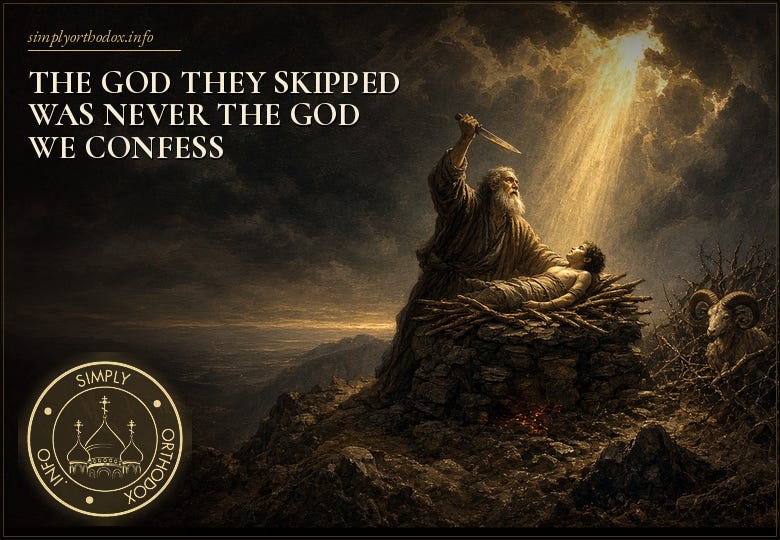
Isaac: A Type the Poem Doesn't Engage
Genesis 22 gets cited constantly and read patristically almost, well, never. The Fathers noticed something specific: Isaac carries the wood of his own sacrifice up the mountain, exactly as Christ carries the wood of the cross to Golgotha. Many holy fathers, such as Saints Irenaeus and John Chrysostom, draw this line deliberately.
The text itself frames the whole episode as a test—“God did tempt Abraham” (Genesis 22:1)—and the angel of the Lord stops the knife before it falls (Genesis 22:11-12). None of that erases what fear and trust demanded of that family. But the passage's own theology is anti-child-sacrifice, standing directly against the Canaanite practices surrounding Israel, where the knife did not stop.
And again, are we even approaching this text properly? Was this text ever about the “trauma” of a historic person named Isaac? Or was it really about Jesus Christ and the unfolding revelation of God to mankind?
The Concubines, the Law, and the Texts We’d Rather Skip
Here Quinn scores real points, and we shouldn’t flinch from them. The text narrates the rape of the Levite’s concubine in Judges 19 without a divine voice interrupting to condemn it in real time. It’s genuinely awful, and pretending otherwise isn't Orthodox exegesis—it’s also bad reading.
She also names the laws about stoning disobedient sons, the prohibition against male same-sex relations, and the virginity tests. These are real texts. They’re in the canon of Scripture. Hand-waving them is what got us the version of catechesis Quinn is rightly angry about.
But we don't need to pretend, because Christ already gave us the interpretive key: “Moses because of the hardness of your hearts suffered you to put away your wives: but from the beginning it was not so” (Matt. 19:8). St. Paul calls the law our “schoolmaster to bring us unto Christ’” (Gal. 3:24). Saint Irenaeus calls this divine pedagogy—God meeting a Bronze Age people where their moral formation actually stood, not where he’d have preferred them to be.
This is a script written to enter into what is already a cruel and broken world—it’s a text narrating a fallen world honestly while the whole canon of Scripture points forward toward something the Law itself never delivers. The hard laws aren’t the destination, they’re the diagnosis—and Christ is the cure, not just a newer, kinder rulebook stacked on top of the old one.
The Cross: Not a Ledger, a Cure
This is where the poem misfires hardest—because it’s not really arguing with us. “God could’ve chosen forgiveness without blood... maybe the crucifixion wasn’t salvation, but spectacle” assumes a God who needs to be talked into forgiving, who requires a payment before his wrath can be set aside. That’s penal substitution, a Western legal framework largely developed centuries after the Fathers, and it has never been the center of Orthodox theology.
Saint Athanasius, in On the Incarnation, is blunt: God can and does forgive freely. That was never the obstacle. The obstacle is ontological—humanity is dying, corrupted, sliding back toward nonbeing, and a pardon doesn't reverse decay any more than acquittal cures a disease. So the Word takes on our corruptible flesh and carries it through death from the inside, “that He might turn again to incorruption” what sin had ruined. Saint Irenaeus calls this recapitulation—Christ retracing Adam’s whole trajectory, including the disobedience, and healing it at every point Adam failed.
As I remind our catechumens at Saint Mark incessantly—the cross isn't a courtroom, it’s surgery. “Spectacle” would be a fair critique of a theology we don’t hold as Orthodox Christians.
The Canon: Bigger, Not Censored
One more correction, smaller but telling. If anyone censored the Bible, it happened in the opposite direction from what the poem assumes. The Orthodox Old Testament is larger than the Protestant one—we kept Tobit, Judith, Wisdom, Sirach, 1 and 2 Maccabees, texts the Reformation later cut. Canon formation wasn’t one editor with a red pen or even a secret cabal of editors colluding to suppress the truth. It was centuries of the whole Church testing books against apostolic use and liturgical life, ratified at councils like Carthage in 397.
You can disagree about which books belong—but “someone hid the hard parts from you” gets the history backwards.
The Line Worth Keeping
I'll grant Quinn her closing line—on our terms rather than hers. Faith without truth is fear in nicer clothing. Saint Gregory of Nyssa spent his whole theological career on the idea that real faith is not the suppression of hard questions but an endless pursuit deeper into a God too vast to exhaust—epektasis, reaching forward, always.
We don’t ask you to stop asking why Job suffered or why Judges 19 happened the way it did. We ask you to keep reading until you get to the empty tomb, and then go back and reread everything before it in that light.
That’s not “just have faith” as a door slamming shut. That's the actual method the Church has used since Pascha morning—nothing in the text gets its final word until it’s read through the resurrection of the God who didn’t stay dead.
Christ is risen from the dead, by death trampling death, and to those in the tombs granting life!
P.S. Much more could be said. If this piece raises more questions for you, I welcome them so that I can expand on this topic in future posts.