


In the late 1970s, a young theology student found himself hiking into the remote, craggy wilderness of the Serbian mountains. He was accompanying a priest-monk from the Studenica monastery to a parish so isolated that the final leg of the journey required hours of walking uphill.
When they finally reached the summit, they found a tiny church—roughly the size of a modern office. Inside, the priest-monk opened the altar table to reveal the reserved sacrament. It had been sitting there for decades. The exact date of the last Divine Liturgy celebrated in that building was lost to memory, unrecorded in any parish registry. Yet, the Holy Communion was perfectly preserved. It hadn’t molded. It hadn’t decayed. Decades later, it remained physically pure.
This story was recounted by Bishop Nikolai Soraich—he was the theology student. For Orthodox Christians, a story like this is more than just a historical curiosity or a neatly packaged miracle. It forces us to confront a startling reality that modern minds instinctively want to domesticate. We are not dealing with a metaphor.
When we talk about the Eucharist, the tension usually lies right here: we either reduce the chalice to a memorial symbol, or we elevate it to an untouchable prize reserved only for the spiritually elite. Both extremes miss the mark entirely.
So, we’re going to clear up two interconnected mysteries of the Church:
What we are actually receiving in the chalice;
And how the gritty, often uncomfortable work of Confession prepares us to approach it.
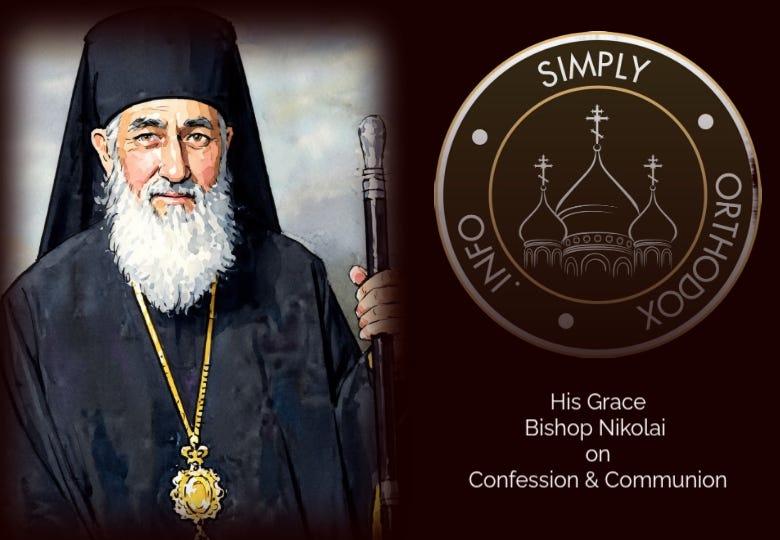
Defining the Mystery: More Than a Symbol
Let’s start with a plain definition: Holy Communion is the literal, true Body and Blood of Jesus Christ, taking the physical form of bread and wine, given to us for our salvation and union with God.
As Bishop Nikolai plainly puts it, “It isn’t just a symbol of Christ’s body and blood. It truly is.”
If you look at the historical development of the Divine Liturgy—specifically the Liturgies of St. John Chrysostom and St. Basil the Great, more or less actualized by the fourth century—you see a clear divergence in how the Christian East and West understand the moment this transformation happens.
In the Roman Catholic tradition, the consecration is tied specifically to the Words of Institution: when the priest points to the elements and says, “Take, eat, this is my body.” The Orthodox tradition, however, understands this as a broader, more mystical action. The transformation occurs during the epiclesis (the calling down of the Holy Spirit), which happens during the anaphora (the Eucharistic prayer).
“In the Orthodox Church, that’s not the case,” Bishop Nikolai explains regarding the Western timing. “That period of anaphora begins right after the Creed... until the end of the anaphora. In there is the calling down of the Holy Spirit upon those gifts, and they’re actually transformed.”
We call it a “mystery” not because we enjoy being intellectually evasive, but because human cognition simply lacks the bandwidth to process the mechanics of how the Creator of the cosmos unites Himself to us through bread and wine. It defies our categories.
Interestingly, this very physical reality—that it is truly Christ’s blood—is why Bishop Nikolai notes that alcoholics need not fear the chalice. It is the zapivka (the blessed wine and water taken in many parishes after communion to wash the mouth) that triggers addiction, not the pure, consecrated Blood of Christ.
This article is based on a conversation between His Grace Bishop Nikolai and a priest. To listen in to the conversation, check out this video on YouTube:
The Hitman and the Witness
If the Eucharist is a consuming fire, an encounter with the living God, then it demands preparation. And this brings us to the great hurdle for modern people: Confession.
Many of us wince at the word. We drag our feet. We convince ourselves that since God already knows our sins, we can just handle the paperwork privately in our own living rooms. I’ve even been surprised many times to hear cradle Orthodox people in class object to confession, “But the priest is just a human like me!”
Father Dimitri Kulp, speaking alongside Bishop Nikolai, counters this widespread misconception. While private repentance is necessary—and we absolutely should confession our sins in our ordinary daily, private prayers—he points out that non-sacramental Christians and modern secular believers largely lack the physical realization of repentance. “There is something to our repentance actually being realized when we confess to a person in the flesh,” Father Dimitri notes.
The Orthodox sacraments are inherently hands-on. Literally. Under ordinary circumstances, you cannot be absolved via Zoom or through solitary meditation. You have to stand before an icon of Christ—with a deeply flawed (but duly called and appointed) human priest standing next to you—and speak your shame into the air in faith that Christ Himself will hear your confession.
Why the priest? Because we need a witness. Before hearing a confession, the Orthodox priest reads a prayer reminding the penitent: “Behold, child, Christ stands here invisibly... I am but a witness, bearing testimony before Him of all the things which you have to say to me.”
Confession is like cleaning out a dark basement. The priest isn’t there to judge your performance or really even to criticize the mess—he’s there to hold the flashlight while you do the work of bringing everything into the light.
Bishop Nikolai shares a jarring example from his first parish to illustrate the absolute leveling power of this sacrament: he became the confessor to an active hitman. This man had been baptized Orthodox but eventually took on a job doing the devil’s work. He would receive an envelope containing a photograph, a gun, and an address. He wanted to know nothing else about the families he destroyed. His life inevitably spiraled into misery and severe alcoholism, which eventually killed him.
“But he had true repentance,” Bishop Nikolai recalls. “He died miserably because he lived miserably for many, many years... But he had true repentance. I believe he had true repentance, and at that point, he could die.”
If the Church has room to witness the repentance of a cartel hitman, she has room for your pride, your anger, and your quiet betrayals. As Father Dimitri observes, “We look at confession as one of the biggest manifestations of our repentance... in this way we’re opening ourselves up to receiving God’s grace.”
“Confession is like cleaning out a dark basement. The priest isn’t there to judge your performance or really even to criticize the mess—he’s there to hold the flashlight while you do the work of bringing everything into the light.” - Jamey Bennett
The Trap of False Piety
All this presents an amusing, if tragic, conundrum. We know the Eucharist is holy. We know we are broken. Therefore, the logical human conclusion is to self-exclude. I am too sinful to approach the chalice.
In many parishes, this has historically devolved into people receiving Communion only two or three times a year—perhaps on Lazarus Saturday or just before Nativity. It looks like humility, but it is actually a subtle form of spiritual pride. It operates on the assumption that if you fast hard enough, pray long enough, and behave well enough, you might cross an invisible threshold into “worthiness.” This has been such a common issue in Church history that both Protestant Reformer Martin Luther and Orthodox monk and holy one, Saint Nicodemus the Hagiorite, each wrote to encourage more frequent reception of Holy Communion.
Bishop Nikolai sharply dismantles this misdirected piety:
You get that false piety of, “I’m not worthy to receive.” No, you’ll never be worthy to receive. I’m not worthy to receive—and nobody’s worthy to receive. It’s a gift that Christ gives us for our salvation, for our very life.
The Church’s preparation is multifaceted. Of course, we universally emphasize fasting from midnight, and we are strongly encouraged to remember the broader fast during fasting seasons, as well as Wednesdays and Fridays. Some are particularly disciplined with attending Vespers the night before, maintaining peace and stillness the morning of Liturgy (and all parents laugh!), or saying pre-communion prayers in advance of the service.
To whatever extent we are doing these things, we need to remember that this is not a transactional currency used to purchase a ticket to the chalice. It is simply the act of tuning our spiritual radio to the right frequency.
When we hold onto anger toward a brother, or when we skip the evening services out of sheer laziness, we are out of tune. We confess to realign. But when we refuse the chalice because we feel “unworthy,” we are entirely missing the theological plot.
Father Dimitri puts it perfectly: “We are supposed to be preparing at all times for Christ. And when we have prepared, God gives us the sacraments as a gift. Who are we to say, ‘No, I don’t want the gift right now’?”
The Medicine of Immortality
The Orthodox Christian life is unavoidably physical. It requires speaking difficult truths out loud in the presence of another human being, going a little hungry on a Friday, and ultimately opening our mouths to receive God Himself from a metal spoon.
Communion and Confession are not distinct, disconnected rituals; they are the rhythmic breathing of the Christian life. At confession we exhale the poison of our own self-will, and at the Eucharist we inhale the very life of the Trinity.
When you next approach the chalice, remember the reserved sacrament sitting pure and incorruptible on a mountaintop in Serbia. Remember that the same God who preserves that mystery is offering Himself to you, not because you have earned it, but because you are starving without it.
We are all unworthy. Thanks be to God, He invites us to the banquet anyway.
I have humbly marveled at all the new experiences and encounters in my journey from Lutheran to Orthodoxy. The prospect of Confession being on the horizon, however, is daunting to say the least.
The example of the basement and the Priest as a flashlight helps ease the anxiety
Thank you!