


Listen to this article:
Years ago when I lived in Philadelphia, and was a member of a century-old Russian Orthodox parish, I was talking to an elderly man about the sheer physical toll of Holy Week. He laughed, his eyes crinkling at the corners, and told me about his own childhood. By the time Holy Saturday rolled into Pascha night, his entire family would be running on fumes. He remembered being seven or eight years old, the Church thick with incense and echoing with Slavonic, and finally just giving up. He said he crawled right under the wooden pews, curled up on the floorboards, and nearly slept through the Resurrection.
If you’ve survived Holy Week before, you know the feeling. We are about to enter the most exhausting, exhilarating, and transformative eight days of the Church year. You will stand until your feet ache. You will be hungry. You will smell like frankincense through Tuesday. And that is exactly the point. We worship with our bodies, not just our brains, because the God we worship took on a body to save us.
Yet it’s incredibly easy to walk into this week treating it like a guilt trip or a piece of theological community theater. We often drag our legalistic baggage right into the nave: the underlying assumption that sin is a cosmic parking ticket, God the Father is an angry judge, and Jesus is stepping in as a divine ATM to pay our fine with His blood. We brace ourselves to feel very sad for Jesus on Friday so we can feel happy for Him on Sunday.
If that is your framework, you are going to miss the midnight earthquake.
Holy Week isn’t a courtroom drama; it is a cosmic rescue mission. In the Orthodox Church, liturgical time isn’t a straight line—it’s a spiral. When we sing these hymns, we aren’t merely reenacting an event from two millennia ago. We are stepping outside of linear time and participating in the eternal Today of Christ’s saving work. Christ isn’t paying a fine. He is the Great Physician, and He has stepped onto the floor of the plague ward.
Here is your field guide to the services, the theology, and the sheer metaphysical weight of what we are about to do.
Palm Sunday: The Warrior King Arrives
It starts this weekend. We just had the raising of Lazarus on Saturday morning, a foretaste of Christ’s own resurrection and the resurrection of all. Then at the nighttime services for Palm Sunday, we read prophecies from Zephaniah and Zechariah that foresee the Messiah coming to Jerusalem to deliver His people from the abyss.
On Palm Sunday, when you stand in the nave holding your blessed palms (or perhaps pussy willows, depending on your parish’s local tradition), you are not a fan cheering at a parade. You are a citizen of a besieged city welcoming the conquering King. But He isn’t riding in to overthrow the Romans; He is riding in to engage in single combat with Death itself. It is truly a joyous celebration, and the Church permits (or encourages) us to lighten the fast a bit with some fish.
By Sunday evening, the tone shifts abruptly. The bright celebration pivots to the Bridegroom Matins, and we hear the dismissal prayer that will anchor us through Great Wednesday: “May the Lord who came to His voluntary passion for our salvation, Christ our true God... have mercy on us and save us.”
Notice the phrase “His voluntary passion”:
Nobody is taking His life;
He is laying it down as a tactical strike.
Fr. Georges Florovsky constantly battled against what he called “eschatological Docetism”—the bizarre but common idea that the Incarnation and the Cross were just temporary “episodes” in God’s timeline. It’s the heresy that Jesus just put on a human meat-suit for thirty-three years, suffered a bit, and then discarded it so we could all return to being pure, ethereal spirits in the clouds. History matters to Christianity, and that history is an outworking of God’s acts.
God didn’t just beam down a theological concept. He entered the dirt, the betrayal, and the blood of human history. The Christ who suffers this week doesn’t just pretend to be human; He takes our actual, physical humanity into the grave to blow the doors off it from the inside.
Moreover, the Ascension didn’t undo the grit of the Incarnation. The God who hangs on the cross is the same God who sits on the throne, forever bearing the marks of His love in His flesh.
The First Three Days: The Bridegroom and the Chamber
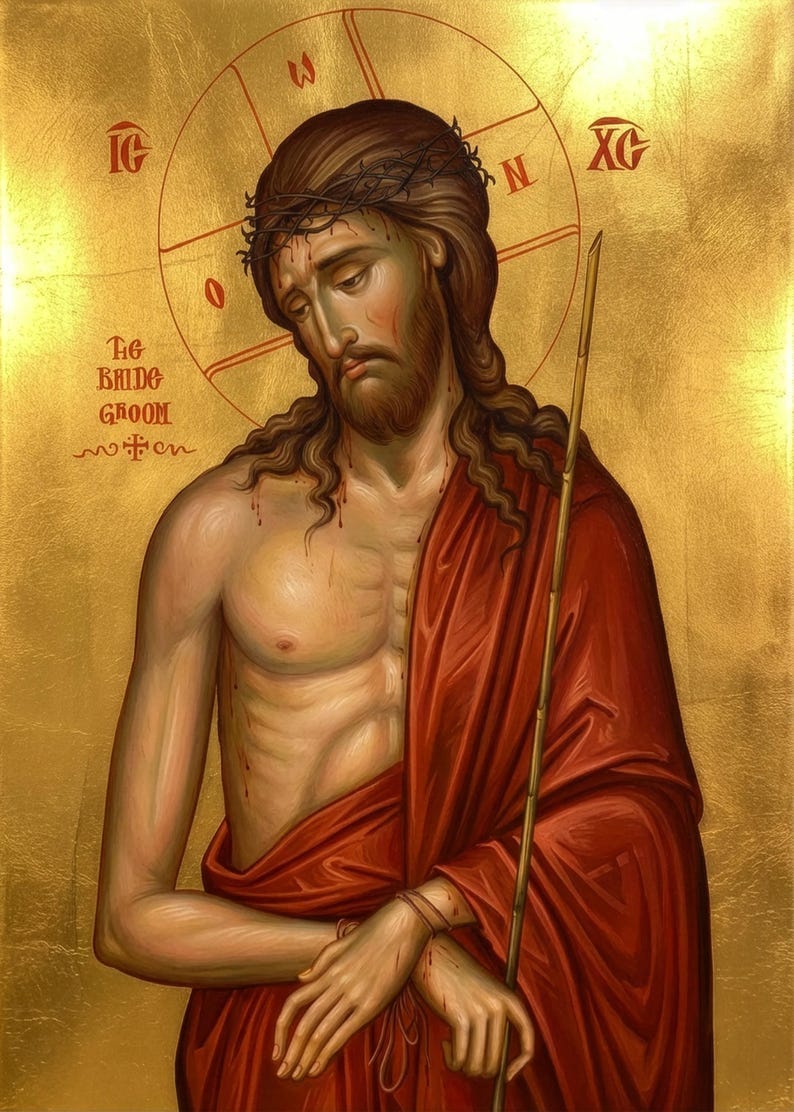
From Palm Sunday evening through Holy Tuesday, we celebrate Bridegroom Matins. The Church is darkened, and the icon of Christ the Bridegroom is brought out in procession. But He isn’t dressed for a wedding—He is wearing the crown of thorns and the purple robe of mockery.
Why a Bridegroom? Because the Cross is a marriage. Christ is coming to unite Himself to humanity, and He is paying the ultimate dowry: His own blood.
But there is an eschatological tension here. We are forced to ask ourselves: Am I ready for the wedding? We sing the haunting Troparion:
Behold the Bridegroom comes at midnight, and blessed is the servant whom He shall find watching... Beware, therefore, O my soul, do not be weighed down with sleep.
At the end of these services, we sing an Exapostilarion, admitting that we see the bridal chamber adorned, but we have no wedding garment to enter.
We are confronting our own unreadiness. We are the foolish virgins who fell asleep; we are the guests who showed up to the King’s feast in filthy rags.
“The kenosis, the self-emptying of Christ is, in itself, the supreme form of tenderness,” says Saint Dumitru Stăniloae. By stepping into the ultimate human suffering, betrayal, and abandonment, Christ fills the darkest, most godforsaken corners of human existence with the uncreated light of God.
Because of this week, there is nowhere you can fall—no depression, no suffering, no betrayal, and not even death itself—where Christ has not already been and planted His flag. Saint Dumitru and other holy fathers have taught that our dogmas are not abstract truths, but rather are an articulation of the living experience of God within the Church.
The Bridegroom services aren’t designed to make you feel guilty; they are designed to wake you up so you don’t miss the rescue mission.
Holy Wednesday: The Harlot and the Traitor
On Wednesday, the Church draws a sharp, terrifying contrast between two people: Judas, the chosen disciple who betrays Christ for thirty pieces of silver, and a sinful woman (a harlot) who shatters an alabaster flask of expensive myrrh to anoint His feet.
We sing the famous Hymn of Kassiani, written by a brilliant ninth-century female hymnographer and saint. It is a masterpiece of biblical exegesis. Kassiani puts words into the mouth of the sinful woman, drawing a direct, chilling line back to the Garden of Eden: “I will kiss Thy pure feet and I will wipe them with my tresses. I will kiss Thy feet Whose tread when it fell on the ears of Eve in Paradise dismayed her so that she did hide herself because of fear.”
Look at what is happening here. This is a metaphysical reversal. In Genesis, God walks in the Garden, and Eve hides in fear because of her sin. This time, God is walking on earth in the flesh, and a woman drowning in sin doesn’t hide—she runs to Him, falls down, and kisses those exact same feet.
Saint John Chrysostom points out the tragic irony of this moment. “And when the harlot had repented, when she had been drawn to the Master, then the disciple betrayed his Teacher.” Judas, the insider, the man who spent three years listening to the Word of God, starts doing math. He calculates the cost of the perfume. He calculates the payout from the Pharisees. The harlot, meanwhile, calculates nothing. She simply recognizes her Creator.
SIDEBAR: Oil, Bread, and the Liturgical Reality
While the historical timeline of Holy Week gives us the narrative, the liturgy drags us directly into the events. If you’re navigating the service schedule this week, keep an eye out for two major sacramental anchors that break the usual rhythm.
Holy Wednesday: The Sacrament of Unction
In many parishes, Wednesday evening is reserved for the Sacrament of Holy Unction. The timing is entirely deliberate. On the exact day we commemorate the sinful woman weeping and anointing Christ’s feet with expensive myrrh, the Church turns around and anoints us with blessed oil. It is administered for the healing of soul and body. We don’t just watch the harlot repent; we step into her shoes and receive the medicine of the Great Physician ourselves.
Holy Thursday: The Mystical Supper
“Accept me today, O Son of God, as a partaker of Your mystical supper.” Thursday is liturgically massive because it is the day Christ instituted the Eucharist. To mark this, we celebrate a Divine Liturgy (specifically, the majestic Liturgy of St. Basil the Great) on Thursday morning or early afternoon. But we are not putting on a historical play. We are not hosting a new supper or merely doing a reenactment. Through the Liturgy, we step outside of time and participate mystically in that exact same upper room in Jerusalem.
Great and Holy Friday: Theopaschism and the Glory of the Cross
If you come from a Christian background that emphasizes “penal substitution,” you might expect Good Friday to focus on the psychological and physical agony of Jesus—the nails, the scourging, the sheer human terror.
We do not ignore the suffering. (Your feet and your fasting stomach will remind you of it.) But the Orthodox Church focuses on something far deeper: the divine glory manifest in that suffering.
On Thursday night, we read the Twelve Passion Gospels. On Friday afternoon, we take the body of Christ down from the Cross (the Unnailing) and place it in the tomb. On Friday night, we sing the Lamentations over His grave. All the drama of Christ’s final week becomes real in our midst as we literally have a funeral for God and eulogize Him as He descends into the tomb.
Saint Andrew of Crete tells us that the cross is the glory of Christ, that it was his goal before the ages:
The cross is called Christ’s glory; it is saluted as his his triumph. We recognize it as the cup he longed to drink and the climax of the sufferings he endured for our sake.
And Saint Andrew of Crete won’t let us treat the Cross like a tragedy that happened to “the human part” of Jesus while the divine nature watched from a safe distance. The Cross is exalted because it’s Christ’s glory—his triumph, the cup he wanted to drink, the summit of his love for us. That’s why it isn’t God’s emergency patch after Eden. It’s the plan “before the ages.” The Cross is the eternal shape of God’s self-emptying: God unites Himself to humanity, meets Death head-on, and kills it from the inside—by death.
So when we look at the cross, we don’t just see an instrument of Roman execution; we see the King of Glory ascending His throne.
We believe in an Orthodox understanding of Theopaschism—as championed by St. Cyril of Alexandria—that God suffered in the flesh.
This means that the One hanging on the wood—and the services say exactly this—is the selfsame One who hung the earth upon the waters. The hymnography of Great and Holy Friday is staggering because it forces us to watch the angels. The bodiless powers are looking down in absolute, unmitigated shock as their Creator allows Himself to be slapped by the clay He molded.
Saint Dumitru Stăniloae again:
Without the cross man would be in danger of considering this world as the ultimate reality. Without the cross he would no longer see the world as God’s gift. Without the cross the Son of God incarnate would have simply confirmed the image of the world as it is now as the final reality, and strictly speaking he could have been neither God nor God incarnate. The cross completes the fragmentary meaning of this world which has meaning when it is seen as a gift which has its value, but only a relative and not an absolute value. The cross reveals the destiny of the world as it is drawn towards its transfiguration in God by Christ. For this reason at the end of this stage of the world this sign, ‘the sign of the Son of Man’, will be revealed in the heavens above all the world, as a light, as a meaning, as a destiny which illumines the whole history of man (cf. Matthew 24:30).
The Cross is not a defeat; it is the ultimate revelation of God’s uncreated love. He is weaponizing Death against itself.
Great and Holy Saturday: The Harrowing of Hades
This brings us to the very hinge of the universe. On Saturday morning, we celebrate a Vesperal Liturgy—the mood has begun to change from the rest of the week. The clergy change from dark purple vestments to bright white. Many parishes throw bay leaves and flower petals all over the Church, shouting, “Arise, O God, judge the earth!”
Christ is in the tomb. But the tomb is not a place of decay, it has become a “life-bearing tomb.”
While His body rests in the grave, His human soul—united to His divinity—descends like a nuclear strike into Hades (the realm of the dead). For all of human history, Death had swallowed everyone: the righteous and the wicked. But when Death swallows Christ, it swallows God. It is like a dark, sealed room trying to swallow the sun.
Hades is shattered. The gates of brass are kicked off their hinges. Christ grabs Adam and Eve by the wrists and pulls them from the graves. The “death of God” becomes the death of Death.
Christ, the New Adam, restores our humanity so that we can once again stand as priests of creation. The Cross and the descent into Hades are the ultimate acts of His priestly offering, reclaiming everything that was lost before.
SIDEBAR: Holy Week at a Glance
If you want to explore a little more, Archpriest Ivan Shandra provides a straightforward breakdown of what the Church actually commemorates each day in this video, and summarized below:
Holy Monday - The Patriarch and the Fig Tree
We hold up two warnings: Joseph the Fair (sold by envious brothers, foreshadowing Christ) and the cursed fig tree. The tree had plenty of green leaves but zero fruit—a stark image of hypocritical religion that looks the part but lacks actual repentance.
Holy Tuesday - Spiritual Vigilance
Christ drops parables in the temple that infuriate the Pharisees. We read the Parable of the Ten Virgins as a blunt, unvarnished call to wake up. Do the actual work of your faith so you aren’t caught sleeping when the Bridegroom arrives.
Holy Wednesday - The Sinner and the Traitor
A terrifying contrast. A sinful woman weeps, anoints Christ’s feet, and repents. Meanwhile, Judas—the insider, the disciple—does the math and sells his God for thirty pieces of silver. The harlot repents; the theologian betrays.
Holy Thursday - The Supper and the Garden
A massively dense day. Christ washes His disciples’ feet and institutes the Eucharist. Then, the narrative plunges into the dark: the agonizing prayer in Gethsemane, the arrest, and Peter’s three-fold denial before the rooster crows.
Holy Friday - The Cross and the Tomb
The trial, the mocking, and the sheer shock of the Creator remaining silent before His creatures. Christ is crucified and dies. Just before the Sabbath, Joseph of Arimathea and Nicodemus take His body down from the wood and seal it in a garden tomb.
Holy Saturday - The Harrowing of Hades
A day of heavy, pregnant silence. Christ’s physical body rests in the grave, but His soul descends like a battering ram to kick the doors off hell and rescue the righteous. By evening, the liturgy noticeably shifts. The Resurrection is coming.
Conclusion: Your Role in the Drama
Every day this week is called “Great” because of the magnitude of what God is doing. But we do not do Holy Week to feel bad for Jesus. He doesn’t need our pity; but he does call us to repentance.
Even in the midst of this cosmic drama, the Church reminds us that our theology must become action. We cannot just read about this; we have to live it in the community of the Church. One of the hymns of the week instructs us plainly:
Let us serve the Master eagerly... Let one gain wisdom through good deeds; Let another celebrate the Liturgy with beauty; Let another share his faith... Let another give his wealth to the poor.
We are about to walk through the darkest, brightest, most exhausting week of the Church year. Pace yourself. We should fast, but not boast about it. We pray more, we pray deeply. We work on forgiveness. And we show up to as many services as the circumstances of life and physical stamina allow.
If your legs are shaking during the Twelve Gospels, and when the smell of myrrh and incense clings to your clothes, remember the old man in Philadelphia—and cut the little boy some slack, too. We bring our whole bodies to the tomb because Christ brought His whole body to the cross.
We are marching with Christ to the grave this week. But we do not go to mourn a martyr. We go to watch the Author of Life plant a bomb in the basement of Hades.
The Bridegroom is coming. Make sure you are awake.
A heck of a nice bat, to knock another one out of the park.
Saving this to review for next year!