


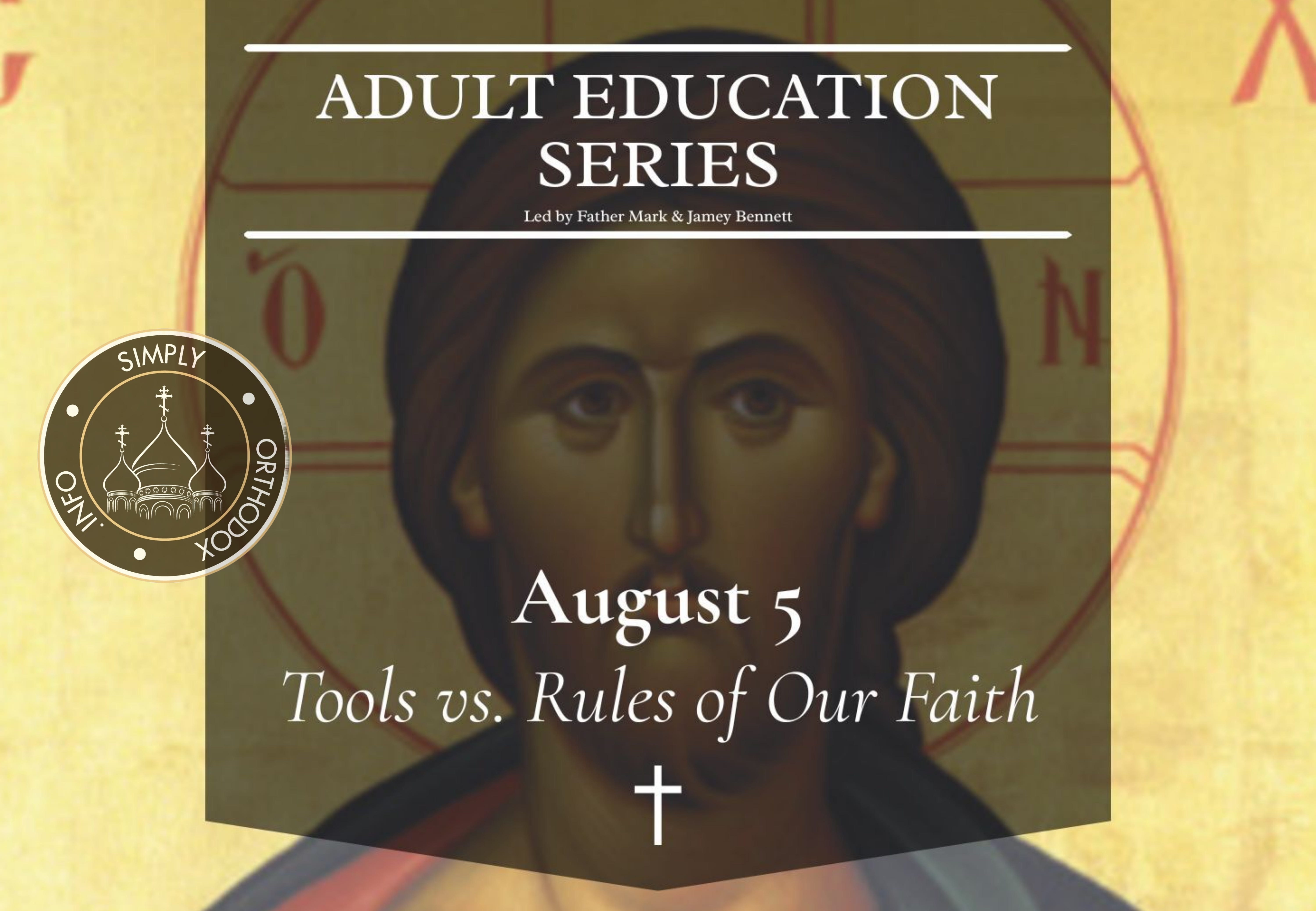
NOTE: St. Mark Greek Orthodox Church in Boca Raton is running a four-part August series on Orthodox Christian living this month. Fr. Mark Leondis taught session one in the video below.
What follows is my own reflection on that session, written for Simply Orthodox readers—catechumens, inquirers, and anyone still sorting out what any of this is actually for. You can read part 2 here and part 3 here.
Training Day
A catechumen one texted me asking if margarine counts as dairy.
Fair question. I answered it (it doesn’t, mostly—somewhere out there, a nineteenth-century Frenchman patented margarine specifically to torment future Orthodox catechumens, and I have chosen to believe this on faith). But the question underneath that question is the one most of us ask before we even notice we’re asking it: what am I allowed to do, and what happens if I don’t?
That’s rules-thinking. It’s the default setting for anyone who grew up measuring faith in checkboxes, and it’s the exact thing Fr. Mark Leondis spent an hour dismantling in the first session of St. Mark’s new catechesis and adult education series. He introduced a term most inquirers have never heard: phronema. I want to walk through why it matters, because the distinction he’s drawing isn’t a technicality. It’s the whole ballgame.
The Word Nobody Translates Well
Phronema doesn’t land cleanly in English, which is probably why so many converts never get properly introduced to it. The closest we can do is mindset—but that undersells it the way “cardio” undersells a marathon. Phronema isn’t an opinion we hold. It’s the lens we see through before we ever form an opinion, the operating system underneath whatever app happens to be open.
Saint Paul names it directly: “Have this mind among yourselves, which is yours in Christ Jesus” (Philippians 2:5, ESV). A few letters later, writing to the church at Corinth, he says it flatter still: “we have the mind of Christ” (1 Corinthians 2:16, ESV). Not his ideas. Not a summary of his teaching we could fit on a bumper sticker. His mind—the way he saw a leper, a tax collector, his own execution.
We don’t acquire that by reading about it, any more than my four-year-old is getting a black belt by reading about jiu-jitsu (he’d fight me on this, mid-armbar, but it’s true). We get it the way Paul describes it: “be transformed by the renewal of your mind” (Romans 12:2, ESV)—renewal, present tense, ongoing. Not a bar we clear once and frame on the wall. A mind we keep letting Him remake, the way a river keeps letting the bank shape it, whether the river notices or not.
This is also, incidentally, where East and West tend to part company. A rules framework treats sin as a broken statute—something owed, something to be settled. Orthodoxy treats sin the way a doctor treats a fever: a symptom worth diagnosing, not a debt worth collecting. Which is a nicer way of saying nobody’s getting sentenced to community service for skipping vespers.
Askesis: The Church as Gym
Here’s where it gets concrete. The Greek word askesis just means training—it’s where we get “ascetic,” and it originally described an athlete’s regimen, not a monk’s. Saint Paul uses it on purpose: “I discipline my body and keep it under control” (1 Corinthians 9:27, ESV). Timothy gets the plainer version: “train yourself for godliness” (1 Timothy 4:7, ESV).
I know a little about training regimens. I spent over a year tracking macros and dropped 75 pounds chasing a protein number I still miss most days (mostly because chicken breast is a personality-free food and I will resent it if I eat it too often). A good coach doesn’t hand you one fixed program and disappear. He’s running the whole operation—when to push, when to back off, when a sore knee means rest instead of another set. That whole job, not just the backing-off part, is closer to what the Church actually means by oikonomia. The word literally means managing a household.
A spiritual father practicing it isn’t handing out exceptions to a rule; he’s governing the whole thing, deciding case by case where strictness serves someone and where it would break them. That strict baseline has its own name too: akriveia, the standard everyone’s aiming at. Oikonomia is the governance holding both together, not a synonym for going easy. A pregnant woman gets something other than the full monastic fast because a shepherd is actually managing the household case by case. The program still serves the person. Miss a day, meanwhile, and nobody revokes your membership. You just don’t build the muscle you’d have built.
That’s the whole logic behind fasting, prayer, and every other tool in the Church’s kit. They’re reps. When Christ tells the Pharisees “the Sabbath was made for man, not man for the Sabbath” (Mark 2:27, ESV), He’s making Fr. Mark’s exact point about tools two thousand years early: the tool serves us, not the other way around.
And when He says “those who are well have no need of a physician, but those who are sick,” then adds that He came “not to call the righteous, but sinners” (Matt. 9:12–13, ESV), that’s the hospital model preached before hospitals had waiting rooms. It’s such a fixture of Orthodox pastoral language by now that half the people who repeat it couldn’t tell you who said it first, which might be its own kind of proof: the Church runs like a hospital, not a courtroom.
Nobody gets discharged from physical therapy for a bad week. If you’ve ever been to PT, you know your program simply gets modified and your therapist has undoubtedly seen worse.
Seven Tools, One Aim
Father Mark walked through the toolbox itself—prayer, fasting, Scripture, the Divine Liturgy, confession, almsgiving, the saints—and made the same case seven different ways: none of these earn us anything. They form us. We can own a Bible and stay unchanged. Light a candle and stay unchanged. Buy the Allen wrench and leave it in the drawer, and the bookshelf still doesn’t build itself. Pick up the tool and use it, though, and something starts happening to the shape of our mind.
Confession is worth pausing on, because it’s the tool people dread walking into and leave describing as relief—which should tell us something’s being mismarketed. It isn’t a deposition; the Church isn’t building a case against us. Almsgiving carries its own quiet correction: it keeps asking whose money it actually was in the first place, which is an uncomfortable question for a culture that names its retirement accounts after itself.
Every one of those seven tools points at the same word the Fathers kept reaching for: theosis. Saint Peter puts it right in Scripture—we’re meant to become “partakers of the divine nature” (2 Peter 1:4, ESV). Saint Athanasius said the same thing in five words that have outlived every empire since: “He was made man that we might be made god.”
That’s the target—becoming something capable of holding the life of God, from the inside out.
The Actual Point
So, margarine. My catechumen got her answer, and nobody had to call a lawyer to figure it out. But the question I’d want every inquirer walking into a series like this one to actually carry isn’t “what’s allowed.” It’s the one Fr. Mark spent an hour training us toward instead: what is this doing to my heart, mind, and soul?
Father Georges Florovsky, writing decades before any of us showed up to a catechism class, put it better than I can:
“To follow the Fathers does not mean simply to quote their sentences. It means to acquire their mind, their phronema.”
That’s the whole thing in one sentence. Not citations. Not compliance. A mind, slowly and stubbornly acquired—one Wednesday fast, one confession, one Liturgy at a time.
Three sessions to go this August. We’ll be back next to discuss preparation for the Divine Liturgy.
Sources
Scripture quotations are from the ESV Bible (The Holy Bible, English Standard Version), copyright © 2001 by Crossway, a publishing ministry of Good News Publishers. Used by permission. All rights reserved.
Saint Athanasius, On the Incarnation, §54.3.
Georges Florovsky, “Following the Holy Fathers,” in Collected Works, vol. 4, Patristic Theology and the Ethos of the Orthodox Church (Belmont, MA: Nordland Publishing, 1987), 15–22.
A note on one line above: “the Church runs like a hospital, not a courtroom” is a common saying in an Orthodox pastoral context, often loosely attributed to St. John Chrysostom. I couldn’t trace it to a specific homily with confidence, so it appears in the piece without his name on it.
Thank you for all the articles you have written. Thank you particularly for the one written and to be written under this topic. I grow in the Orthodox way by reading your work.
I am offering gratitude for your mindful reflections on becoming orthodox. Todays article is especially helpful.