


Listen to this article:
In the Gospels, people are always getting to Jesus through something tangible. Water, mud, the hem of his garment, bread he breaks with his own hands. He breathes on the Apostles. He lays hands on the sick. He sends them out to anoint with oil.
The sacraments—what we often call the Mysteries—are how that same Christ still touches us now, in his Church, by the Holy Spirit.
Not magic tricks or bare symbols; they’re how he feeds, heals, forgives, joins, and sends real human beings in real places…and yes, in ways that look different from parish to parish. (I’ve been in the OCA, the Moscow Patriarchate, and the Greek Archdiocese; I can assure you, standards and styles vary.)
What I want to do here is walk through the “big seven” without pretending that grace only flows through seven pipes. We’ll keep it simple: what each Mystery is, what it’s for, and how it fits into a normal Orthodox life.
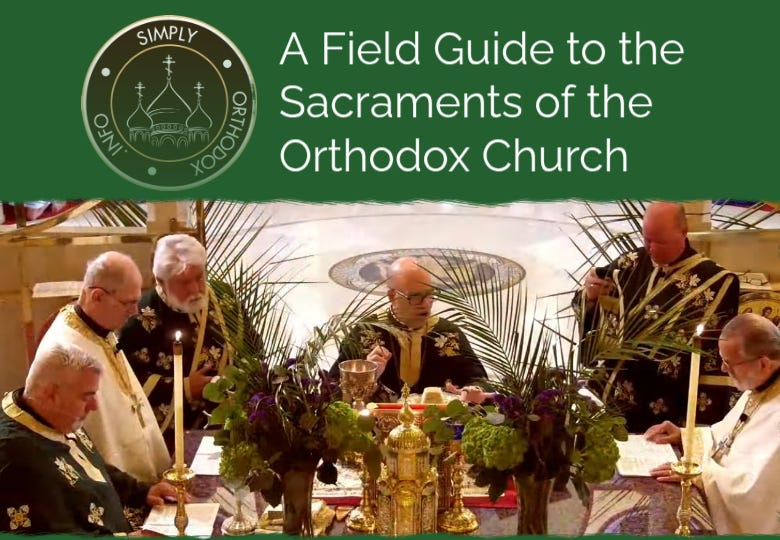
What a “Mystery” Is (And Why We Use That Word)
Orthodox Christians are often more comfortable saying Mystery (mysterion) than “sacrament.” That’s not because we enjoy being vague! It’s because the primary reality here is not a human ceremony—but Christ acting in His Body by the Holy Spirit.
In very simple terms: A Mystery is a concrete act in which Christ himself works, through his Church, to unite us to Himself and to one another.
That means:
There is always a visible side (water, oil, bread and wine, hands, words).
There is always an invisible side (grace, the Spirit’s action, forgiveness, healing, union) that you can’t measure with a lab test.
The point is not to treat the sacraments as spiritual vending machines, but as the places where the Lord of the Gospels still touches us.
The life of the Church is sacramental in a much wider sense—blessings, icons, funerals, monastic tonsure, holy water—but the “seven” give us a clear, catechetical set of central encounters to talk about.
So we number the sacraments at seven out of convenience, but the reality is that the Church herself is Sacrament and therefore all of her actions are sacramental in some sense.
“A Mystery is a concrete act in which Christ himself works, through his Church, to unite us to Himself and to one another…. So we number the sacraments at seven out of convenience, but the reality is that the Church herself is Sacrament and therefore all of her actions are sacramental in some sense.” - Jamey Bennett
Baptism and Chrismation: Birth and Seal
Baptism: Dying and Rising with Christ
If you want one biblical image for Baptism, it’s burial and resurrection. Saint Paul (Romans 6:3-4, ESV) doesn’t say we get a religious label; he says:
Do you not know that all of us who have been baptized into Christ Jesus were baptized into his death? We were buried therefore with him by baptism into death, in order that, just as Christ was raised from the dead by the glory of the Father, we too might walk in newness of life.
In Baptism:
We are washed—sins forgiven, including the whole backlog of our old life.
We are buried and raised with Christ—united to his death and Resurrection.
We are adopted—no longer spiritual freelancers, but sons and daughters in a household.
While it is sometimes talked about as a mere rite of passage that “gets the baby done” or gives the adult a nice memory, but the deeper reality is that it is a spiritual crossing of the Red Sea, a real change of status and belonging, an escape from Egypt, and a true deliverance like the ark delivered righteous Noah and his family (1 Peter 3:20).
Chrismation: Our Personal Pentecost
Immediately after Baptism (or on its own, when someone is received by chrismation as a completion of their prior baptism), we are anointed with holy chrism. The priest says, “The seal of the gift of the Holy Spirit.”
Chrismation is:
Our personal Pentecost—the Spirit given, not as an external visitor, but as indwelling gift.
A sealing—marking us as belonging to Christ, equipped for the life we’ve just been born into.
The moment when all the “you” commands of the New Testament start to make sense: we’re not being told to live this life alone; we’re given the Spirit to live it in us.
Baptism and Chrismation are the great doorway. Everything else—Eucharist, Confession, Marriage, Unction—assumes this new birth and seal are already there first.
Eucharist and Confession: Food and Medicine
Eucharist: Christ Our Food
In the Divine Liturgy, we don’t just remember something that happened; we enter into Christ’s once‑for‑all sacrifice and receive his Body and Blood.
Orthodoxy insists on three things at once:
The Eucharist is truly the Body and Blood of Christ (not just a symbol, not just a mental prompt, and not just thinking really hard about Jesus).
It is not a new sacrifice, but our participation in the one sacrifice of the Cross, made present to us. But it is absolutely a sacrificial meal.
It is the sacrament of unity: it both expresses and deepens the fact that we share one faith, one baptism, one life.
That’s also why we practice closed communion. It’s not a statement that “we’re better than you”; it’s a statement that Communion presupposes a shared faith and sacramental life. To pretend unity at the chalice when it doesn’t exist in belief and practice would be dishonest and, frankly, spiritually dangerous (see 1 Corinthians 11:30).
For those who are baptized and chrismated into the Church, the Eucharist is normal food. The basic expectation over time is: we prepare and come regularly, not as a rare treat but as our life.
Confession: Naming the Sickness, Receiving the Cure
If the Eucharist is food, Confession is medicine. In Confession, we stand before Christ and speak the truth about our sins in the presence of the priest, who is both witness and physician.
A few important distinctions:
Confession is not therapy, though it may be therapeutic.
The priest is not a prosecutor; he is there to help you tell the truth and to pronounce Christ’s forgiveness.
The goal is not to produce a perfectly exhaustive sin‑inventory, but to repent—to turn from known sins and ask for grace to begin again.
How often? That varies, depending on the jurisdiction or region, parish or individual. Some people confess before every communion, every few weeks, four times a year, and so on; others less frequently, some more.
The real question is: am I letting my sins harden into habits, or am I bringing them into the light regularly? Your priest can advise you how to find an appropriate rhythm.
Marriage and Ordination: Sacraments of Vocation
Marriage: A Shared Road to Holiness
In Orthodox terms, Marriage is not just a romantic upgrade with incense. It is a Mystery of union in Christ between a man and a woman, ordered toward shared salvation and, ordinarily, open to children.
So what makes Orthodox weddings unique?
The couple are not just making a contract; they are being joined in a life that is now accountable to Christ and his Church.
The crowns placed on their heads are both royal and martyrial: symbols of honor and of self‑giving love.
That’s why the Church doesn’t simply “host weddings” as venue rentals. To be married in the Church is to enter a sacramental state with real content and expectations.
There are edge cases—mixed marriages, previous divorces, complex histories—but those belong in personal conversation with a priest, not in a brief overview.
Holy Orders: Service, Not Promotion
When someone is ordained a deacon, priest, or bishop, there is again a laying on of hands, a prayer, a gift of the Spirit for a particular kind of service.
Ordination is:
A sacramental configuration to Christ the High Priest: the ordained man becomes a visible icon of Christ’s pastoral care in that community.
A call to sacrificial service, not a perk package.
A gift given for the sake of the Church, not for the private holiness of the man alone.
This is one reason (among many) why Orthodoxy doesn’t talk about “starting your own church.” The Church’s sacramental life is received, not invented.
Holy Unction: Healing Along the Way
We’ve already described this, but here’s the short form.
Holy Unction (or the Sacrament of the Anointing of the Sick) is rooted in James 5:14–15, where the apostle calls the elders to anoint the sick with oil and pray for healing and forgiveness. In the Orthodox Church, this is not reserved for the edge of death; it is a sacrament of healing in the midst of the journey.
In Unction, we ask God for:
Physical healing of illnesses and infirmities,
Spiritual healing of soul and mind,
Forgiveness of sins—including those forgotten or unknown.
During Great Lent, many parishes celebrate a communal Unction service, often on Holy Wednesday. Everyone present (who is an Orthodox Christian) is anointed—not only those who look sick—receiving Christ’s healing touch as we step into Holy Week and Pascha.
It’s a very concrete way the Church says: this life of repentance we talk about is also a life of real, applied mercy.
Beyond Seven: A Life Filled with Sacramentality
At this point, you might be tempted to say, “Okay, that’s seven. Are we done?” The answer is: yes and no.
Yes, in the sense that:
These seven Mysteries give us a clear frame:
Birth and seal (Baptism, Chrismation),
Food and medicine (Eucharist, Confession),
Vocation (Marriage, Ordination),
Healing (Unction).
No, in the sense that:
The Church’s life overflows with sacramental actions:
Monastic tonsure and the monastic life.
The daily cycle of services, which bathe us in Scripture and prayer.
Much more could be said!
Some theologians will happily point out that the “seven sacraments” language came into Orthodoxy partly through Western influence and systematization. Fine. The deeper truth is that Orthodox life is simply thick with Christ’s presence. We don’t engage the Mysteries like a definitive checklist to complete; they are the main arteries in the circulatory system of the Body of Christ.
Standards and styles do vary—between jurisdictions, between parishes, sometimes even between priests in the same diocese. But beneath those variations, the same Christ is at work, through water, oil, hands, bread and wine, words and gestures, to save, heal, and unite.
If you’re new to all this, the best next step is simple: bring your questions about these Mysteries to your priest. Ask him to help you see how they fit together in your life, in your parish. The point is not to master a system, but to keep showing up where Christ has promised to meet you, again and again, until the day you see him face to face.
Fr. Alexander Schmemann in For the Life of the World (p. 102), writes:
A sacrament—as we already know—is always a passage, a transformation. Yet it is not a “passage” into “supernature,” but into the Kingdom of God, the world to come, into the very reality of this world and its life as redeemed and restored by Christ. It is the transformation not of “nature” into “supernature,” but of the old into the new. A sacrament therefore is not a “miracle” by which God breaks, so to speak, the “laws of nature,” but the manifestation of the ultimate Truth about the world and life, man and nature, the Truth which is Christ.
Love the way you put this!
The point is not to treat the sacraments as spiritual vending machines, but as the places where the Lord of the Gospels still touches us.