


Listen to this article on audio:
June 1862—A Prophet Cornered
It’s June 1862, and a splinter community of Latter-day Saints is dug in behind dirt and desperation, waiting for the end of the world—or at least for the territorial militia to arrive first. Their prophet has been receiving visions. He has been writing letters to Brigham Young. He has been gathering followers. He has been gathering property.
And in at least one of his prophecies, he says something so big and audacious, it feels like it should belong in a dystopian film, not a family tree: If you are a son or daughter of Adam, I am now your leader.
Some of the followers try to leave. They want their things back—things that were “given” to the communal cause under the pressure of imminent apocalypse. But the camp doesn’t just say no, they detain people, making their own people into prisoners within their own settlement. Word gets out. The governor issues an ultimatum and a militia forms. The standoff collapses into violence, and Joseph Morris—the would-be prophet-king of the whole human race—ends up dead in the chaos.
This is usually told as a strange footnote in the history of American Mormonism: an obscure, short-lived confrontation in the Utah Territory in 1862. For my family, it’s not a footnote. It’s part of our inheritance—one of the earliest chapters in a long, complicated habit we’ve had for generations: We convert.
Not in the shallow sense—religion as a lifestyle tweak, a new community, a better playlist. I mean conversion as upheaval. As rupture. As “we can’t stay where we are, not honestly.” The kind of movement that costs you something, and sometimes costs you almost everything.
My great-great-great grandfather George Thompson and his family didn’t drift into “Zion” the way modern people drift into a new city. They traveled close to 5,000 miles from England to Utah because they believed the Mormon claim was not a private spirituality but a map of reality. They joined, they moved, they built, and somewhere along the line they ended up tangled in the Morrisite movement—one more schism in an already schism-prone frontier religion.
If you want a neat and tidy moral lesson here, I can give you the cheap version: people can be fanatics, and religion is a major driver of fanaticism.
Purported prophets can really be liars. Communities of faith can become coercive. It’s true. It’s also an easy judgment to make. It lets us stand above it all like a safe, modern narrator—shaking our heads at those weird 19th-century zealots while we sip on something cold.
But that’s actually missing the point.
The point is that the modern world—especially the American version—trains you to assume religion is basically a preference. A choice. A consumer menu. If we don’t like one thing, we can try another. If we outgrow a community, we can just “move on.” If a doctrine feels too sharp, we can sand it down and choose to believe whatever variation of that doctrine suits our fancy. If a practice feels too strange, we can just leave it behind.
My family story doesn’t let me pretend that’s what’s happening.
Because whatever else the Morrissites were, they weren’t casual. And whatever else my ancestors were doing, they weren’t browsing. They were staking their lives on something they believed was True—with a capital T—and that’s why their mistakes were dangerous, and why their devotion was costly, and why their conversions mattered.
And here’s the uncomfortable twist: I didn’t inherit this story as a warning about “those people.” I inherited it as a prelude to my own.
Today’s piece is a reflection based on an interview I did on The Areopagus Podcast with Father Andrew Stephen Damick and Pastor Mike Landsman on Ancient Faith Radio.
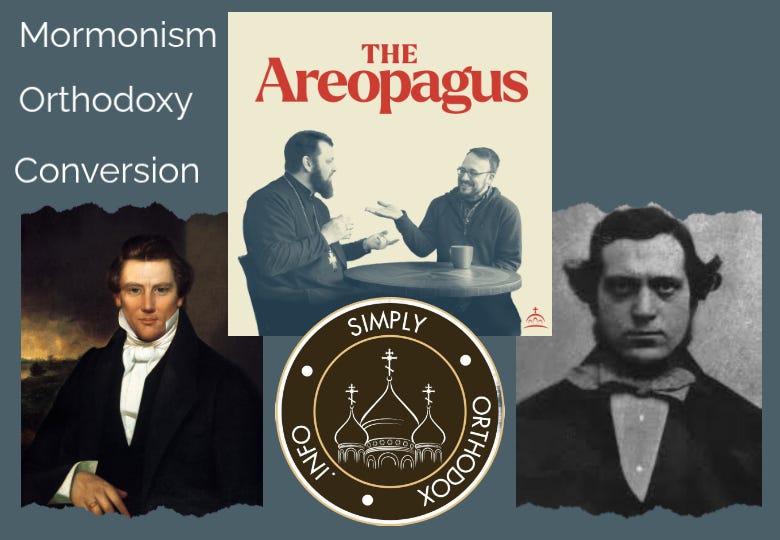
Conversion: An American Inheritance?
Growing up in an evangelical home, I sometimes felt like I was living in two religions at once. My extended family—cousins, grandparents, the larger web—largely remained Mormon. The culture and identity were there. And because my mother left Mormonism when I was a toddler, the differences were not theoretical in our home. They were daily. They were linguistic. They were about the very shape of reality.
Mormonism says Jesus is our elder brother who lived righteously and showed us the way.
Evangelicalism says Jesus is God incarnate.
To some, those sentences may look like they’re making similar points—but they’re not. They’re actually making very different points. And when you grow up hearing both in deliberate contrast, you learn early that theology isn’t academic—it’s the difference between two worlds.
I was two years old when my father died in a car accident. My mother was widowed with four children. And in the middle of the trauma of that loss, she became open—truly open—to something else. She converted to evangelical Christianity.
That conversion wasn’t merely “switching churches.” It was a change in the very grammar of God. She went, as I often put it, from seeing Jesus as our elder brother who did all the right things to help us do all the right things… to seeing Him as God incarnate. Not a creature elevated, not a moral hero with divine backing, but the eternal Word made flesh. This is no minor doctrinal adjustment, but an entirely different Christ.
And once we change Christ, everything changes downstream: salvation, the Church, Scripture, worship, what a human being even is.
So my childhood wasn’t merely “Bible time.” It was catechesis by contrast. My mother would read Scripture at breakfast, and when I’d ask a question, she’d sometimes stop herself mid-answer and say, Wait—that might be a Mormon teaching. And then she’d go study. Not to win an argument, not to prove something, but to tell her son the truth about God.
That’s where my long road “home” actually starts—not with an adult intellectual quest, not with my later zig-zags through Protestant traditions, not with Orthodox liturgy, not with some aesthetic romance about icons.
It starts with grief, with a widow. With the slow, costly work of unlearning and relearning who Jesus is.
My mother gave me a gift, though I didn’t understand it at the time: she taught me that conversion is real. Not therapy; not an upgrade. Real. The kind of thing that asks you to rebuild your house from the ground up.
The Protestant Pendulum: Or, How I Learned to Read the Reformers
I inherited her seriousness. As a teenager and young adult, I threw myself at evangelicalism with the intensity of someone who believed every word mattered—because I did believe that. I handed out Jack Chick tracts. I memorized apologetics. I was sure of just about everything. Later, I spent time in charismatic circles, waiting and listening for the gift of tongues. Later still, I became what we called a “cage stage” Calvinist—a young Reformed Christian so convinced of five-point Calvinism that it would have been a mercy to put me in a cage until I calmed down and got some sobriety.
I was probably pretty tiresome. Also, looking back, I was hungry.
The hunger showed itself especially through reading. I read the Reformers—particularly Martin Luther—and something shifted for me. Luther kept saying that baptism saves you. Not “baptism represents salvation” or “baptism is a symbol of your faith.” He kept saying what Saint Peter says it in the epistles: “Baptism . . . now saves you” (1 Peter 3:21). And suddenly the purely symbolic view of the sacraments—the “well, it’s just a memorial meal” approach—began to feel thin. Not wrong, exactly. Just thin.
I was sensing something the modern Protestant world had stopped sensing: that God might actually do something in the holy things. That He might really be present. That matter might, well, matter.
So I drifted into Anglo-Catholicism—that high-church Anglican tradition where you try to hold onto your Protestant identity while grasping for the liturgical weight and sacramental conviction of the ancient Church. You get the bells, the incense, the sense that something real is happening. You get to keep your Bible confidence. You get the both/and.
Except the both/and started to feel like neither/nor.
The Wafer in the Trash: Or, When Symbols Aren’t Enough
Here’s where the theology got concrete for me. I was part of a small Anglican community. We took the sacraments seriously, but being Anglican put us in the position of having to reconcile our self-conscious efforts at “being catholic” with the historical reality of Protestantism inherent to the Anglican way of Christianity.
During this period, I was working a temp job as a janitor at an Assembly of God. One week I found a box of discarded communion wafers in the trash of one of the Sunday School classrooms—and week after week, I was there to clean up communion “leftovers” from this particular classroom. Apparently, this class was experimenting with more liturgical Christianity, because Sunday after Sunday there were leftover wafers, clearly intended as communion bread, designated to be tossed out by the janitor.
From the first discovery, the question appeared in my head with force: What do I do with this? I couldn’t throw it away, could I? Even though they weren’t a high church religious body with claims to Apostolic Succession, I couldn’t bring myself to toss it. It meant something deeply meaningful to them, and was intended to be connected with Christ’s institution of the Eucharist. Somewhere in my bones, I knew: you don’t toss away something holy like it’s a soggy napkin.
So I called my Anglican bishop, explained the situation, and got my orders. I was to consume it. Alone, reverently, in the Sunday School room, like someone who didn’t quite know what he believed about these particular elements, but knew he believed something special is in the Eucharist, and whatever this is, it is certainly intended to be a ritual Supper with our Lord.
I was on a low carb diet at the time, so this was no small sacrifice—I downed so many wafers and grape juice thimbles that summer!
As a Protestant, I had wandered into the territory of Catholicism—the conviction that the Eucharist is really Christ, not symbolically Christ—but I was trying to camp out in Protestantism, which kept insisting it was just bread, just memory, just a beautiful sign.
You really can’t live in both places. Growing up, the modern Protestant world had trained me to think that symbols are enough, that meaning doesn’t require presence, and that worship is primarily about what happens in your mind, not what happens in matter.
But the wafers in my hands said something different.
The Fear That Broke: Hawaii, Galatians 3, and the Mercy I Didn’t Expect
By this point in my life as an Anglican, I had read my way into believing something radical: the early Church still exists. Not as a memory, not as a beautiful ideal that we study and learn about from a distance. Still exists. With Apostolic Succession, with the sacraments, with the full liturgical inheritance.
That belief should have sent me running to the Orthodox Church. But it didn’t. Instead, it sent me running from the Orthodox Church for quite some time.
Because I was afraid.
And the fear had a name: works righteousness. I had been evangelical and Reformed long enough to absorb the Protestant anxiety about salvation by works. And from a distance, Orthodoxy—with its talk of theosis/deification, transformation, the healing of human nature through grace—sounded like an elaborate system of spiritual earning. Like you had to do enough, pray enough, fast enough, pull yourself up high enough to finally meet God halfway.
It sounded exhausting. It sounded like moralism dressed up in liturgy.
I was wrong. But I didn’t know it yet.
Then I visited an Orthodox parish a few months after I moved to Hawaii. A bishop was visiting, and he stood up to preach on Galatians 3—that classic Protestant proof-text about faith, not works, about the Spirit, about grace. And he preached the Gospel of God’s grace and mercy so clearly, so purely, so Christianly that it felt like something in me broke open.
He said—and I’m really relaying my memory’s impressions—that in Orthodoxy, we don’t view salvation as a legal contract we have to pay off. We don’t view it as a transaction where God demands a price and we have to scramble to meet it. We view it as the healing of our human nature by the grace of God. The deification of humanity. Theosis.
It’s not earning. It’s union.
When you’re sick, you don’t negotiate with the doctor about how much sickness you’re allowed to keep, you go to the doctor to be healed. And healing means the doctor’s medicine enters your body, does its work, and you’re restored to wholeness.
That’s what salvation is. Not a legal settlement. A healing.
And suddenly, the fear dissolved.
Not because I had figured out every theological detail. Not because I was ready to be Orthodox in the way a person is ready to be something after a committee vote. But because in that moment, I realized: this is what I’ve been looking for. Orthodoxy is the coherence I kept searching for in Protestantism. This is the sacramental realism I couldn’t quite articulate in Anglicanism. This is the Church that still exists, still carries the apostolic faith, still offers the fullness of Christ.
This is home.
A Decision Point: The Early Church Still Exists
People sometimes ask me: don’t you still feel like a convert? Aren’t you worried that you chose Orthodoxy, rather than being born into it? Like you’re somehow less of a “real” Orthodox Christian because you didn’t inherit it from your grandmother?
And Father Andrew Stephen Damick said something in our conversation that cut through all of that noise: Christianity started with converts.
Think about it. The Apostles didn’t grow up Christians. Peter didn’t attend an Orthodox liturgy as a child and then become an altar server and one day a priest. The early Church was entirely composed of people who had chosen to follow Christ, often at enormous cost. They converted from Judaism. They converted from paganism. They converted from false gospels. And their conversions weren’t timid intellectual movements—they were upheavals that cost them property, relationships, sometimes their lives.
Conversion isn’t less authentic than inheritance. It’s the pattern of Christianity itself.
But here’s what matters: true conversion isn’t brand-switching. It’s not “I tried that thing, it didn’t work, so now I’m trying this thing.” It’s the fundamental realignment of your life with Christ. It’s the moment where you encounter the fullness of the faith and it becomes—to use the language of Scripture—bone of your bone and flesh of your flesh. It becomes you. You can’t imagine being any other way, not honestly.
The Apostle Peter captured it perfectly: “Lord, to whom shall we go? You have the words of eternal life” (John 6:68).
Not “Lord, I’ve compared the options and Orthodoxy seems optimal.” Not “Lord, I like the aesthetics of your Church.” But: to whom shall we go? There’s nowhere else to go. There’s no higher ground. There’s no other place where the fullness of Christ dwells.
That’s the place I’ve arrived at. Not because I’m a perfect Orthodox Christian—I’m not. Not because I have all the answers—I don’t. But because I’ve encountered something real. Something that can’t be upgraded from. Something that holds together the whole inheritance of the faith, from the Apostles to now.
My great-great-great grandfather George Thompson traveled 5,000 miles to find what he thought was Zion. His daughter ended up in a siege, and nearly was shot herself, before returning to the mainstream Mormon fold. My mother lost her husband and had to rebuild her faith from rubble. I zig-zagged through evangelical fervor and Reformed conviction and Anglo-Catholic longing to the calm, still waters of Orthodoxy.
All of it was looking for the same thing: a place where God is really present. Where the sacraments are really efficacious. Where the ancient faith hasn’t been watered down into a consumer preference or gutted of its sacramental meaning. Where you can finally stop auditioning religious identities and come home.
I found it. Not in a neat package. Not after a five-step program. But in the ancient Church, still alive, still singing the same psalms, still offering the same Christ.
Lord, to whom shall we go? You have the words of eternal life.
Listen to the original conversation here:
As a catechumen in Utah coming from a Mormon background I appreciate your story. Thank you!
A compelling read - thanks Jamey - this is going onto our Parish whapp group.
Good Fast!