


So you’re staring down your first Orthodox Lent.
Perhaps people at coffee hour lately have been tossing around words like Triodion and Presanctified as if everyone was born understanding them. Some dork jokingly calls Lent “Byzantine CrossFit.” Someone else mentions giving up oil and alcohol and then clarifies, “No, not that oil and not that alcohol,” and now you’re wondering if you need a degree just to grocery shop.
This guide is my attempt to zoom the camera out. I want to show you what Great Lent actually is, where it came from, how it hangs together, and how you—especially if you’re a catechumen or recently received—can walk into it without either burning out or treating it like a mere religious diet.
Contents of Post:
1. So What Is Great Lent?
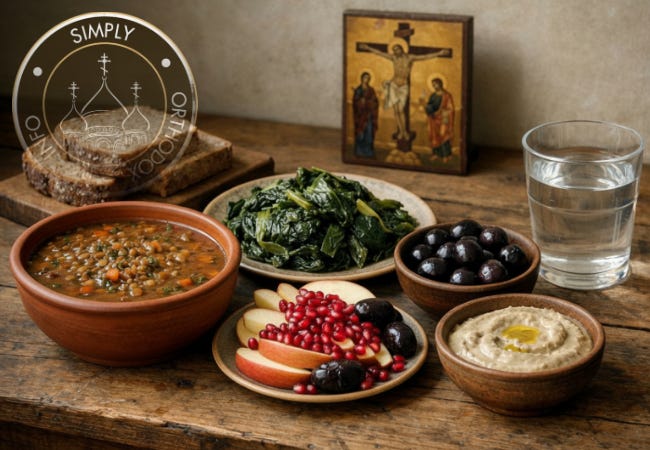
Most of us come to Orthodoxy with some idea of “Lent” already in our heads. Maybe you thought of it as a time to “give up chocolate for forty days,” or perhaps it was “that thing Catholics do with ashes.” So Orthodoxy shows up with several weeks of a countdown, a bunch of sequential weeks of fasting, extra services, and something called the Triodion, so it’s natural to ask: What’s actually going on here?
In the most straightforward of terms, Great Lent is a focused and intensive time set aside by the Church annually to focus on repentance, prayer, fasting, and almsgiving—in preparation for the great celebration of Holy Week and Pascha. But that simple line conceals three big pieces you don’t want to miss.
Lent is ecclesial. This is not a private affair, and it’s not a “spiritual challenge.” It is something the Church does together as a spiritual discipline. Parishes, monasteries, catechumens, long‑time faithful—we are all being carried along by the same liturgical current. Or maybe think of it is a spiritual training ground or boot camp.
Lent is baptismal. In the ancient Church, this period was tightly linked to people preparing for baptism. The catechumens were being exorcised, instructed, and scrutinized; the faithful were fasting and praying with them and for them. You can still hear echoes of this in the prayers and hymns throughout this season.
Lent is Paschal. The point of the fasting and prostrations is not to prove we can suffer. The point is to walk with Christ into his death and resurrection. Everything is aimed at the glory of Pascha night: the holy light, the proclamation of “Christ is risen,” the feast of the Kingdom.
While there are many other important dates and seasons in the Church year for the Orthodox, Lent and Pascha are kind of the main show. If you remember nothing else, remember this: Great Lent is the Church walking you somberly into the tomb and out again in victory.
And if you’re preparing for baptism or chrismation, you’re not a side‑project—you’re at the center of this whole movement.
2. The Countdown: Triodion and the Four Pre‑Lenten Sundays
At some point, you’re going to hear someone say, “We’ve entered the Triodion,” like a pilot announcing you’re now over Kansas. That can sound mysterious, but the basic idea is simple.
The Triodion is a liturgical book the Church uses from the first pre‑Lenten Sunday all the way through Holy Week. It contains hymns and texts that shape the season.
You might think of it as the Church’s Lenten playlist, curated over centuries.
Before Great Lent proper even starts, the Church spends four Sundays getting our hearts ready. This is a time where things ramp up, and each Sunday is meant to strike a different chord.
Publican and Pharisee: Smashing Spiritual Pride
Two men go up to the Temple to pray. One thanks God he’s not like other people. The other can barely raise his eyes and just says, “God, be merciful to me a sinner.”
The shock of the parable is that the “good” religious man goes home unjustified, and the tax collector goes home right with God. Lent opens here because the Church wants to blow up any idea that this is about spiritual performance. If Lent makes you impressed with yourself, you’re doing it wrong.
The point? The first Sunday of our countdown begins by reminding us of what we lack, of our own sin, and to remind us to resist the spiritual pride of the Pharisee.
If Lent makes you impressed with yourself, you’re doing it wrong.
Prodigal Son: Coming Home Filthy
Then we get the Prodigal Son. A kid demands his inheritance, wastes it in a far country, and crawls home rehearsing an apology. The father runs to meet him and throws a feast before he can finish his speech. While the story has much bigger implications than individualist considerations, it is normal to see a little bit of ourselves in this story.
This is Lent’s second move: repentance is returning to the Father who runs to meet you. You cannot out‑sin His hospitality. The point is not to wallow in guilt, but to actually come home to the Father.
Sunday of the Last Judgment (Meatfare): Love in Deeds, Not Just Foods
On Meatfare Sunday, we hear the Gospel of the Last Judgment. Christ separates the people of all nations based on how they treated “the least of these”: the hungry, the stranger, the sick, the prisoner.
This is the Church reminding us: fasting without mercy fails the test. If we obsess over ingredient labels but ignore the poor or neglect the people right in front of us, we’ve missed the heart of Lent.
Saint Basil the Great has said:
“The benefit of fasting is not limiting to one abstention from food, because true fasting is eliminating evil deeds. Destroy every connection with the unrighteous. Forgive your neighbor his offenses; forgive him his debts. Do not fast in judgment and quarrels. You do not eat meat, but you eat your brother. You abstain from wine, but you do not abstain from insults. You wait until evening to eat food, but you spend the day in judgment places.”
Expulsion from Paradise (Cheesefare Sunday): Standing at the Gate
Finally, Cheesefare presents us with Adam and Eve being cast out of Paradise. The hymns put words in Adam’s mouth as he weeps outside the closed gates. It’s poignant and painful, and reflects the universal human experience in this fallen and broken world.
Lent begins with this image so that we understand where we’re standing: outside Eden, looking in, beginning the journey back. The “good news” is that we don’t walk back alone; the Church takes us by the hand.
By the time we reach this point, we’ve been spending weeks preparing. Across the Orthodox world—regardless of Greek, Slavic, Antiochian, Romanian, old calendar, or new calendar—while melodies and local customs may differ in minor details, these four Sundays form a shared pre‑Lenten grammar. They tell us who we are and what we’re about to do.
SIDEBAR:
In Orthodox Christianity, preparing for Pascha (Easter) is not a single 40-day Lenten block, but a sequence of spiritual seasons. While people often say “40 days,” the full spiritual journey is 70 days long. It begins with 22 days of preparation, moves into 40 days of Great Lent, and finishes with the 8-day “sprint” of Holy Week.
The 70-Day Journey to Pascha
Phase 1: The Pre-Lenten Warm-Up (22 Days)
Day 70–64 (Week of the Publican & Pharisee): The “fast-free” week. No fasting even on Wednesday or Friday, emphasizing that we are not saved by our own efforts.
Day 63–57 (Week of the Prodigal Son): Normal fasting resumes (Wednesday/Friday). Focuses on returning to the Father.
Day 56–50 (Meatfare Week): The “Farewell to Meat.” You stop eating meat on Sunday (Day 56) and eat dairy all week to ease into the strict fast.
Phase 2: The Great 40 Days (40 Days)
Day 49 (Clean Monday): The official start of Great Lent. A day of strict abstinence and “cleaning house” spiritually.
Day 49–10: The core 40-day fast. Unlike the West, Orthodox Lent includes Sundays in the count, totaling six full weeks of fasting.
Day 10 (Friday of the 6th Week): The “Great 40 Days” technically conclude here.
Phase 3: The Bridge (2 Days)
Day 9 (Lazarus Saturday): A celebration of the resurrection of Lazarus, foreshadowing Christ’s victory over death.
Day 8 (Palm Sunday): A festal break commemorating the entry into Jerusalem; fish, wine, and oil are typically permitted.
Phase 4: Holy Week (7 Days)
Day 7–1 (Holy Monday to Holy Saturday): A separate, intensified fast. These days are not part of the “40 days” but are the most rigorous days of the entire 70-day cycle.
Day 0 (Pascha): The Resurrection. The fast is broken, and the 70-day journey concludes.
3. Walking Through Great Lent: A High‑Level Map
Now we actually step into Great Lent. No, I won’t give you a day-by-day manual—this is still just a blog post—but you should at least know the lay of the land.
The Forty Days
Great Lent proper runs from Clean Monday through the Friday before Lazarus Saturday. The number 40 echoes Israel’s forty years in the wilderness and Christ’s forty‑day fast. The tone is sober but not despairing; it’s more like focused training.
During these weeks you’ll notice:
More frequent services.
A different, more penitential musical tone.
A general sense that the Church has shifted gears.
Calendar details—exact start dates, how the civil calendar lines up—will vary, especially between Old and New Calendar jurisdictions, but the basic architecture is common, and most of the worldwide Orthodox Churches follow the same calculation for Pascha.
The Canon of St. Andrew: Learning to Repent in First Person
In the first week (and again in full later on) we meet the Great Canon of St. Andrew of Crete. It’s a long poetic work that walks through Scripture, putting us in the shoes of figures who repented and those who refused.
If you stick with it, you realize something important: the Church doesn’t let us keep our sins at arm’s length. We say, “I have become like…” this or that figure. It’s an extended exercise in honest self‑knowledge, but always in conversation with God’s mercy.
Presanctified Liturgies: Food for the Road
In the middle of the week, many parishes celebrate the Liturgy of the Presanctified Gifts, traditionally on Wednesdays and Fridays. The Eucharist is consecrated on Sunday and reserved so that in the middle of the fasting struggle, the faithful can receive communion even though we don’t serve a full festive Liturgy.
If you’ve never been, the feel is different: more prostrations, more Psalmody, a sense of being pilgrims at dusk, stopping at a roadside spring. It embodies the idea that Lent is not starvation; it’s a different kind of nourishment. This is my favorite Liturgy of the year after the Pascha Vigil and Holy Saturday.
The Akathist Hymn: Joy in the Middle
In many parishes, especially those of Greek and Arab extraction, Fridays in Lent may be marked by the Akathist Hymn to the Theotokos. In the middle of all this penitence, we stand and pour out a long, joyful poem of praise to the Mother of God for her role in the Incarnation.
It’s as if the Church says, “Don’t forget why you’re doing this. The Word became flesh. Salvation is already at work among you.”
Even in Lent, joy keeps breaking through the floorboards.
4. Holy Week and Pascha: Pump up the Volume
The reality is that all of Great Lent in Orthodox Christianity is a gradual ramp up to Holy Week and Pascha.
Lazarus Saturday & Palm Sunday: Life and Kingship
At the end of the Forty Days, we hit Lazarus Saturday: Christ calls his friend from the tomb. Death loses its grip. The next day, Palm Sunday, we follow Christ into Jerusalem with palms and branches. He comes as the King who conquers by being slain.
For catechumens, these days are not background drama. They proclaim what baptism is about: being called out of the tomb and pledging loyalty to this upside‑down King.
Holy Unction: Strength for the Finish
In the middle of the Lenten journey, the Church does something that can look almost surprising: she stops us all—healthy, sick, young, old—and lines us up to be smeared with oil.
This is Holy Unction (also called the Sacrament of the Anointing of the Sick or Euchelaion), one of the chief “seven” sacraments of the Orthodox Church, rooted in Apostolic practice (James 5:14–15), where the prebyters/priests are instructed to anoint the sick with oil and pray for healing and forgiveness.
In the Orthodox mind, though, this isn’t a narrow “last rites” for the visibly ill; it is a sacrament that asks God for physical healing of illnesses and infirmities, spiritual healing of soul and mind, and the forgiveness of sins—even those forgotten or unknown.
During Great Lent many parishes serve a special communal celebration of Holy Unction, most commonly on Great and Holy Wednesday evening, as we stand on the threshold of the Passion; the service weaves together seven Epistle readings, seven Gospel readings, and seven prayers, punctuated by the anointing of the forehead, hands, and sometimes other parts of the body by one or more priests with the blessed oil.
Every Orthodox Christian present is anointed, not just those who “look” sick, receiving this touch of mercy as preparation for Holy Week and Pascha, a concrete way the Church presses home Lenten themes of repentance, spiritual renewal, and readiness to meet Christ in his suffering and in his Resurrection.
Bridegroom Services: The Road to the Cross
Early in Holy Week, the Church serves the Bridegroom Matins services. Christ is pictured as the Bridegroom who comes in the night; the Church calls us to wakefulness: “Behold, the Bridegroom comes at midnight…”
As the week goes on, we are drawn into:
The Mystical Supper;
The betrayal and arrest;
The Cross;
The placing of Christ in the Tomb;
The storming of Hades and Christ’s triumph over death and evil;
The dark sadness of waiting for the Resurrection—shot through with triumph.
Orthodoxy does not so much pretend to “reenact” these things like a play, but rather the liturgy assumes that we are being drawn into the once‑for‑all Pascha of Christ, made present to us sacramentally. The Holy Mysteries usher us into the reality, making the reality present in a mystical, but real, way.
Pascha Night: Stepping into the New Creation
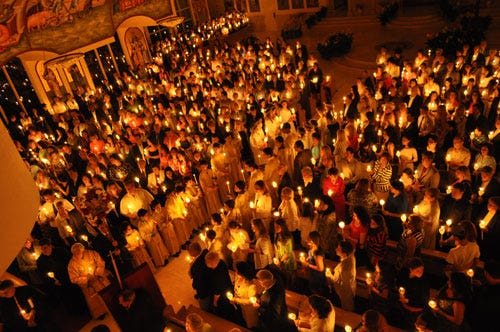
Then comes Pascha. The dark church, the single flame, the spread of light from candle to candle, the triumphant hymn announcing Christ’s victory over death—this is where the whole season has been headed.
For the newly baptized and chrismated, this is the first time receiving the full Paschal feast as Orthodox Christians. For the rest of us, it is a yearly renewal of the baptism we may barely remember.
By the time we shout “Christ is risen,” the goal is not that we have completed a spiritual challenge. The goal is that, by grace, we have taken another real step into the life our baptism already gave us.
5. So What Do I Actually Do during Lent?
At this point, you may be thinking: “Okay, I get the big picture, but what am I supposed to do?” This is where I need to be very clear: I’m not your priest, and a blog post is not adequate for spiritual direction.
Think of your priest as a kind of spiritual trainer. He knows (or should know) your spiritual condition, your health, your job, your family situation, your particular temptations. Any real, concrete “rule” for Lent—what you eat, how you pray, how often you come to confession—belongs in that relationship, not in an internet article.
What I can give you here are categories and questions to bring into that conversation.
Fasting: More Than Food, Not Less
The Church sets a “gold standard” for our fasting pattern. But nobody lives the Typikon on the internet.
Instead of asking, “How hardcore do I have to go?” start by asking:
What keeps me enslaved to my appetites?
Where can I embrace simplicity and self‑control?
How can my fasting free time, money, and attention for prayer and mercy?
Then take those questions to your priest and let him set the dose and intensity. Fasting is not a dare; it’s medicine.
Prayer and Services: Showing Up
If Great Lent is the Church’s journey, then showing up with the Church is already a major step.
Talk with your priest about a realistic pattern, but for many people starting out, it might look as simple as this:
Treating Sunday Liturgy as absolutely non‑negotiable.
Adding at least one Lenten service during the week if your schedule allows—often a Presanctified.
Establishing or modestly strengthening a daily prayer rule (morning, evening, or both), even if it’s brief.
Don’t let the perfect be the enemy of the possible. Better a small, honest rule you keep than an imaginary monastic schedule you abandon a mere eight days in.
Almsgiving and Mercy: The Weightier Matter
Meatfare already warned us: Christ will judge us on how we treated the hungry, the thirsty, the stranger, the sick, the imprisoned. Lent is a perfect time to let that sink in.
Good questions here include:
Can I deliberately redirect some of what I save by simpler eating toward concrete charity?
Is there a person in my life I’ve been avoiding who needs my time, attention, or forgiveness?
Am I fasting from meat while still devouring my brother online or in gossip?
Listen to Saint John Chrysostom:
“Let the mouth also fast from disgraceful speeches and railings. For what does it profit if we abstain from fish and fowl and yet bite and devour our brothers and sisters? The evil speaker eats the flesh of his brother and bites the body of his neighbor.”
If our Lenten discipline makes us pickier in the supermarket but just as harsh, cynical, or indifferent as before, we’ve got the equation backward.
Repentance and Confession: Not Just Guilt Management
Lent is the main season when many Orthodox Christians go to confession. If you’re a catechumen, your priest will guide you on when and how that begins for you.
The point, though, is not to tick a sacramental box. It’s to:
Name the ways we keep siding with the old Adam.
Receive forgiveness and healing.
Learn to live more truthfully before God.
Overzealous converts sometimes try to fix everything at once and end up in shame or scrupulosity. If that’s you, remember: Lent is not about achieving. It’s about returning. Go at the pace obedience and honesty require, not the pace your religious ego demands. (This is a great time to learn the meaning of the word “prelest.”)
6. Common Pitfalls (For New and Old Orthodox Alike)
Lent has its clichés, and they exist for a reason. A few to watch out for:
Overzealous Convert Syndrome - You discover the fasting rules and decide to out‑monk the monks on your first try. By week three you’re exhausted, irritable, and quietly judging everyone else’s oil intake.
Antidote: humility, obedience, and gradualism. Let your priest set something doable. Holiness is a marathon, not a stunt.
Lent as Religious Diet - You can recite what’s “allowed” on every day, but you haven’t prayed more, given more, or forgiven more.
Antidote: periodically ask, “Is my heart softer? Are the people around me safer from my anger, sarcasm, and online takes?” If not, the fast needs recalibration.
Apathy and Background Lent - You treat Lent as liturgical wallpaper: it’s there, but nothing in your life changes.
Antidote: don’t aim for a complete overhaul. Pick one concrete next step—in services, prayer, or mercy—and actually do it.
Weaponizing the Fast - You use your Lenten discipline as a quiet superiority complex or as a yardstick to measure others. “Keep your eyes on your own plate” is great spiritual advice.
Antidote: remember the Publican and Pharisee. If your fast makes you more aware of other people’s sins than your own, it’s time to go back to square one.
7. Lent: Baptismal and Ecclesial Renewal
Underneath all the details, this is what I want you to hear: Great Lent is the Church’s yearly catechumenate. Even if you were baptized as an infant and don’t even remember it, the Church brings you back, again and again, to the waters.
If you’re preparing for baptism or chrismation this year, you are not tagging along on something meant for “the real Orthodox.” You are part of the reason this whole season exists. The rest of us walk with you so that we can remember who we are and what we’ve already received.
By the time we come to the empty tomb and shout, “Christ is risen,” the deepest hope is not that we can boast about how strictly we fasted or how many services we made it to. The hope is that—by grace—we have taken even one real step further into the death and resurrection of Christ, together.
Fr. Alexander Schmemann writes in Great Lent: Journey to Pascha:
“As we make the first step into the ‘bright sadness’ of Lent, we see—far, far away—the destination. It is the joy of Easter, it is the entrance into the glory of the Kingdom. And it is this vision, the foretaste of Easter, that makes Lent’s sadness bright and our lenten effort a ‘spiritual spring.’ The night may be dark and long, but all along the way a mysterious and radiant dawn seems to shine on the horizon.”
P.S. You may have noticed we didn’t include a list of foods. We did this on purpose—the list of foods can become a distraction if the other points mentioned above are not dialed in first. If you want to explore the “food rules,” you can see the following articles:
Additional Resources:
Thank you so much for this guide! Very well organized and thought out. I might have to print this one out to share!
Wow, this is really beautiful! Im not orthodox but i have been wanting to learn more abt fasting in general. I also really appreciate how the steps here are focused on God and quite practical ❤️