


Editor’s Note: Slide deck, printable handout, and live class recording at bottom. This is the fourth installment in a teaching series at Saint Mark Greek Orthodox Church in Boca Raton, Florida. Here are the previous classes in the series:
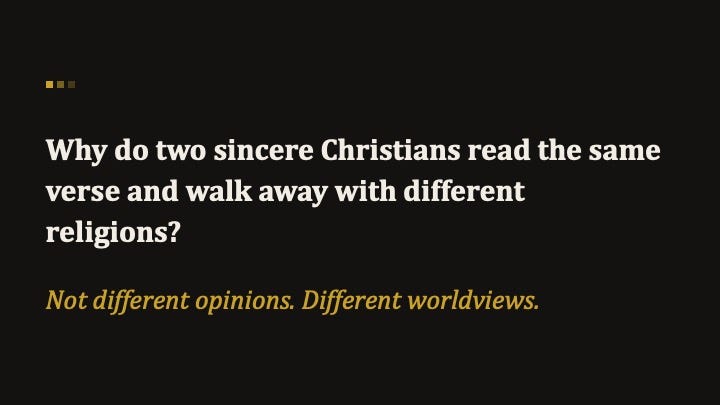
Two sincere Christians read the same verse and walk away with different religions.
Not different opinions, but different worldviews. Different gods, sometimes, though both would swear they’re reading the same Bible and loving the same Lord.
I was one of them for years. Open Bible, closed commentary. I was convinced the text spoke to me directly, personally, without mediation. “Just me and my Bible” felt like faithfulness. It felt like the Reformation’s best instinct carried to its honest conclusion. What it actually was—and I’m being charitable to myself here—was a method whose assumptions I had never examined.
Nobody told me this. The moment you decide what a verse means, you’re already interpreting it. Whether a command is universal or local, symbolic or fulfilled, spoken to you or to ancient Israel—interpretation has begun. You can’t opt out.
The real contrast was never interpretation versus no interpretation. It’s disciplined versus undisciplined. Ecclesial versus private. Christ-centered versus reader-centered. The question isn’t whether interpretation happens. It’s whether it happens well.
Saint Peter said it first: “Knowing this first, that no prophecy of the scripture is of any private interpretation. For the prophecy came not in old time by the will of man: but holy men of God spake as they were moved by the Holy Ghost” (2 Peter 1:20-21). You can read the Bible alone. You just shouldn’t read it as though nobody before you has.
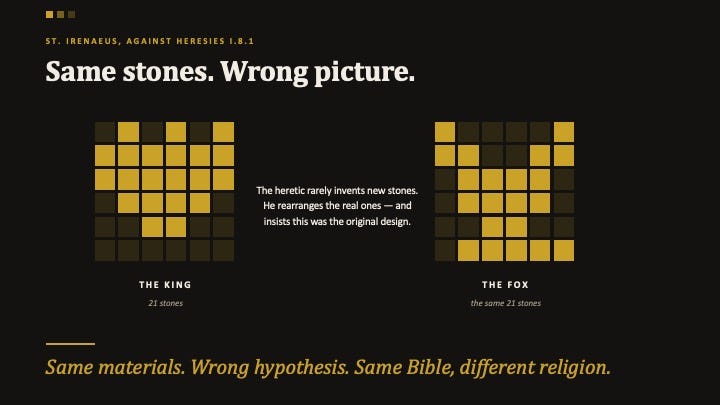
Saint Irenaeus saw the same danger in the second century. He pictured a heretic who pulls the tiles from a mosaic of a king and rearranges them into a fox. Same tiles. Same materials. Wrong hypothesis. The heretic rarely invents new stones. He rearranges the real ones and insists this was the original design.
Heresy usually knows how to quote. Same Bible, different religion. What follows is how the Church has always read—a center, four guardrails, and a way to start tonight.
What We’re Even Holding
Before arguing about how to read it, we should agree on what it is. The Bible is a library, not a singular book. Roughly forty-some authors across many centuries, and every shelf points to one Person. Two Testaments, one arc: promise, then fulfillment. The Orthodox Old Testament follows the Septuagint, and the Anagignoskomena—what some traditions call the deuterocanon—belong in the room.
Genre is more like instructions than decorations. Law, History, Wisdom, Prophets. Gospels, Epistles, Apocalyptic. Read a psalm like a lab report and the Bible will not cooperate. The Bible tells you what happened and what it means, and “accurate” and “literal” are not the same word.
A library, one Author, aimed at one Person. The Church’s book, read in her community and her worship. An icon of Christ, showing His face on every page. Forget the fridge magnets.
“Live, Laugh, Leviticus” is not a hermeneutic. Keep the icon.
Christ Is the Key
Luke 24. Two disciples on the road to Emmaus, confused and grieving, carrying their Scriptures like a safe deposit box they’ve lost the combination to. Jesus walks up—unrecognized—and “beginning at Moses and all the prophets, he expounded unto them in all the scriptures the things concerning himself” (Luke 24:27).
This is not a nice resurrection-side Bible study that behaves well. It’s a hermeneutical earthquake that shook them no less than the resurrection shook the earth and moved a stone.
Christ doesn’t point to a few predictions that happened to line up, and He didn’t just do a nice Bible study. He turned their world upside down. He teaches that Moses and the Prophets speak of Him. Then He opens their understanding—”that they might understand the scriptures” (Luke 24:45). The disciples already had the texts. What they lacked wasn’t information. It was the center, and the opened mind to receive the whole.
Christ is the key to the Bible.
Saint Athanasius gave this a name: the skopos of Scripture. The scope, the aim, the governing center. The Fathers asked not only “what does this verse say?” but “what is Scripture doing here, and how does it fit the whole?” Athanasius used this against the Arians. Their problem wasn’t a shortage of verses. They had plenty. Their problem was loss of scope. A passage can be grammatically correct in your mouth and theologically wrong in your system.
If you miss Christ, you can quote the text and still miss the point.
Guardrails, Not Vibes
Christ-centered reading sounds loose to a Protestant ear. Sounds like the door opening to whatever the reader feels the Spirit saying today. I carried that fear for years. Anything “allegorical” or “spiritual” meant the text had slipped its moorings. Give people permission to find Christ in the Old Testament and pretty soon someone’s saying Jonah’s fish is baptism and the whale is Rome and the gourd is—you get the idea.
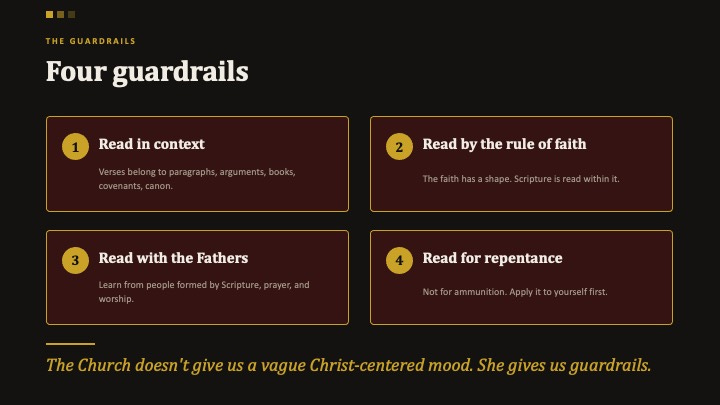
When I finally looked at it honestly, I found something I didn’t expect. Christ-centered reading isn’t looser than modern reading. It’s stricter. The Church doesn’t give us a vague Christ-centered mood. She gives us guardrails. Four of them, and each one bites.
The first is context. A verse belongs to a sentence, a paragraph, a literary unit, a book, a covenant setting, and finally the canon as a whole. Ordinary but decisive questions: who is speaking, to whom, in what kind of text, and for what purpose? Orthodoxy isn’t against the literal or historical sense. It refuses to stop there. A surprising amount of theological nonsense begins when someone falls in love with half a verse.
The second is the rule of faith. Christianity isn’t reinvented every Tuesday by whoever happened to be unusually caffeinated during morning devotions. The faith has a shape: Trinity, the true divinity and true humanity of Christ, Incarnation, Cross, Resurrection, the Church, the sacraments, the judgment to come. St. Vincent of Lérins warned against interpretive vanity: “We hold that faith which has been believed everywhere, always, by all.” Sometimes the “fresh new reading” is just the old mistake with better branding.
The third is the Fathers. They’re not there to make the slide look Orthodox. They’re witnesses to how the Church learned to hear Scripture—in doctrine, worship, and pastoral life. And they’re not a monolith. Alexandria (Origen, Cyril, Gregory of Nyssa) pressed spiritual and allegorical depth. Antioch (Diodore, Theodore, Chrysostom) leaned harder on the literal-historical sense, and on theoria. The Orthodox synthesis flattens neither and canonizes chaos in neither direction. The choice was never between dead literalism and baptized imagination run amok.
The Fathers had more tools than we do, and used them with less worry about it all. The fourfold sense—literal (what it says), allegorical (what it says about Christ), moral (what it asks of you), anagogical (where it’s all going)—they used all four without apology. Home base is the Liturgy. You meet Scripture on your feet, in worship, long before you meet it at a desk.
Chrysostom gave us a word for what Scripture does when it says God “walks” in the garden or “repents”: synkatabasis. Divine condescension. God speaking according to our weakness. He’s not trapped by our language. He mercifully enters it. This protects against two opposite errors—crude literalism on one side, embarrassed dismissal on the other. Scripture stoops. God is not confined by our words. He enters them.
The fourth is repentance. It is possible to know enough Bible to become unbearable. History has demonstrated this repeatedly. Chrysostom insisted Scripture belongs in the household—in the actual wounds and temptations of ordinary believers, not in the hands of specialists only. The point is to become less blind about yourself. Before your spouse, your enemies, the bishop, or the internet.
Using Scripture as ammunition is not the way it should be used. Scripture is medicine.
The Old Testament Is Already Lit
Two ways to read the Old Testament. One says it’s a Jewish preface. Then Jesus arrives and the real book finally begins. The other says the same Christ who is incarnate in the New Testament is promised, prefigured, active, and often manifest already in the Old.
Same Scriptures. Different center. Different result.
The Fathers read theophanies christologically. The burning bush. Jacob at Peniel. The Angel of the Lord. Isaiah’s vision in the temple. If the Father is unseen—who is it that appears? The Son, the eternal Logos, the image of the invisible God. My professor Father Bogdan Bucur has shown this was no decorative patristic poetry but a real and widespread early Christian habit of reading.
The Old Testament is already lit from within by the Son.
Typology—Adam and Christ, Passover and the Cross, Exodus and baptism, Manna and Eucharist, Jonah and resurrection—preserves both history and fulfillment. It keeps the Bible one drama instead of a stack of disconnected religious episodes. Saint Paul says it plainly, and the word is right there: “Now all these things happened unto them for ensamples [τύποι]: and they are written for our admonition” (1 Corinthians 10:11).
Typology is not baptized imagination with a cape.
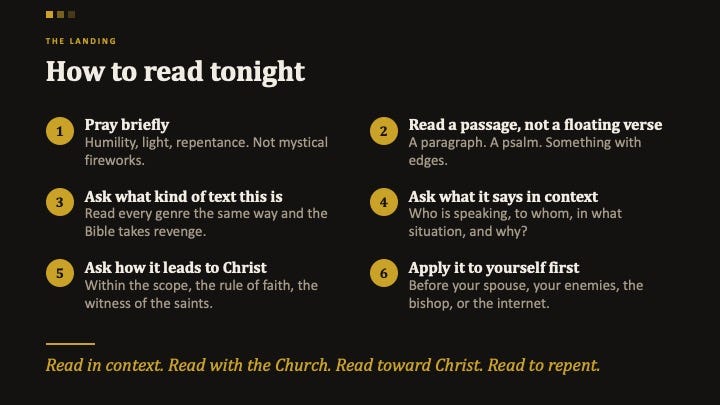
How to Read Tonight
You don’t need to be a specialist. You need humility and the Church.
Pray briefly. Humility, light, repentance. We aren’t looking for mystical fireworks here. Read a passage, not a floating verse—something with edges. A paragraph. A psalm. Ask what kind of text it is, because read every genre the same way and the Bible takes its revenge. Ask what it says in context: who is speaking, to whom, in what situation, and why. Ask how it leads to Christ, within the scope, the rule of faith, the witness of the saints. Apply it to yourself first.
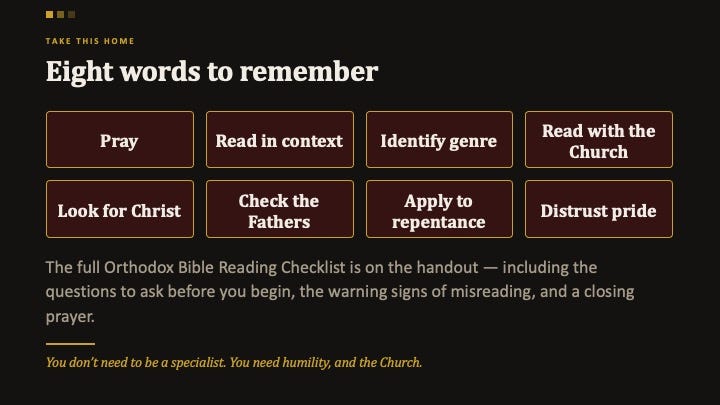
Eight words to take home: pray, read in context, identify genre, read with the Church, look for Christ, check the Fathers, apply to repentance, distrust pride.
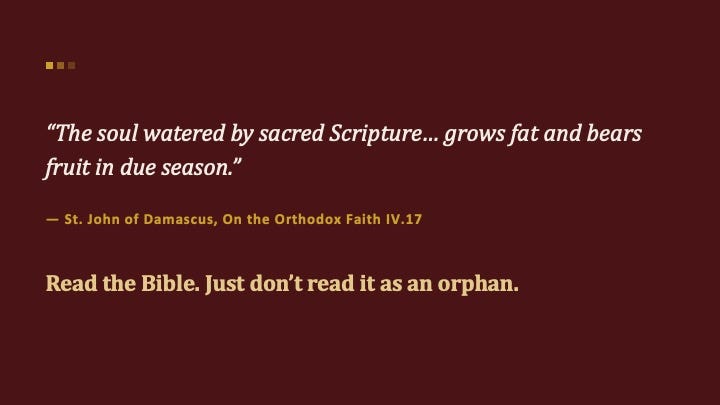
Saint John of Damascus said the soul watered by sacred Scripture grows fat and bears fruit in due season.
Two disciples on a road. A stranger. Moses and the Prophets. Bread broken. Eyes opened.
Read the Bible. Just don’t read it as an orphan; read it as a son or daughter of the Church.
For more:

Last week I attended Bible Study via Zoom. This week in person. It was this week that I actually 'heard' what Father was teaching. I am nothing without the Church! Thank you for this article, Jamey!