


Today’s post is available on audio, too! Tune in or download below:
To borrow an opening line from the rock band Foo Fighters, I have another confession to make—and I have never felt more fiercely righteous than when I was absolutely certain someone else was ruining the Church.
It is an intoxicating feeling, being “right” when everyone else is so wrong. You look around at the state of your parish, or your Orthodox administrative jurisdiction (or someone else’s jurisdiction—i.e., GOA, OCA, ROCOR, etc.), or the latest theological trainwreck unfolding in the Orthodox corners of the internet, and a hot, clean zeal washes over you. You know exactly what needs to be fixed. You know exactly who the problem is. And you know, with the unshakeable confidence of a crusader, that if people would just listen to you, the Bride of Christ would finally be pristine again.
It is also, almost without exception, a complete spiritual delusion.
On Friday, His Eminence Metropolitan Saba of the Antiochian Archdiocese published a piece that stopped many of us dead in our tracks. It wasn’t a standard encyclical or a theological treatise. It was a prayer—a raw, honest, public confession written directly to Christ. In it, he named the exact temptation that plagues anyone who cares deeply about the Church, from the newest convert on YouTube to the bishops in their cathedrals: the terrifying ease with which we confuse our own ego with zeal for God’s house.
So, today I want to go through the Metropolitan’s prayer, “Lord, Do Not Discipline Us Harshly.” We are going to look at the messiness of the Church, the strange geometry of Christ’s life, and why the most dangerous thing you can do is try to “fix” the Body of Christ.
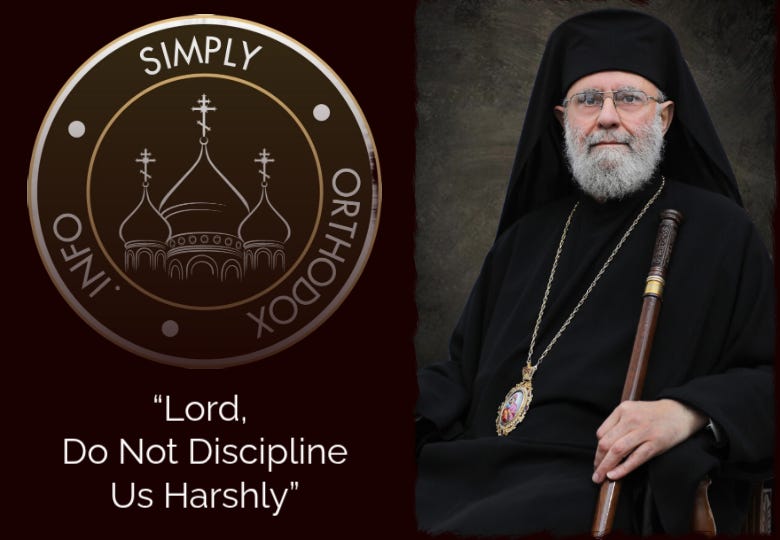
My Lord,
Perhaps one of the most difficult things in Your Gospel is that You allowed the wheat to grow together with the tares until the final judgment. In doing so, You taught us that Your Church on earth is not a gathering of saints as much as it is a community of strugglers seeking holiness.
Some may attain it; others may glimpse it only from afar; and many may not see it at all.
You willed Your Church to be a community of seekers of the truth—and the Truth is You, and in You it is revealed. Yet we still wonder why the Church is persecuted and in conflict until the end of time.
In our disputes and zealotry—which we mistakenly attribute to You—we imagine that we are defending You and defending Your Body stretched out across the earth.
But the truth is: we belong to this and that of your servants more we belong actually to You.
You also taught us that holiness is not given except to those who truly seek it on the narrow path.
Thus, we learned that we must be strict with ourselves, not others, and that we must demand truth and uprightness from ourselves before anything else.
Then You offered Your life so that truth, purity, and self-sacrifice might hold the highest place in Your creation. Your sacrifice became the true expression of Your pure words.
And because You humbled Yourself and made Your life consistent with Your word, Your whole life was a descent.
You ascended only twice.
The first time was so that the multitudes might hear Your teaching, when You went up the mountain to give them the new law.
The second time was upon the Cross. On the hill of Golgotha, You allowed Yourself to be lifted up as a martyr, embracing the world with Your outstretched arms.
Yet even this elevation was the summit of Your descent, for it led You to the tomb in an earthly cave.
And through this utmost descent You rose again and burst forth with life—the life of which You spoke in the Gospel, saying that You came to give it to us, and to give it to us abundantly.
But we often act contrary to you.
We love display and self-exaltation. We prefer that people see us as leaders rather than as servants and fathers.
We want followers, even if we lead them to destruction.
Because we are small within, we seek to become great—not through You, but through them—so that we may feel effective, influential, and important.
If Your children, out of love for us, see only our outward appearance, what excuse do we have, when we ourselves know who we are and are aware of the baseness, weakness, and impurity that dwell within us?
Teach us, Lord, how to descend so that You may raise us up.
Guide us to understand the true exaltation that befits Your people and Your servants.
Is it not enough for us to remain at Your feet?
Is not the whole fulfillment in listening to You, as Mary did when she received the good portion that shall not be taken away from her?
In the intoxication of our self-importance and ego, we often forget You, my Lord, and replace You with our followers.
We become preoccupied with the devil dwelling within us, following his whispers so we no longer see You or hear You. Thus, vainglory leads us to do what we perceive is right—when in truth it is our own sins.
And so, Lord, we no longer know how to distinguish between our passions and our zeal for Your house.
Do not allow turmoil, Lord, to drive us to act contrary to Your Gospel.
Have mercy on us and on our hardness of heart. Pour out upon us much more of Your abundant mercy.
You have entrusted us with a fearful responsibility, for You have chosen to place Your Holy Spirit in us—vulnerable vessels so easily broken.
How can we keep our vessels intact while slipping is so easy, and the illusion that we are Your chosen agents to correct Your Church and the world is so enticing?
Lord, how many times have we been tempted to act against Your Gospel in order to serve Your Church “better”?
How often have we violated Your Gospel when we sanctified the means for the sake of the end?
And how often have we betrayed You when we set You aside and used You as a tool for our own interests and desires?
Teach us, Lord, that we are not greater than You, for no servant is greater than his master.
Help us to accept Your example—the example of the one who is the persecuted, not the persecutor.
Direct our steps so that You may be our first love.
Grant that we may listen to You more than we speak about You, so that we may rightly discern between Your will and our passions.
My Lord, throughout history You have taught us that You permit both external and internal persecution when we stray from the truth and depart from the straight path.
Do not discipline us harshly, Lord, for we can scarcely endure it.
Preserve among us a remnant that bears witness to You—to the fullness of life You desired for us, and to the joy that Your angels proclaimed when You honored our earth when You visited us.
People are weary of Your Church because of us, O Lord. Forgive us and guide us onto the straight path.
It is You who we desire, Lord. Do not let us become distracted from You by that which belongs to You.
Setting Up the “Agricultural” Problem
Most Orthodox Christians want a pure Church.
This is not a new problem. In the fourth century, a group of hardline Christians in North Africa looked around at their bishops and priests. Some of those clergy had caved under Roman persecution, handing over holy things to save their own skins. When the persecution ended, these lapsed priests wanted to return. The hardliners—who became known as the Donatists—said absolutely not. They demanded a pure Church, stripped of the compromised, the weak, and the cowardly. For the Donatists, these people weren’t invited to the party.
The Orthodox, Catholic response—championed most famously by Saint Augustine—was far more messy. The Church, they argued, is a hospital for sinners, not a museum for saints.
Metropolitan Saba addresses this directly in his prayer, pointing straight back to Christ’s parable of the wheat and the tares. “Perhaps one of the most difficult things in Your Gospel,” he writes, “is that You allowed the wheat to grow together with the tares until the final judgment.”
He gives a beautiful definition of what we are actually doing here:
You taught us that Your Church on earth is not a gathering of saints as much as it is a community of strugglers seeking holiness. Some may attain it; others may glimpse it only from afar; and many may not see it at all.
The human tendency is to hate this. We want to pull the weeds, and we’re pretty sure the other guys are the weeds. We may be tempted to draw sharp lines between the “True Believers” and the “Compromised.” But the tension of the Gospel is that Christ actually tells us to knock it off with the weed-pulling (Matthew 13:24-30)—primarily because our spiritual eyesight is so warped by pride that we are almost guaranteed to uproot the wheat while protecting our own favorite tares.
Or, more frighteningly, and I already hinted at this: we might realize that we are the tares.
“Thus, we learned,” His Eminence concludes, “that we must be strict with ourselves, not others, and that we must demand truth and uprightness from ourselves before anything else.”
The Two Ascents of Christ
If the first temptation is to purge the Church, the second is to climb to the top of it.
Here, Metropolitan Saba makes a profound observation about the physical trajectory of the Incarnation. Our culture is obsessed with upward mobility. We want platforms. We count clicks, subscribers, followers, and comments. Enter YouTube, and the newly zealous want to be seen as leaders, defenders of the faith, important voices.
But Christ’s life moved in the exact opposite direction. His entire existence was an act of kenosis—a Greek word meaning self-emptying. God becomes a fetus. The Creator of the cosmos learns to walk in the dust of first-century Palestine. He famously rode into Jerusalem on a donkey, and yet was greeted by the masses as a King and Royal Victor.
“Your whole life was a descent,” Metropolitan Saba writes. And then he points out an astonishing detail: “You ascended only twice.”
The first time Christ goes up is to the mountain, so the multitudes can hear the new law (Matthew 5). The second time is upon the Cross: “On the hill of Golgotha, You allowed Yourself to be lifted up as a martyr, embracing the world with Your outstretched arms.”
Even when Christ goes “up,” it is actually the summit of His descent. He ascends the mountain to serve the crowds. He ascends the cross to die for them.
Contrast this with how we operate. “Because we are small within,” the Metropolitan confesses on our behalf, “we seek to become great—not through You, but through them [our followers]—so that we may feel effective, influential, and important.”
We use the things of God to build monuments to ourselves. We gather followers, readers, and allies under the banner of “defending” or promoting Orthodoxy, but the engine driving the train is often just our own desperate need to matter.
We are like the disciples arguing over who is going to be the greatest in the Kingdom; meanwhile, Christ is prepping a bowl of water to wash the feet of the disciples.
Sanctifying the Means
All this presents an amusing—or rather, tragic—conundrum. What happens when we convince ourselves we are fighting a holy war for the Church? And what if we are really being driven by ego?
“How often,” the Metropolitan asks, “have we violated Your Gospel when we sanctified the means for the sake of the end?”
When you believe that the survival or purity of the Church depends entirely on you winning an argument, securing a parish council vote, or “destroying” an opponent online, you will justify almost any behavior. Snark, slander, political maneuvering, gossip, personal attacks—it all gets baptized as “zeal” or is justified “because he brought so many to the Church.”
But the Metropolitan pierces right through this delusion:
In the intoxication of our self-importance and ego, we often forget You, my Lord, and replace You with our followers. We become preoccupied with the devil dwelling within us, following his whispers so we no longer see You or hear You. Thus, vainglory leads us to do what we perceive is right—when in truth it is our own sins.
Read that line again. Vainglory leads us to do what we perceive is right.
The most terrifying moment in the spiritual life is not when you are tempted to do something obviously evil. It is when the demons convince you to do something “holy” using the methods of Hell.
We set Christ aside, the Metropolitan says, and “use [Him] as a tool for our own interests and desires.”
The Weariness of the World
If we stay on this path of arrogant, self-appointed crusading, the results are inevitable. As is usually the case, history shows us exactly what happens, even when new technologies give platform to our sins.
When we become swollen with in our own self-importance, and when the broader Church begins to forget the strange geometry of downward mobility, God prunes us. He permits external hardship or internal fracture to break the pride of His people. He lets the structures collapse so we will hear the message and we can remember how to pray.
This leads to the most sigh-inducing line in the entire piece:
People are weary of Your Church because of us, O Lord. Forgive us and guide us onto the straight path... Do not discipline us harshly, Lord, for we can scarcely endure it.
If you have spent any time trying to evangelize, you know how true this can be. People are rarely kept away from Orthodox Christianity by the doctrine of the Trinity or the complexity of the Divine Liturgy. They are kept away by us. They see our infighting. They see our arrogance. They see leaders and laymen who demand to be served rather than to serve. They see people who claim to eat the Body of the crucified God, but who refuse to crucify their own egos. The see a prideful bunch who fill X with posts about being right, and everyone else is just stupid, wrong, and probably dishonest.
Is it any surprise that some are weary of us? And we are, if we are honest, frequently weary of ourselves.
“The most terrifying moment in the spiritual life is not when you are tempted to do something obviously evil. It is when the demons convince you to do something ‘holy’ using the methods of Hell.” - Jamey Bennett
The Good Portion
So how do we fix it? How do we stop being the obstacle? The answer is unexciting to the human ego: you stop trying to “fix” the Church, and you sit down.
“Is it not enough for us to remain at Your feet?” Metropolitan Saba asks. “Is not the whole fulfillment in listening to You, as Mary did when she received the good portion that shall not be taken away from her?”
This is where the Metropolitan reframes it for us. The next time you feel that hot flush of righteous indignation—the next time you are absolutely certain that you need to step in and correct someone, or launch a theological offensive, or save the parish from itself—pause.
Look at your own hands: Are they reaching for a towel to wash feet, or are they reaching for a crown?
The Church doesn’t need more saviors. It already has one. What it needs is a committed bunch of men and women who are willing to take the downward path. It needs people who are more concerned with their own repentance than their neighbor’s theology and morals.
“Direct our steps so that You may be our first love,” the Metropolitan prays. “Grant that we may listen to You more than we speak about You.”
May it be so. Because when we finally stop trying to ascend, we might just bump into the God who is already waiting for us at the bottom.
Beautifully written. I hadn't seen this prayer before, thanks for highlighting and unpacking it.
My ego sadly makes it possible for me to distinguish who is the wheat and who is the tares in others but hides this X-ray vision when looking inward. Thank you for this post, it totally hits home…