


Listen to this article:
When my wife and I brought our newborn baby girl home from the hospital earlier this year, we did not immediately strap her into a highchair, set a plate of roast chicken in front of her, and announce, “I will feed you once you can explain the value of protein and the mechanics of digestion.” We actually just fed her.
We feed her milk so that she can survive. We feed her so she can grow. We feed her because she is already part of the family, and families share life together at the table.
But in the modern West, we have adopted a very different approach when it comes to the table of the Lord. Across the Roman Catholic and Protestant traditions, there is a generally held assumption that religion is largely a mental exercise. Faith risks being reduced to understanding data and giving an intellectual assent. Because of these assumptions, we delay communion until a child reaches a somewhat arbitrary “age of reason,” which varies from group to group.
We end up turning a holy meal into a math problem.
I grew up in a nondenominational evangelical Church with baptistic and dispensational emphases, and we definitely didn’t commune the little kids. But when I started running with Reformed and Presbyterian folks (and even Lutherans), I was forced to face the question of infant baptism, and by implication, infant communion (also known as paedocommunion).
I studied the issue closely, and by the time I joined an Anglican Church, I was already convinced that children belonged at the altar. And significantly, my Anglican parish functionally practiced paedocommunion. If the parents had approached the chalice with a baptized toddler, and he or she looked at the priest and offered a hearty “goo goo ga ga” unto the Lord, we basically accepted that as a credible profession of faith and gave them the Eucharist.
While it was a beautiful pastoral instinct, it was also a workaround; not really something from within the tradition of Anglicanism.
We were trying to hack a modern Protestant framework—to do an ancient Catholic thing in Anglo-Catholic vestments. It wasn’t until I really looked long and hard Eastward that I realized I didn’t need a workaround. The Orthodox Church is the only game in town that has been communing infants since the early Church—without interruption, and without apology.
There is no theological pop quiz at the chalice for the baptized. As I say over and over on this site and in our in-person classes, God’s saving actions are a rescue mission.
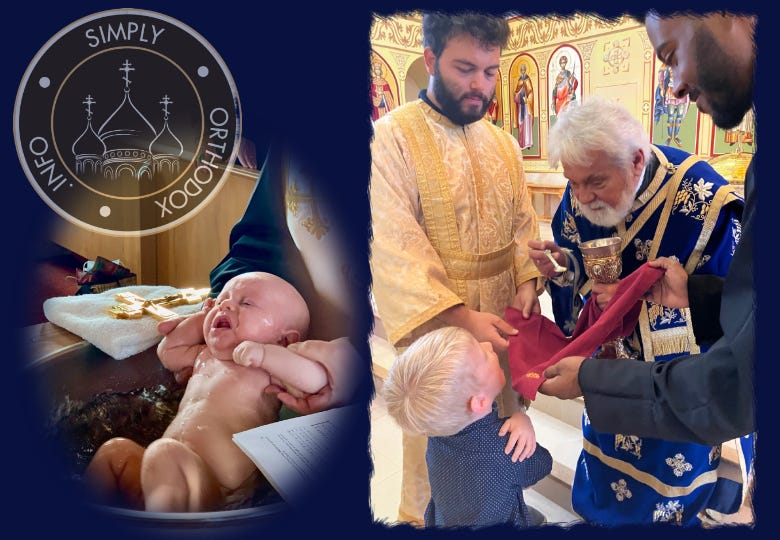
The Burial and the Promise
To understand why a baby needs the Eucharist, you have to understand what happens to a baby in the font of baptism.
We do not baptize children because they understand theology. We baptize them because they, like us, are trapped in the domain of death. In Romans 6, Paul does not describe baptism as a public declaration of a private intellectual ah-ha moment. He describes baptism as a grave: we are buried with Christ into death in order that we might walk in newness of life (Romans 6:4).
You certainly do not need a PhD to die, and you do not need one to be resurrected.
When the Apostle Peter preaches at Pentecost in Acts 2, he declares that the promise of the Holy Spirit is “for you and for your children.” This wasn’t a new concept at all. It was the age-old structure of the covenant. In Colossians 2:11ff., Paul explicitly links the waters of baptism to the Old Testament practice of circumcision—and goes so far as to see it as a triumph over death and wicked authorities:
In him also you were circumcised with a circumcision made without hands, by putting off the body of the flesh, by the circumcision of Christ, 12 having been buried with him in baptism, in which you were also raised with him through faith in the powerful working of God, who raised him from the dead. 13 And you, who were dead in your trespasses and the uncircumcision of your flesh, God made alive together with him, having forgiven us all our trespasses, 14 by canceling the record of debt that stood against us with its legal demands. This he set aside, nailing it to the cross. 15 He disarmed the rulers and authorities and put them to open shame, by triumphing over them in him.
Under the Old Covenant, male infants were circumcised on the eighth day. They were marked as members of the covenant before they could speak a single word, before they could make a choice, and before they could articulate the meaning of the Covenant. And when the time came for the defining meal of that covenant—the Passover—the children were not sent out of the room. They ate the lamb with the family. And the blood on the doorpost was a shield and protector for the whole house, while the meat on the table fed the whole family.
If the Old Covenant, which was merely a shadow, included infants in its initiating signs and its saving meals, it is unthinkable that the New Covenant—which is built on better promises—would suddenly cast them into the outer darkness until they could pass a Sunday School exam.
The Invention of the Age of Reason
So, how did the West lose this? It wasn’t the result of a sudden flourish of biblical exegesis. Believe it or not, it was a medieval spilling hazard, and a curiosity of regional differences in practice.
First, in the West, Chrismation was performed by the bishop, whereas in the east Presbyters could perform the sacrament. This led to a gradual separation of the two rites in time, and since bishops’ visits are infrequent, kids were being chrismated older and older.
In addition, in the Middle Ages, the Latin Church became terrified of spilling the consecrated wine. Out of an understandable desire to protect the holy mysteries, they began withholding the chalice from the laity entirely, offering only the bread.
This created a stark, practical problem: a six-month-old cannot chew and swallow a dry wafer—and chances are that six-month-old was still waiting for the bishop to come and chrismate. So, by sheer logistical necessity, babies stopped receiving.
As time went on, theologians looked around and realized their children were no longer communing. Instead of fixing the practice, they retrofitted their theology to justify the accident. The Council of Trent formally declared that little children do not need the Eucharist because they have not attained the “use of reason.”
They turned a logistical accident into a standard practice of Western Christianity.
But the Orthodox Church never withdrew the chalice from the children; and we have been using the spoon for about as long back as we can remember. Because of that, our theology of the child remained intact. We leaned on the reality of what the sacraments actually do.
If baptism is the rescue from death, Chrismation is the personal Pentecost. We don’t just wash our babies—we anoint them for battle. The Holy Spirit gives to each person their unique, unrepeatable distinctness, and makes them into a full communicant member of the deified humanity of Christ.
They are in the Body and they need the Blood.
Discerning the “Loafness”
There is a fairly common objection at this point, and it usually comes with a furrowed brow and a Bible opened to 1 Corinthians 11.
Paul writes that whoever eats the bread or drinks the cup of the Lord in an unworthy manner will be guilty of sinning against the Body and Blood of the Lord. He commands a person to examine himself before eating, lest he eat and drink judgment on himself by “not discerning the Body.”
I get the fear here—I really do. The Eucharist is a consuming fire. Taking it lightly is dangerous, and if you read Saint Paul’s warning as a demand for intense intellectual self-auditing, it makes perfect sense to keep the elements away from a toddler who can’t even examine their own shoes.
But look at the context. Paul was not writing to toddlers.
Paul was writing to adult Christians in Corinth who were getting drunk at the Lord’s supper (1 Corinthians 11). They were feasting and hoarding the food before the poor (which included slaves who had become Christians) could even arrive from their shifts.
When Paul tells them they are failing to “discern the body” (vv. 27-32) he is not talking about the ontology of bread turned to flesh. He is talking about the unity of the Church. He is talking about the “loafness” of the community. Because there is one loaf, we, who are many, are one body. The Corinthians were eating and drinking judgment upon themselves because they were fracturing the Body of Christ through their pride and gluttony.
Saint Paul’s solution to adults abusing the poor was not inventing a cognitive baseline that bars infants from the Lord’s Table.
The Medicine of Immortality
We have to get this right, because the stakes are definitely higher than a mere theological debate.
If salvation and grace require an “age of reason,” then the Gospel is disastrous news for the vulnerable.
If you have to understand the mechanics of grace to receive it, what happens to the severely mentally disabled?
What happens to the grandfather whose mind has been slowly hollowed out by the advancement of Alzheimer’s disease?
If communion is a reward for cognitive coherence, the vulnerable are left to starve at the very moment they need the medicine of immortality the most.
But Christ unites Himself to our human nature, from the womb to the tomb.
In Mark 10, when the disciples tried to act as bouncers to kidlets, Jesus rebuked them. He did not say, “Let the little children come to me, provided they can pass a theological exam.”
He authoritatively said the kingdom belongs to them.
When you approach the chalice in an Orthodox parish, the priest doesn’t ask for your academic credentials. He holds the golden spoon, he calls you by your baptismal name, and he feeds you the life of the world. He didn’t ask for your intellect. He just asked for you.
You don’t need a PhD to receive God. You just need to be united to Christ and then open your mouth.
I grew up in a Methodist church until I was around 11 and while it did practice infant baptism, communion was a no-no until you were 10 for the whole 'age of reason' thing. Well, not-yet-10 me (I was at most 8 years old) might not have known theology, but I *did* know that I was a Christian and that Christians took communion and yet I wasn't allowed. So I did a work-around: at Sunday School before Church you got candy if you answered a question correctly. Smarty-pants me decided to always answer a question and so I would get to chose my candy and I always chose Sweet-tarts if I could. Then, during communion at Church, I would save a blue candy and a purple candy and take each one while the adults around me took communion.
I love seeing babies commune at my parish. Yes there are sometimes spitups, but there are practical fixes for that just like there are fixes for accidental spills that can happen even to adults. And even if they don't know the meaning, those little kids know that communion is important.
That is to say, thank you for the defense of infant communion and the explanation as to why I wasn't allowed it until I was 10.
Lumping us Catholics in with the prots is just low.