


No one ever schedules a crisis.
It comes in the phone call that wakes you at 2 a.m., in the doctor’s hand on your shoulder, in the tiny hospital bracelet around a baby’s wrist, in the empty chair at the dinner table that used to be filled. One moment you’re managing life; the next, you’re staring at a world that doesn’t make sense anymore.
And somewhere in the middle of that shock a very old question forces its way to the surface: Where is God when it hurts?
You can find that question in Job sitting in the ashes, in the Psalms of lament, even on the lips of Jesus on the Cross. It isn’t new. But when it’s your diagnosis, your child, your loss, it stops feeling like a topic for books and becomes something much more raw—a kind of wordless howl at the center of your chest.
Evangelical Christian writer Philip Yancey has done important work helping many people wrestle with that question in his book Where is God When it Hurts? A Comforting, Healing Guide for Coping with Hard Times. I’m grateful for that. But in this piece I want to approach the same cry from within the Orthodox Church’s way of seeing: her conviction that evil is parasitic and without true being, that God is never the author of it, and that the God who seems absent in our suffering has in fact descended into it—all the way down.
In this post, I don’t want to give you a color‑coded theology of suffering or a tidy list of verses to tape on the fridge. What follows is offered not as a final word, but as an Orthodox companion on the road—a way of thinking and praying that has been tested in hospital rooms and at gravesides and in back pews where the tears finally spill over, and that dares to say: God is not watching your hurt from far away—He has gone into it Himself.
First, You’re Allowed to Ask This
If you grew up with a tidy religious script, you may have absorbed the idea that real faith doesn’t ask why. That to question, or to cry out, is to doubt.
But the first thing I want you to see is that God has already put your question into His own book.
The Psalms are full of it:
“How long, O Lord? Will you forget me forever?” (Psalm 12/13:1)
“Why do You stand afar off, O Lord? Why do You hide Yourself in times of trouble?” (Psalm 9/10:1)
“My God, my God, why have You forsaken me?” (Psalm 21/22:1)
Those words are not a failure of faith; they are what faith sounds like when it is wounded. And the Church gives us those words to pray. We don’t have to invent our own “where are You?” God hands us His own language of lament and tells us to use it.
So when you ask, “Where is God when it hurts?” you are not stepping outside the life of faith. You are stepping directly into the middle of it. Orthodoxy doesn’t try to slap a smiley‑face sticker over your grief. We bring that grief into prayer, even when the prayer is closer to a groan.
God Is Not Watching From a Distance
A lot of the bad answers to suffering start with a hidden assumption: that God is basically far away, occasionally intervening. He’s up there; we’re down here; sometimes He reaches in.
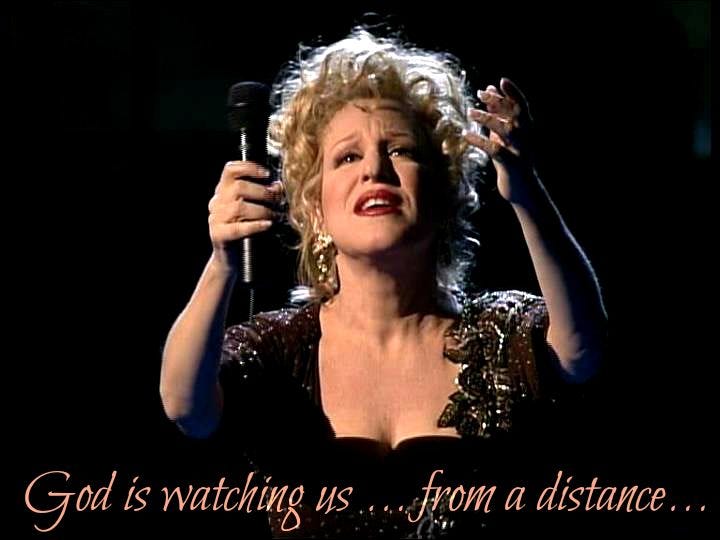
God is watching us, God is watching us
God is watching us from a distance
-Bette Midler
But in the Orthodox vision, God is never “over there” watching the tragedy unfold like a spectator “from a distance.” Saint Paul tells us, “In Him we live and move and have our being” (Acts 17:28). God is, as we pray in almost every service, “everywhere present and filling all things.”
That does not mean everything that happens is His will—he did not decree your suffering like some calloused emperor watching condemned people go to their death in the coliseum. It does mean there is no place your pain can go that is outside His presence. Even Hell is not really “God‑forsaken”; rather, it is where God’s very real and true love is rejected. This is why the Psalmist can say, “If I make my bed in Hades, You are there” (Psalm 138/139:8).
When it hurts, you may feel like God is absent. Orthodoxy is clear: your feelings are real, but they are not the final word on what is Real.
Christ went down into the grave, into Hades itself. He has stooped lower than your worst night. He is not waiting for you on the other side of the dark; He is in the dark with you.
What Evil Is—and Isn’t
Here is where the Fathers help us name something that’s usually only felt.
When you stand at a graveside, or in an ICU, or with your eye on the phone waiting for bad news, evil feels like a solid wall. It feels like a thing slamming into you.
But the Orthodox Church insists on something strange and freeing: evil is not a “thing” in the way goodness is. It has no real being of its own.
It is a distortion of what God made, a parasite feeding on good, a hole torn in reality rather than a substance God manufactured.
God creates being; He creates life, light, goodness, beauty. Sin, death, and pain are what happens when that goodness is twisted, when that life is wounded, when that light is refused. Think of rust on iron, rot in wood, illness in a body. Rust is not a new, positive creation; it is iron corrupted. In the same way, death is not a created “thing” God sends. It is the ripping apart of what God joined together.
That distinction won’t make your tears stop, but it does matter. It means:
God is never the positive author of evil.
God is not secretly hiding behind the bullet, the cancer cell, or the drunk driver.
God is always, by His very nature, on the side of being, healing, and restoration, not on the side of the tear in the fabric.
When you rage against what has happened—“This should not be”—you are not fighting God’s will. You are agreeing with Him. Death really, truly is an enemy (1 Corinthians 15:26). We are supposed to hate death’s stinking breath; we are supposed to be at enmity with the serpent and his love of death.
Your horror at it is not a lack of faith; it echoes God’s own verdict lodged in your heart.
God Isn’t Behind the Bullet or the Tumor
There is a cheap way to protect God’s power that ends up wounding people: “Everything happens for a reason,” we say, meaning, God chose this for you. God sent this cancer. God took your child. If we want to be faithful to the Orthodox Christian faith, I think we should not talk this way.
We confess in every Divine Liturgy that God is “the lover of mankind.” The One who took on flesh, healed the sick, wept at the tomb of His friend Lazarus (John 11:35), and went to His own unjust death on a cross. He is not the secret author of evil, nor did He sign a deal with the devil for your downfall. Death, that last enemy, is not His tool; it’s what He came to overthrow.
So where does the hurt come from?
From a broken world: creation itself is “groaning” (Romans 8:22). Bodies fail. Cells misfire. Accidents happen. The fabric that is the goodness of creation has been torn, and we all feel the draft.
From human sin: our freedom to love also means a real freedom to harm. Drunk drivers, abusers, negligent doctors, indifferent systems—none of that is God’s will. Rather, these are the suffering that God enters into with us.
From the mystery of spiritual warfare: there are forces that hate the image of God in you. Orthodoxy takes that seriously without reducing everything to demons under the bed.
None of this makes your pain smaller. It does something else: it moves God to your side of the equation. God is not the One throwing the punches. He is the One with you in the ring, working—even in the midst of parasitic, senseless evil—to bring healing, repentance, and resurrection.
When Shadrach, Meshach, and Abednego where thrown into the fiery furnace in anticipation of certain death, there was a fourth Man with them, and they were saved—we too can hope for such a Presence when we call out to God for mercy.
The Cross Is God’s Answer, Not God’s Excuse
Sometimes Christians rush to the resurrection so fast we never really stand at the Cross. But if you want to know where God is when it hurts, the Cross is the one place you must not skip.
On the Cross, the Son of God cries out in the words of the Psalm: “My God, My God, why have You forsaken Me?” (Psalm 21/22:1; Matthew 27:46). The Fathers are clear: Christ is not having a crisis of faith. He is taking into Himself our feelings of rejection, our humiliation by death, our feelings of God‑forsakenness into Himself. There is no human question about suffering that He did not make His own.
The Cross does not give us a neat explanation. It gives us a companion.
God does not explain our pain from a safe distance; He enters it.
He is spat on, abandoned by friends, tortured, humiliated, and killed. The answer Orthodoxy gives to the problem of suffering has a crucified face.
And remember what we said about evil: it has no true being; it is a distortion. On the Cross, Christ lets that distortion do its worst. It tears at Him, rips life from His body, drags Him into death. And then He walks out of the tomb on the third day, carrying our humanity with Him, leaving the distortion behind like a broken shell. He conquers it, leaving it vanquished.
The resurrection is not God saying, “It wasn’t that bad.” It is God taking what was truly that bad and filling it with His life. Christ keeps His wounds; they do not keep Him.
Your wounds, too, are not annihilated in Christ; they are destined—however impossible it seems now—to be transfigured.
Where Is God? In the Church…With You
One of the quiet Orthodox answers to “Where is God?” is very simple: He is in His Body.
That’s not just a metaphor. When you are baptized, chrismated, and fed with His Body and Blood, you are joined to Christ in a way deeper than biology. “You are the body of Christ and individually members of it” (1 Corinthians 12:27). That means that when you hurt, the Body hurts.
And when the Body gathers around you in prayer, meals, childcare, hospital visits, and simply sitting in silence, Christ Himself is gathering around you.
This is why we make such a big deal of the services for the departed, of the Trisagion prayers at the grave, of the memorials at 40 days and beyond. The Church believes something real is happening there. We are not just “remembering” your loved one. We are standing with them before God, asking that their sins be forgiven, their wounds healed, their rest made bright.
And we are standing with you. Orthodoxy refuses to make suffering into a purely individual project. We bear one another’s burdens (Galatians 6:2), sometimes very clumsily, but really. If you are asking “Where is God?” and you are doing it alone, the Church’s answer is: come stand among us; let us hurt with you.
You Don’t Have to Make Sense of This Today
I wish I could give you a satisfying explanation. I can’t. The book of Job ends without one; God does not tell Job why he suffered. He shows Job Himself. He gives Job back more than he lost, but He never gives him a tidy answer.
That, too, is part of our Orthodox honesty. There are mysteries we do not solve, we only endure. The Scriptures do promise that “all things work together for good to those who love God” (Romans 8:28), but they do not ask you to see that good right now, from where you are sitting. Often we only glimpse the pattern by hindsight, and sometimes we will only see it clearly in the age to come.
In the meantime, here is what you are not required to do:
You are not required to call evil good.
You are not required to pretend you are “fine.”
You are not required to put on a brave religious face for God.
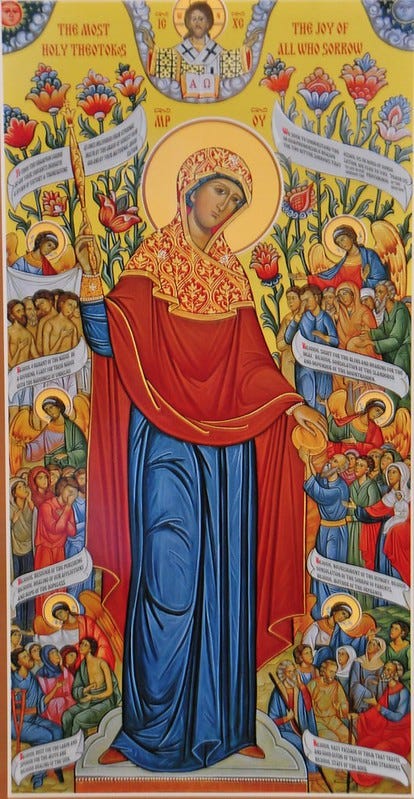
What you are invited to do is simpler and harder: to bring your raw, unedited self into prayer. It’s okay to not be okay—even “Lord I believe; help my unbelief!” is faith (Mark 9:24). To stand before an icon of Christ or the Theotokos and say, “This hurts, and I don’t understand, and I need You.”
A Final Word, From One Pilgrim to Another
If you are struggling with life right now, I am not writing this from a safe, untouchable place. I’ve had my own seasons of asking where God is when everything falls apart. I’ve watched people I love suffer in ways that still haunt me.
Orthodoxy did not solve that; it christened it. It gave me language, saints, services, and a crucified‑and‑risen Lord to cling to.
So if you find yourself staring at the ceiling tonight asking, “Where are You?” know this much: the very act of asking is already a kind of prayer. It is already a reaching out. And the God who has gone into death and out the other side knows how to find those who can barely lift their eyes.
He is not indifferent to your tears. He has collected every one of them. The evil that has touched you is real as a wound but thin as a shadow next to His being and His love. And even if you cannot yet see Him in the dark, the Church will stand with you there and keep saying His name until, little by little, the dawn begins to show.
Sitting here in tears. I needed to read this so badly. The Lord knows why. Thank you.
I’ll keep this for when it is needed. Thank you