


Listen to this article here:
It’s Bright Week now, but I can’t stop thinking about Pascha. I want to go back to Saturday night, to the greatest Vigil and Liturgy that comes only once a year.
The nave is entirely dark. It is 11:07 PM on Great and Holy Saturday, and the air inside the church is heavy. It is thick with the scent of spent beeswax, residual frankincense, and the undeniable, physical exhaustion of a parish that has been standing, kneeling, and chanting for a long season, and especially in the past week. The people in the pews are waiting in anticipation, eager for the Resurrection. The expectation and faith are palpable.
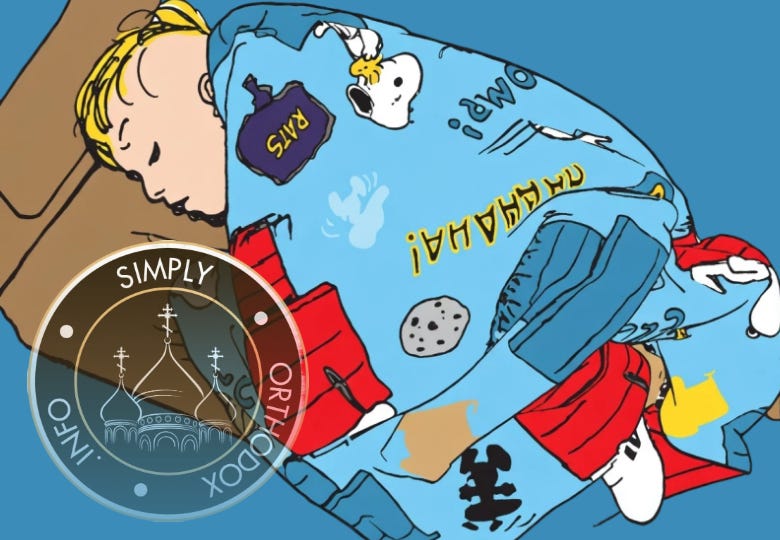
Beside me in the pew, completely oblivious to the cosmic threshold we are about to cross, my four-and-a-half-year-old son is totally sacked out. He is curled up tightly against the wooden pew, his head resting heavy as a rock on his beagle pillow, covered from the neck down in a Snoopy blanket. He is breathing the deep, rhythmic, unbothered breaths of a boy who could not possibly make it to midnight.
It is amusing to watch—and perfectly fitting. He is sleeping peacefully through the harrowing of Hades. He is participating in the Great Sabbath. Just as the Creator is currently resting in the tomb from His labor of saving the world, my son is resting in the pew.
The Orthodox tradition beautifully holds this in tension. As the Synaxarion of Holy Saturday proclaims:
On the Great and Holy Sabbath the Church celebrates the burial of the divine Body and the descent into Hades of our Lord and Savior Jesus Christ... This is the blessed Sabbath, this is the day of rest, on which the only-begotten Son of God rested from all His works.
As I look down at his tiny body, resting heavily in the darkness of the nave, I realize his physical exhaustion perfectly mirrors the spiritual reality of the rest of us. Holy Week is both a physical and spiritual grind. We do not arrive at the empty tomb pristine, polished, and piously full of energy. We usually arrive battered. We drag our mortality, our failures, and our sheer fatigue right up to the stone.
The raw, real world shows what this approach is really about. As my friend Steve Robinson notes in his essay “Stealing Paradise,” the Gospels are not populated by spiritual elites effortlessly ascending from glory to glory. The Kingdom of Heaven is routinely taken by the desperate. Robinson catalogs the dramatic interlopers: the bleeding woman crawling through the dirt of a crowded street just to touch a hem; the blind beggar screaming loud enough to annoy the religious gatekeepers.
He rightly includes the thief on the cross, who did his own Ocean’s Eleven heist when he stole his way into Paradise with his dying breath. God seems to look upon great desperation as great faith. Salvation, Robinson observes, is as simple and difficult as that.
But Robinson does not romanticize the unexpected, eleventh-hour conversions. He honors the quiet, ongoing “desperation” of ordinary faith. He points to the fifty-year, monotonous, repetitive slog of daily life—the mortgages, the relational friction, the temptations managed but never fully eliminated, the mid-life crises endured without surrender.
Whether you arrive at the tomb through a tragic, revelatory moment of the eleventh-hour desperation, or through decades of tedious, uninspiring faithfulness, the intention is what God honors. Both the flash-in-the-pan interloper and the guy who’s worked his whole life drag their exhaustion up to that stone, still hoping against hope the tomb is empty.
And what do we find inside our exhausted selves when we finally stop moving? Often, we find our own tombs.
Archimandrite Justin Pârvu, a Romanian confessor who survived years of communist imprisonment, offers insight on this dark interior reality. When asked how we can descend into our hearts when they feel full of passions, rot, and darkness, he flipped the script on us. The darkness is not a disqualification; it is the exact purpose of Christ’s descent.
“There is no depth that God has not reached,” Pârvu reminds us. He shone in the deepest, most terrible darkness of Hell itself. How much more, then, will He shine in the darkness of our hearts if we simply wait for Him?
The heart is a tomb. The more you look at your own heart unvarnished, you will find it is actually a terrifying space to inhabit. But our job is not to miraculously fix our own brokenness before the Feast—our job is to keep watch in the dark without despair.
Pârvu prescribes an important tool for this vigil of the soul: the Jesus Prayer. We sit in the dark, calling upon the Name, waiting for the King of Glory to melt our corruption with His warmth. We endure the spiritual Holy Saturday.
As we stand in the dark church, waiting for the light, human reason often hits a wall. The intensity of the services, combined with the rationalist conditioning of the modern world, can breed intense cognitive dissonance. Thomas del Vasto, reflecting on his own Holy Saturday struggles as a modern “Doubting Thomas,” admits that human intellect cannot neatly resolve the paradox of the God-Man lying dead in a grave.
When human reason fails at the boundary line of the tomb, we are left only with the desperate pivot of the Apostle Peter: “Lord, to whom shall we go? you have the words of eternal life” (John 6:68). This cognitive failure is not a modern, secular invention. It is embedded right there in the original Paschal morning.
The Resurrection does not produce an automatic, tidy, doubt-dissolving certainty for most of us. It is instead a shattering, terrifying reality that breaks all human paradigms. The Gospel of Mark tells us that the myrrh-bearing women did not leave the empty tomb with triumphant theology; they fled in trembling and astonishment, saying nothing to anyone out of sheer terror (Mark 16:8).
Even the remaining eleven disciples, standing on the mountain in Galilee with the Risen Lord standing right in front of them, experienced a similar dissonance. “When they saw him, they worshiped him; but some doubted” (Matthew 28:17). You cannot logic your way into the Resurrection. Reason may still fracture at the empty tomb.
The truth is that the historical event of the Resurrection is inaccessible to us. We can only experience the Resurrection mystically through the Liturgy, trusting the reality of “cosmic Agape”—a love so vast that it embraces us entirely as we are, trembling, afraid, and even if we are of two minds.
We hear the cosmic stakes chanted in the darkness during Matins (Triodion):
Hell trembled, O Savior, when he saw Thee, the Giver of life, despoiling him of his wealth and raising up the dead from every age.
Suddenly, the Royal Doors swing open in the darkness:
Come receive the light from the unwaning light, and glorify Christ, who has risen from the dead!
A single flame emerges from the sanctuary. It passes to the altar servers, then to the front pews, spreading backward until the entire nave is ablaze with candlelight. The heavy, dark grind of the fast is visibly broken by the light. The smell of melting wax replaces the stale air. We begin the shuffle for the procession, my son still dead to the world, his Snoopy blanket now illuminated by the flickering glow of hundreds of tapers.
Why does this light matter? How did the locks of Hades actually break? Turning to the Cappadocian Fathers, we can address the “mechanics” of our salvation.
St. Gregory the Theologian (Nazianzus) rightly corrects the false idea that Christ’s death was a transaction or a ransom paid to some all-powerful Devil. He calls the very idea an “outrage.” As he puts it:
To whom was that Blood offered that was shed for us, and why was it shed? ... If to the Evil One, fie upon the outrage! If the robber receives ransom, not only from God, but a ransom which consists of God Himself...
No, the Incarnation was not a payoff. It was a cosmic rescue mission initiated from the inside. Humanity had to be sanctified by the Humanity of God. But how did He trap the great tyrant?
His great friend, St. Gregory of Nyssa, answers this with a well-known analogy of the fishhook. The Divine Nature clothed itself in human flesh, using the fleshly, human body as bait. Death saw the broken, exhausted body of Jesus of Nazareth on the Cross and swallowed it eagerly, assuming it had claimed just another mortal victim.
“The Deity was hidden under the veil of our nature,” Saint Gregory of Nyssa explains, “that so, as with ravenous fish, the hook of the Deity might be gulped down along with the bait of flesh, and thus, life being introduced into the house of death, and light shining in darkness, that which is diametrically opposed to light and life might vanish.”
In swallowing the bait of His humanity, Hades choked on the hook of His Divinity. We needed an Incarnate God, put to death, that we might live. Christ blew death apart from the inside out, poisoning Hades with the unendurable presence of God.
Because of this supreme victory, Saint Gregory Nazianzus issues his sweeping, pastoral invitations to all of us holding our candles in the night:
If you are a Simon of Cyrene, take up the Cross and follow. If you are crucified with Him as a robber, acknowledge God as a penitent robber... enter with Jesus into Paradise, so that you may learn from what you have fallen. If you be a Mary, or another Mary, or a Salome, or a Joanna, weep in the early morning. Be first to see the stone taken away... If, like a Thomas, you were left out when the disciples were assembled to whom Christ shows Himself, when you do see Him be not faithless; and if you do not believe, then believe those who tell you; and if you cannot believe them either, then have confidence in the print of the nails.
Whatever your state, whatever your burden, the Incarnation was designed specifically to draw you into the life in Christ.
The procession reaches the doors of the church. The priest raises the cross into the air, and the first, explosive chant shatters the silence.
Christ is Risen from the dead, by death trampling down upon death, and to those in the tombs He has granted Life!
In most parishes, the doors are pounded open, symbolizing the shattering of the gates of brass, and then everyone floods back into a church now blazing with full light. The sorrow is gone. The grind is over. And here, the majestic, triumphant words of St. John Chrysostom’s Paschal Homily are woven through the chanting, calling forth our joy.
Chrysostom reminds us that the feast is prepared for everyone. The first and the last, the fasting and the non-fasting, the zealous and the slothful. The gritty reality of our personal failures is entirely swallowed by the majestic triumph of His mercy on all. He unleashes a roar against the gates of Hell:
Let no one fear death, for the Savior’s death has set us free. He that was held prisoner of it has annihilated it. By descending into Hell, He made Hell captive. He embittered it when it tasted of His flesh. And Isaiah, foretelling this, did cry: Hell, said he, was embittered, when it encountered Thee in the lower regions. It was embittered, for it was abolished. It was embittered, for it was mocked. It was embittered, for it was slain.
O death, where is your sting? O Hades, where is your victory?
The Divine Liturgy carries on into the early hours of the morning, a blur of incense, beautiful vestments, and chaotic, joyful Paschal greetings in multiple languages. By the time we receive the Eucharist and finally hear the dismissal, it is the wee hours of the morning. Through it all, my son has barely moved an inch. He is still out cold on his beagle pillow.
He missed the dramatic lighting of the candles. He missed the procession. He missed all the activity at the doors, the shouting, the bells, and even the triumphant homily.
It’s not lost on me that Christ’s Resurrection icon depicts Adam and Eve pulled out by their wrists—from what I know about Orthodox theology and the idea of “synergy,” one would expect them to be holding on with their own hands, too. But they aren’t.
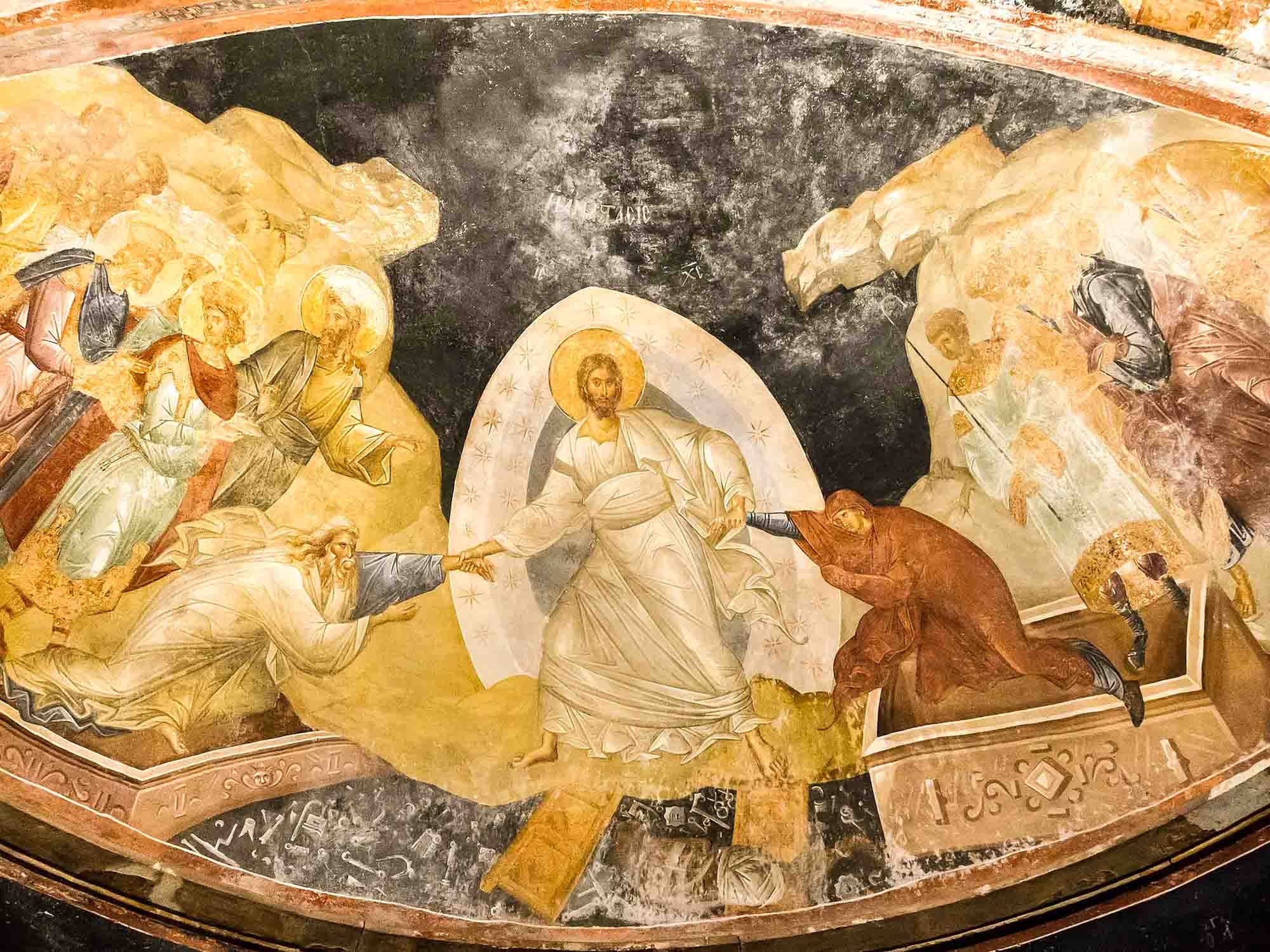
I, too, “pulled” my son “out by the wrists,” when I woke him up at the appointed time to receive communion—my sleeper stirred long enough to tell the priest his name and to receive the Pure Gift in the chalice. “Come receive the light, my son, it’s time for communion—and I want you to say your name at the chalice, like we always do,” I told him as we walked the aisle.
Awake, O sleeper,
and arise from the dead,
and Christ will shine on you.
(Ephesians 5:14, ESV)
In context, Saint Paul prefaces this quote with this: “Therefore it says...” Usually, that’s the setup for a direct Scriptural quote. But because this exact phrasing doesn’t exist anywhere in the Old Testament, the consensus among the Church Fathers and modern scholars alike seems to be that Paul is quoting a song the early Church was already singing.
Specifically, it’s widely believed to be a fragment of an early baptismal hymn. When a catechumen descended into the baptismal waters (representing the tomb) and rose back up, the congregation would sing this over them. It’s a Christological remix of a few key prophecies from Isaiah:
Isaiah 60:1: “Arise, shine, for your light has come, and the glory of the Lord has risen upon you.”
Isaiah 26:19: “Awake and sing for joy, you who dwell in the dust, for your dew is a dew of light, and the earth will give birth to the dead.”
The early Christians took these ancient promises of Israel’s restoration and applied them to their ultimate fulfillment: Jesus Christ. They took the raw materials of Isaiah, baptized them in the reality of the Resurrection, and swapped out the generic “light” for Christ Himself. And those of us present in the morning for the baptisms and chrismations saw this too—two dozen people “rose from the dead” and were united to Christ.
So as I gather up his Snoopy blanket and hoist his little, sleeping body over my shoulder to carry him out to the car, the profound reality of the night hits me. It doesn’t matter that he slept through it. The victory was won for him, too. He didn’t have to earn it. He didn’t have to stay awake to secure it. He was completely helpless, entirely exhausted, resting in a deep “Sabbath sleep”—and yet, he was carried out of the church a true victor.
All of this is exactly what Christ did for us. He descended into our dark, passion-filled tombs while we were entirely helpless. He carried our dead weight out of Hades upon His own shoulders. That is the very definition of Κοσμικὴ Ἀγάπη (Cosmic Agape).
That is the majestic truth that remains when all of the grit of our personal striving is finally exhausted. Christ is Risen!
Sources for this reflection:
This post was inspired by a roundup of resources sent to me by a reader. That roundup served as the foundation of my own reflections, though the direction I go with it is a bit different. I’ve supplied links to sources above, but here’s a list for those keeping track at home.
Steve Robinson, “Stealing Paradise: Desperate Measures,” Pithless Thoughts II (Substack), March 2025.
Archimandrite Justin Pârvu, “The Heart as the Tomb of Christ’s Resurrection,” Trans. Grig Gheorghiu (Substack), April 2026.
Thomas del Vasto, “Faith & Doubt During Holy Week,” Shapes in the Fog (Substack), April 2026.
“The Synaxarion of Great and Holy Saturday,” from the Lenten Triodion.
“Matins of Great and Holy Saturday, The Praises,” from the Lenten Triodion.
St. Gregory of Nazianzus, “The Second Oration on Holy Pascha,” Oration 45, Section 22, c. 380 AD.
St. Gregory of Nyssa, “The Great Catechetical Oration,” Chapter 24.
St. John Chrysostom, “The Paschal Catechetical Homily,” c. AD 400.
I totally get the emotion of the Myrrh-bearing Women…as I feel I am finally onto something substantive in my walk of faith I often run from it rather than towards it. Sometimes the concepts are so profound that they frighten us. Like we are getting too close to that Fiery Bush. Thankful that I have another day to keep trying…
Thank you for your sharing this story about your sleeping young son.
It reminded me that salvation is the gift of the Word through the example of Jesus who rose from the dead - the Risen Christ who breathes the Holy Spirit upon all of us for our Theosis Journey for all who repent and accept it!